

For most small-to-medium tea brands, the right starting point is a custom barrier pouch or sachet with a low-MOQ sample run. That combination gives you proven freshness protection, full-color branding, and the flexibility to test before committing to volume. Here is what to do next:
- Request physical samples and MVTR/OTR technical datasheets from any supplier you’re evaluating.
- Schedule a converting trial on your filling line before placing a production order.
- Ask for seal-strength data specific to your fill weight and pouch format.
- Impacked offers custom flexible packaging starting at 500 units with sample support, so you can validate format and barrier before scaling.
Key Takeaways
Custom barrier pouches with validated MVTR/OTR specs, qualified eco claims, and a low-MOQ sample run are the most reliable starting point for small-to-medium tea brands entering or upgrading their packaging.
| Point | Details |
|---|---|
| Match barrier to shelf life | Target MVTR below 0.2 g/m²/day for export or 9-month shelf life; validate with real-time aroma panels. |
| Run converting trials first | Adjust seal temp, dwell, and web tension before any production run when switching film types. |
| Qualify eco claims precisely | Use “compostable in industrial facilities where available” language to stay FTC-compliant under 16 CFR 260.7. |
| Request datasheets, not just spec sheets | Ask suppliers for MVTR/OTR datasheets, certification copies, and seal-strength test reports before ordering. |
| Impacked for low-MOQ custom runs | Impacked starts at 500 units with express 2-week production and single-point-of-contact support. |
Table of Contents
- What types of tea packaging bags fit your product?
- Which materials actually keep tea fresh?
- How do you make honest eco claims on tea packaging?
- What printing and finishing options should you consider?
- What should you expect for MOQ, pricing, and lead times?
- What machine adjustments do you need when switching film?
- How do you choose the right packaging supplier?
- What we see work, and what trips brands up
- Ready to order samples or get a quote?
- Sources
What types of tea packaging bags fit your product?
The format you choose shapes everything from shelf presence to shipping durability. These are the most practical options for tea brands:
- Sachets and overwraps: The standard for single-serve tea bags. Heat-sealed sachets in non-woven or filter paper work for pyramid and flat bags. Overwraps add a secondary moisture barrier for retail display.
- Stand-up pouches: The go-to for loose leaf tea pouches. A gusseted base holds the bag upright on shelf, and a resealable zipper keeps aroma in between uses.
- Flat and gusseted bags: Lower-cost option for small-batch or subscription brands. Less shelf presence than stand-up pouches, but they pack efficiently for e-commerce fulfillment.
- Tins and tubes: Premium positioning for retail gift sets or single-origin blends. Packaging tubes offer a distinctive shelf silhouette and pair well with a foil inner liner for barrier.
- Pyramid bags and pyramid overwraps: Growing in specialty retail. The pyramid shape allows full leaf expansion, and a sealed overwrap protects aroma until the customer opens it.
Closures and add-ons matter as much as the format itself. Resealable zippers are standard on stand-up pouches for loose leaf. Tin ties work for smaller kraft bags. Degassing valves are common in coffee but rarely needed for tea. Clear windows let customers see leaf quality, though they do reduce barrier performance in that panel.
Pro Tip: If you sell through subscription boxes, flat bags with a tear notch and a foil inner layer often outperform stand-up pouches on cost-per-unit and pack density, without sacrificing freshness for a 90-day shelf life.
Market suppliers commonly offer compostable stand-up pouches and overwraps across a range of small SKUs, with multiple finish choices available at the consumer-facing level, as tea packaging supplier pages illustrate.
Which materials actually keep tea fresh?
Tea is more demanding than most dry goods. Moisture, oxygen, and light all degrade aroma compounds, and the margin for error narrows with longer shelf lives or export through hot, humid routes. Matching your MVTR and OTR specs to your shelf-life target is the single most important decision you will make in packaging.
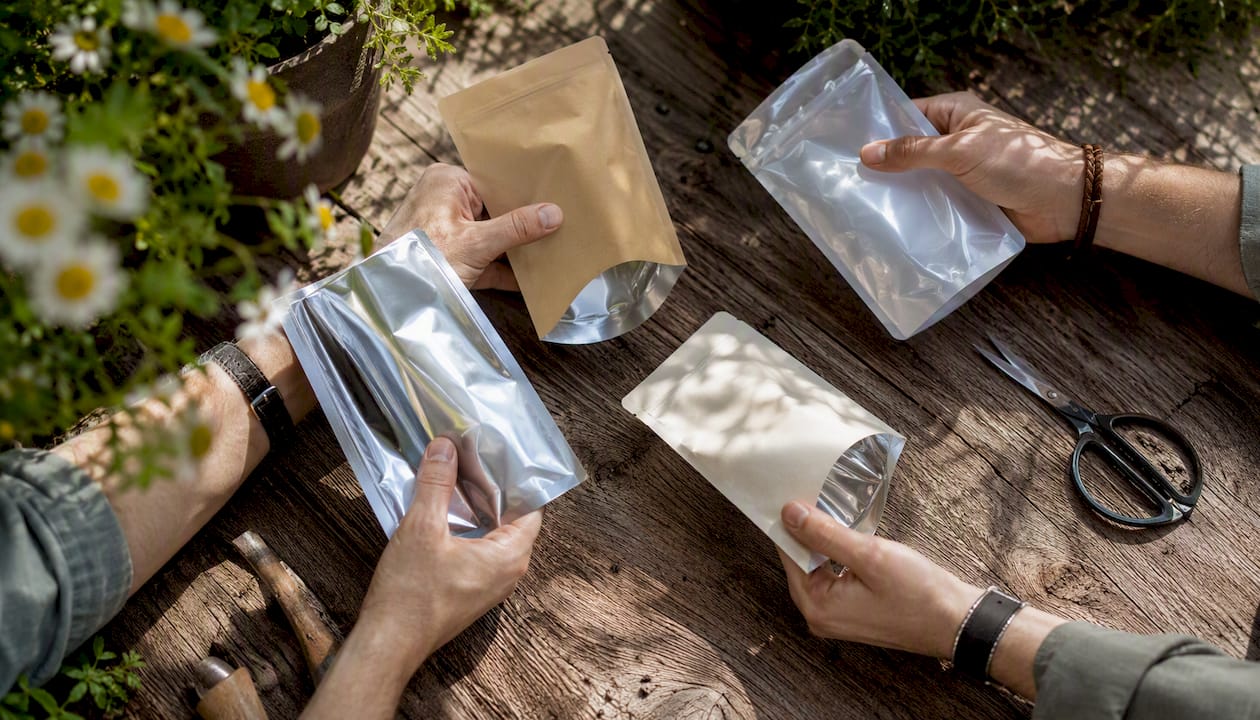
MVTR (moisture vapor transmission rate) measures how much water vapor passes through a film per square meter per day. OTR (oxygen transmission rate) measures oxygen permeability. Lower numbers mean better barrier. For tea sold domestically with moderate shelf life, a low MVTR target is reasonable. For export or longer storage in hot or humid climates, more stringent barrier specifications are advisable, validated with real-time shelf-life tests.
| Material | Typical MVTR (g/m²/day) | Typical OTR (cc/m²/day) | Recyclable/Compostable | Notes |
|---|---|---|---|---|
| Multilayer laminate (BOPP/met-PET/PE) | Below 2 | Below 5 | Neither | Best barrier; bonded layers prevent recycling |
| Metallised paper (e.g., FlexC) | Below 2 | Below 10 | Compostable pathway available | 15–30% material cost premium; lower seal strength |
| Kraft paper + foil liner | 1–3 | 10–20 | Partial (paper recyclable, liner not) | Good for short shelf life; premium look |
| Mono-material PE or PP | 1–5 | 20–50 | Recyclable (store drop-off) | Lower barrier; suits short shelf life or inner-packed formats |
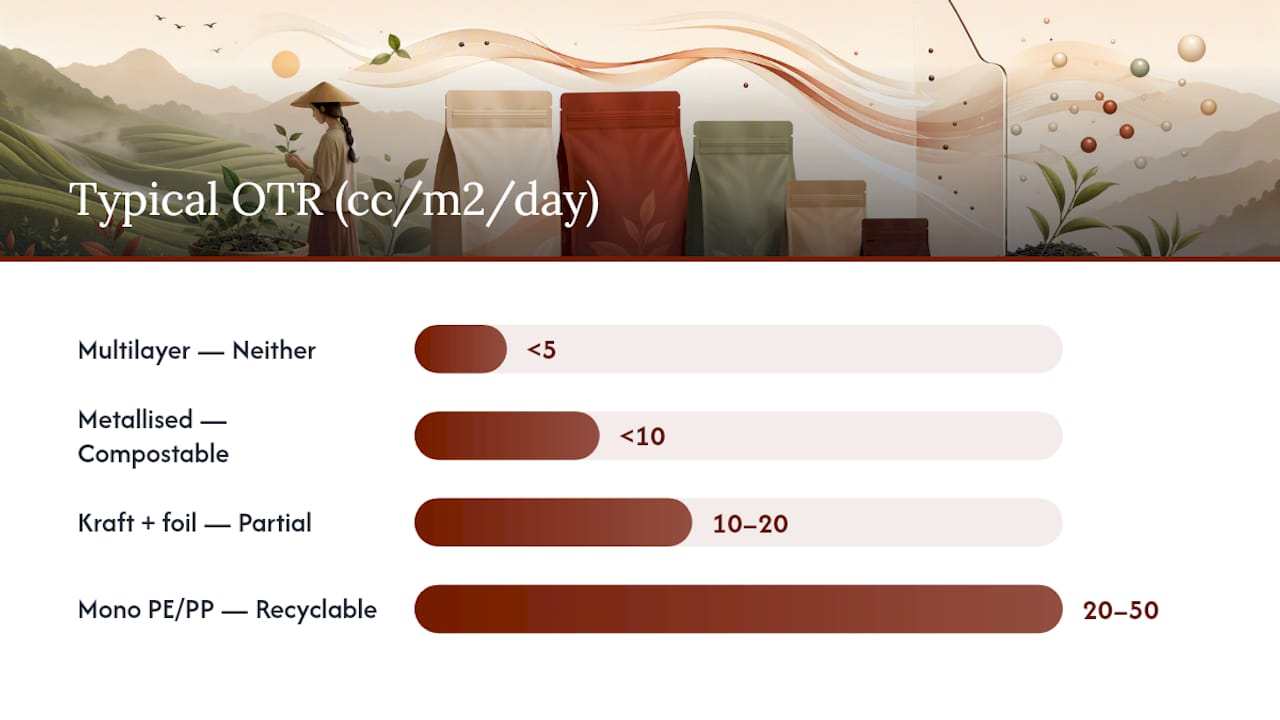
FlexC metallised paper can meet MVTR targets below 2 g/m²/day and OTR below 10 cc/m²/day, and it runs on existing VFFS/HFFS lines with seal-temperature windows 10–20°C lower than conventional laminates. Seal strength is lower than standard laminates, so validation for heavier fills is required.
Nitrogen flushing at the point of fill extends shelf life meaningfully, especially when you are using a modest-barrier material. A nitrogen-flushed pouch with an MVTR of 1 g/m²/day often outperforms a high-barrier pouch without flushing.
Pro Tip: Run a 3-month real-time aroma panel on your actual tea blend, not just an accelerated lab test. Accelerated tests can miss the specific volatile compounds that make your blend distinctive.
How do you make honest eco claims on tea packaging?
Recyclable and compostable are not interchangeable, and the distinction matters legally in the U.S. Under 16 CFR 260.7, a compostable claim requires competent scientific evidence and a prominent qualification when municipal or home composting is not widely available to consumers in your market.
Practically, that means:
- Compostable pouches (industrial): Certified to ASTM D6400 or EN 13432. Must be labeled “Compostable in industrial facilities only, which may not exist in your area.” Most U.S. consumers do not have access to industrial composting, so the claim needs that qualifier on-pack.
- Home-compostable formats: Certified to AS 4736 or equivalent. A stronger consumer claim, but fewer substrate options meet this standard at commercial scale.
- Recyclable mono-material pouches: Store drop-off programs (How2Recycle) are the most accessible pathway for flexible film in the U.S. Label accordingly.
- Conventional laminates: No credible end-of-life claim is available. Do not use “eco-friendly” language without a specific, substantiated basis.
As Michigan State University’s packaging guide notes, a certification shows capability, not consumer access. For tea bags specifically, composting adds genuine end-of-life value because the bag itself is often food-contaminated and not recyclable anyway. That is a strong argument for compostable filter paper in the bag, with qualified on-pack language. For a deeper comparison of material pathways, the compostable vs. recyclable guide from Impacked covers the compliance differences clearly.
Certifications and documents to request from any supplier:
- ASTM D6400 or EN 13432 certificate (for compostable claims)
- ISO 17088 certificate where applicable
- MVTR/OTR technical datasheets (not just spec sheets)
- Repulping or composting test reports
- Organic certification labeling compliance confirmation if your tea is USDA Organic
What printing and finishing options should you consider?
Print method and finish affect both shelf appeal and barrier integrity. Choosing the wrong combination can compromise the very protection you paid for.
Digital printing suits low-MOQ runs (typically under 5,000 units). Color accuracy is excellent, setup costs are low, and you can run multiple SKUs in one order. The trade-off is a slightly higher per-unit cost at volume.
Flexographic and rotogravure printing become cost-effective above roughly 10,000–20,000 units. Color consistency across long runs is the main advantage. Setup costs are higher, so short runs are rarely economical.
Finishes to consider:
- Matte or soft-touch lamination: Premium feel and reduced glare. Soft-touch lamination adds a tactile quality that reads as premium on shelf, but it can affect recyclability, so confirm compatibility with your chosen substrate.
- Aqueous coatings: A more recyclability-friendly alternative to plastic lamination for paper-based pouches. Check that the coating does not interfere with heat-seal performance.
- Clear windows: Let customers see leaf quality. They reduce barrier in that panel, so position them away from the primary seal zone and confirm the window film’s MVTR with your supplier.
- Resealable zippers: Standard for loose leaf. Confirm that the zipper does not compromise the bottom or side seal integrity during filling.
- Tear notches: Low cost, high utility. Place them above the zipper so the customer does not accidentally cut through the reseal.
Pro Tip: Always order a physical sample pack before approving final art. Digital proofs show color but not texture, seal feel, or how the window film reads under retail lighting.
What should you expect for MOQ, pricing, and lead times?
Custom tea packaging bags involve more variables than off-the-shelf options, so setting realistic expectations early prevents budget surprises.
Typical MOQ ranges:
- Stand-up pouches (custom printed): 500–2,000 units for digital print; 5,000–10,000 units for flexo/rotogravure.
- Sachets and overwraps: Often 1,000–5,000 units minimum, depending on format complexity.
- Tins and tubes: 500–1,000 units is achievable for custom-printed tubes; tins typically require higher minimums.
Pricing signals to factor in:
- Compostable or metallised paper substrates carry a 15–30% material cost premium over conventional laminates.
- Print complexity (number of colors, spot finishes, windows) adds to setup costs.
- Express production typically adds a premium but can compress lead times to 2 weeks.
A typical production timeline looks like this:
- Sample order and datasheet review: 1–2 weeks.
- Converting trials on your filling line: 1–2 weeks.
- Artwork approval and digital proof: 3–5 business days.
- Production run: 2–4 weeks standard; express options available.
- Shipping and delivery: 1–2 weeks domestic.
Impacked’s low-MOQ capability starts at 500 units, with express production available in as little as 2 weeks. That makes it practical to run a sample order, validate on your line, and move to a full production run without a long gap between phases.
What machine adjustments do you need when switching film?
Switching to a new substrate, especially paper-based metallised film, without adjusting your filling line is one of the most common causes of seal failures and wasted product.
Key parameters to check before running a new material:
- Seal temperature: Paper-based metallised substrates typically require a seal temperature 10–20°C lower than conventional laminates. Confirm the exact window with your film supplier’s datasheet.
- Seal bar parallelism: Uneven pressure creates weak spots. Check parallelism before every material change.
- Dwell and cooling time: Longer dwell improves seal integrity on lower-seal-strength materials. Cooling time prevents the seal from peeling under tension immediately after sealing.
- Web tension and servo control: Paper-based films are less forgiving of tension variation than BOPP laminates. Reduce tension incrementally and monitor for wrinkling.
- Line speed: Expect a 10–20% speed reduction during optimization when switching to paper-based metallised substrates.
A short trial plan for any material switch:
- Set up at reduced speed (60–70% of target).
- Run 50–100 units and inspect seals visually and by squeeze test.
- Perform ASTM F1140-style burst or leak checks on a sample set.
- Pull a sensory aroma panel on sealed pouches at 2 weeks.
- Adjust seal temp, dwell, and tension incrementally until reject rates drop below your threshold.
For VFFS lines, paper-based metallised substrates behave differently than BOPP at the forming collar. HFFS lines generally handle the transition more smoothly. Confirm compatibility with your equipment manufacturer before ordering film. The eco-friendly coffee bags guide covers similar converting adjustments for paper-based materials and is worth reviewing alongside your equipment manual.
How do you choose the right packaging supplier?
A supplier checklist keeps evaluation consistent and surfaces problems before they become production delays.
One-page checklist:
- Barrier specs: Can they provide MVTR/OTR datasheets for the specific substrate you need?
- Certifications: Do they hold ASTM D6400, EN 13432, or ISO 17088 certificates for compostable claims?
- Sample policy: Do they offer physical samples before production? Is there a sample fee?
- MOQ: Does their minimum order quantity fit your current volume?
- Proofing: Do they provide both digital proofs and physical press proofs?
- QA processes: What is their seal-strength testing protocol? Do they run leak checks?
- Lead time: What is standard production time, and is express available?
- Returns policy: What happens if a production run has seal defects?
Questions to ask every supplier:
- Can you share MVTR and OTR datasheets for this specific substrate and structure?
- What seal-temperature window do you recommend for this film on a VFFS line?
- Do you offer converting trial support or can you connect us with a converter who does?
- Can you provide copies of your compostability certificates and composting test reports?
- What is your reject rate on seal integrity for this format at your standard line speed?
- Do you have sample images of this substrate under retail lighting, including the window panel?
Red flags to watch for:
- Evasive answers on barrier numbers (“our film is high barrier” without a datasheet).
- No offer of converting trial support or sample runs.
- Compostable claims without a named certification or local availability qualification.
- No QA documentation available on request.
For packaging design considerations that affect retail presentation, the coffee brand packaging design guide from The Flaming Bean Roastery offers useful perspective on how structural and visual choices interact at shelf.
What we see work, and what trips brands up
Most early packaging mistakes we see at Impacked come down to three patterns. Brands over-specify barrier, choosing the most expensive high-barrier laminate when a nitrogen-flushed mid-barrier pouch would have achieved the same shelf life at lower cost. They skip machine trials, assuming a new film will run identically to the old one, and then discover seal failures mid-production run. And they use unqualified compostable language on-pack, which creates real legal exposure under FTC Green Guides.
What actually works is simpler than most brands expect. A low-MOQ sample run lets you validate barrier, seal integrity, and line compatibility before committing to volume. Combining nitrogen flushing with a mid-range barrier material often outperforms a high-barrier material without flushing, and costs less. And clear, qualified sustainability copy, “compostable in industrial facilities where available,” builds more trust with informed consumers than an unqualified claim that invites scrutiny.
The brands that move fastest are the ones who come to us with their SKU weight, target shelf life, distribution climate, and artwork files ready. That information lets us match the right substrate and structure from the first conversation, rather than iterating through multiple sample rounds.
Ready to order samples or get a quote?
Custom tea packaging does not have to mean long lead times or high minimums. At Impacked, we work directly with you from the first sample through full production, with a single point of contact managing every step.
Here is what to prepare before you reach out:
- SKU fill weight and pouch dimensions (or target format).
- Target shelf life and primary distribution climate (domestic, export, hot/humid).
- Eco goals: recyclable, compostable, or conventional.
- Artwork files or a brief for design support.
- Target MOQ and timeline.
With low-MOQ runs starting at 500 units and express production available in as little as 2 weeks, you can move from sample to shelf faster than most brands expect. Get a quote and we will match you with the right substrate, structure, and print process for your product.
Sources
Pull these into any supplier conversation or internal spec review:
- Metallised Paper for Premium Tea Packaging: Barrier Data and Cost Guide
- Ecfr
- Compostable Packaging: A U.S. Packaging Producer’s Guide to the New Rules — and the Science Beneath Them
- Tea Packaging
When contacting a supplier, request MVTR/OTR datasheets, seal-strength test data, certification copies, and converting trial reports as a baseline. Any supplier who cannot provide these documents on request is not ready to support a validated production run.