

For most small food brands, the right starting point is a resealable foil stand-up pouch built on a PET/AL/PE multi-layer laminate with a bottom gusset, a reclosable zipper, and a thickness of 5 mil commonly used for retail and shipping applications. That structure blocks oxygen, moisture, and light simultaneously, and the zipper keeps the product fresh after the first open. Your immediate next step: request physical samples, ask for OTR (oxygen transmission rate) and MVTR (moisture vapor transmission rate) data sheets, and get a custom quote from Impacked before committing to a production run.
Your three-item supplier checklist:
- Request the laminate structure in writing (e.g., PET/AL/PE or PET/VMPET/PE) plus mil thickness
- Ask for OTR/MVTR values and an FDA food-contact compliance statement
- Order samples before approving any production run
Table of Contents
- What features should foil stand-up pouches have?
- How do you choose the right foil pouch for your product?
- Ordering, printing, quantities, and what drives your cost
- What technical specs should you request before signing off?
- Solid foil vs. metallized film vs. metallized with a window
- How to test samples and validate performance before a production run
- Why Impacked is the right partner for small brands
- Key Takeaways
- What small brands consistently get wrong with foil pouch procurement
- Ready to source custom foil pouches with low minimums?
- Useful sources and supplier documentation
What features should foil stand-up pouches have?
The performance of any foil pouch comes down to its laminate stack. A standard food-grade laminate like PET/AL/PE uses three distinct layers: the outer PET film handles printability and puncture resistance, the aluminum foil middle layer delivers the barrier, and the inner PE layer provides heat-sealability and food-contact safety. Metallized variants swap the solid foil for a vacuum-deposited metallic coating on BOPP or PET, giving you PET/VMPET/PE, which costs less and allows for a clear window.
Common laminate structures at a glance:
- PET/AL/PE — maximum barrier, opaque, ideal for light- and oxygen-sensitive products
- PET/VMPET/PE — strong barrier, window-capable, lower cost, better print finish options
- Kraft/AL/PE — natural aesthetic with full barrier; popular for coffee and tea
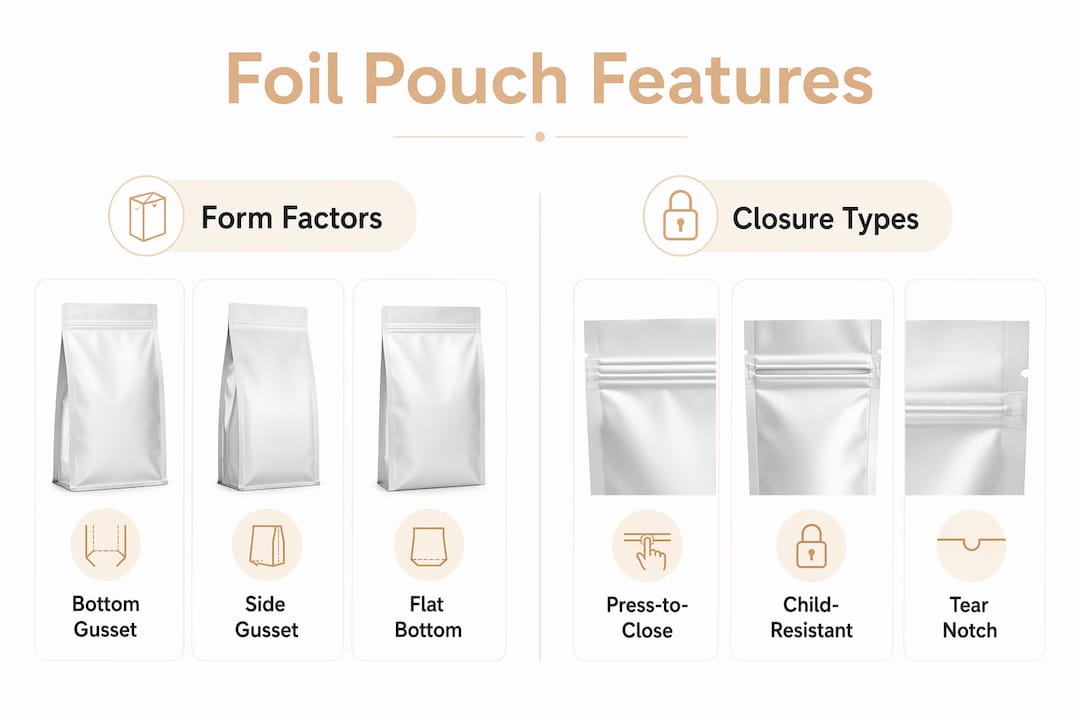
Resealable closure options include standard press-to-close zippers, child-resistant zippers (required for some cannabis and supplement products), and tamper-evident heat seals. Tear notches are standard on most retail pouches and let the end user open cleanly without scissors.
Form factors worth knowing: the bottom gusset creates the stand-up base and maximizes shelf presence; side gussets add volume for bulkier products; quad-seal pouches offer a flat, box-like profile. Optional features like degassing valves (critical for fresh-roasted coffee packaging), hang holes, and clear windows are factory add-ons that affect both cost and lead time.
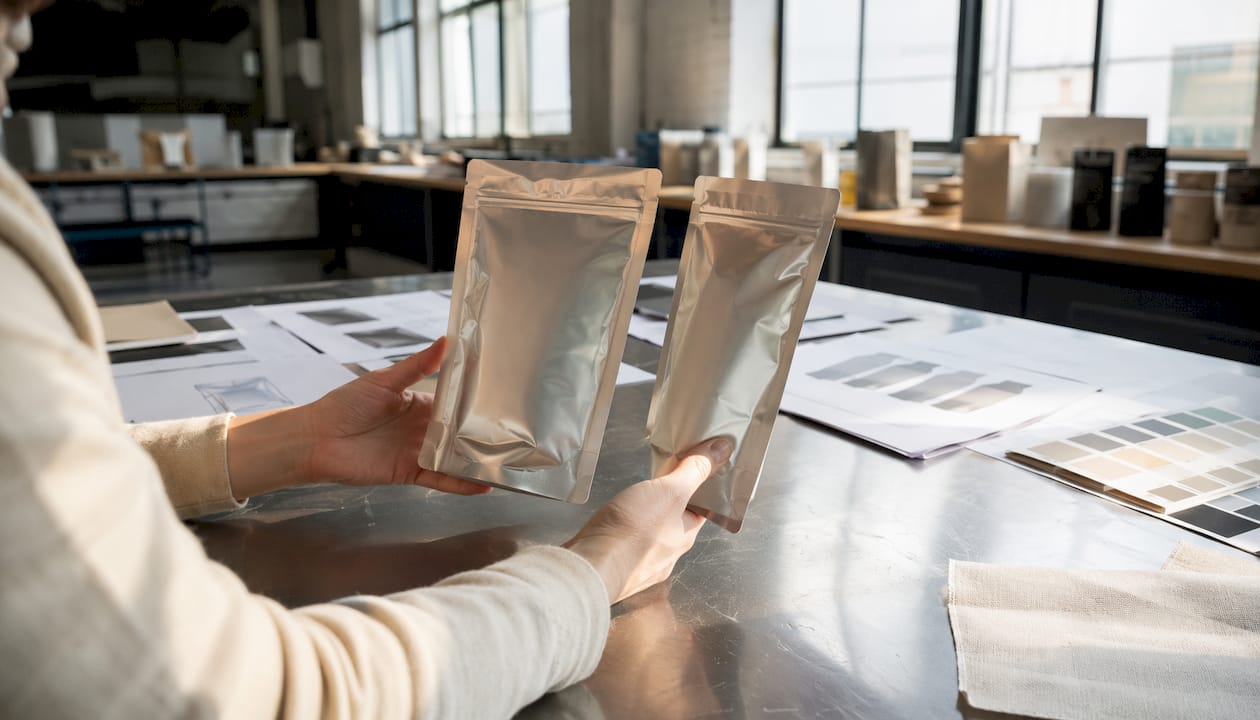
Thickness varies, with lighter films suitable for retail and heavier films for shipping durability. Thicker film resists punctures during transit and rough handling on a fulfillment line.

Pro Tip: The single most common hidden failure in foil pouches is a weak heat seal caused by an impulse sealer set at the wrong temperature or dwell time. Always request seal-strength data (measured in N/cm) and run a peel test on every sample batch before approving production.
How do you choose the right foil pouch for your product?
Start with your product’s sensitivity profile, then work outward to size, closure, and film type.
- Classify your product’s sensitivities. Oxygen-sensitive (nuts, coffee, meat snacks)? You need low OTR. Moisture-sensitive (protein powder, spices)? Prioritize low MVTR. Light-sensitive? Solid aluminum foil, not metallized.
- Match size to bulk density. Use a bulk-density reference to confirm your product’s actual fill volume before choosing a pouch size. Common retail sizes range from 4x6" (small samples) through 5x8" and up to 6.5x10.5" for larger SKUs. Getting this wrong means the zipper sits below the fill line and can’t close.
- Choose your closure. Retail products that get opened repeatedly need a reclosable zipper. Single-use or sample pouches can use a heat-seal-only top. Child-resistant zippers add cost but may be legally required depending on your product category.
- Decide on solid foil vs. metallized. If your product is highly light-sensitive or needs maximum shelf life, solid aluminum foil is the call. If you want shoppers to see the product or prefer a premium metallic finish, metallized film with a window is the better fit.
-
Ask your shortlisted suppliers these questions directly:
- What is the laminate structure, layer by layer?
- What are the OTR and MVTR values for this film?
- Do you provide an FDA food-contact compliance statement?
- What is your sample policy and minimum order quantity?
- What are your standard and rush lead times?
- What QA certifications does your facility hold?
Red flags to walk away from:
- Supplier refuses to share OTR/MVTR data or says it’s “proprietary”
- No physical sample policy before production
- Inconsistent thickness specs across the same SKU
- Vague food-safety language like “food safe” with no supporting documentation
Recommended sample plan: Order at least two laminate variants (e.g., PET/AL/PE and PET/VMPET/PE), fill them with your actual product, and test aroma retention and seal integrity over 7–30 days before placing a production order.
Ordering, printing, quantities, and what drives your cost
Print method is the first cost lever. Digital printing suits short runs and frequent design changes with no plate setup fees. Rotogravure and offset printing deliver sharper color at scale but require cylinder or plate costs that only make sense above a certain volume threshold. For most small brands testing a new SKU, digital is the practical starting point.
Key pricing factors:
- Film layers and total thickness (more layers = higher material cost)
- Number of print colors and finish type (matte, gloss, metallic)
- Add-ons: clear windows, degassing valves, child-resistant zippers, hang holes
- Secondary operations: zipper placement, tear notch punching, rounded corners
- Order quantity (unit cost drops meaningfully as volume increases)
Typical ordering tiers:
- Sample/prototype stage — small quantities to validate size, film, and print; turnaround often 2–3 weeks
- Small-batch production — Impacked’s flexible packaging options start at 500 units, which lets brands test a design in-market before scaling
- Mid-volume runs — 1,000–5,000 units where per-unit cost drops and rotogravure becomes viable
- Bulk production — 5,000+ units for established SKUs with locked designs
Stock foil pouch sizes like 6"x9.5" at 5 mil are available from some suppliers with no print customization, which works for early-stage testing, and you can find options for metallized pouches with windows and stock bag sizes at EZSUPPLY.CA. Custom-printed bags require artwork, a dieline, and a proofing step.
Pro Tip: Always ask your supplier for a landed-cost breakdown: unit price, freight to your warehouse, any applicable import duties, and packaging/carton fees. A low unit price can flip when freight is added, especially for international production.
What technical specs should you request before signing off?
This is where most small brands leave money on the table. Requesting the right documentation upfront protects you if production quality falls short.
Data-request checklist:
| Specification | What to ask for | Why it matters |
|---|---|---|
| Laminate structure | Layer-by-layer callout (e.g., PET/AL/PE) | Confirms barrier and food-contact layer |
| Mil thickness | Measured value per film spec | Affects puncture resistance and durability |
| OTR | cc/m²/24h at standard conditions | Quantifies oxygen barrier performance |
| MVTR | g/m²/24h at standard conditions | Quantifies moisture barrier performance |
| Seal strength | N/cm (minimum acceptable threshold) | Predicts real-world seal integrity |
| FDA compliance | Written food-contact statement | Required for food-grade applications |
| Ink/adhesive CoA | Certificate of analysis for food-grade inks | Confirms no migration risk |
Beyond the data table, ask for press-proof photos and a physical printed sample before approving a full run. A digital mock-up is not a substitute for holding the actual pouch.
In-house sample tests to run:
- Visual inspection: print registration, color accuracy, zipper alignment, gusset dimensions
- Fill-and-settle check: fill to intended weight, seal, and confirm the zipper closes above the fill line
- Immersion leak test: submerge a sealed, filled pouch for 30 minutes and check for bubbles
- Aroma retention: seal a fragrant product and check at 7, 14, and 30 days
- Puncture/rough-handle simulation: drop-test and compress filled pouches to mimic shipping conditions
When to bring in a lab: if your product has a shelf-life claim or regulatory requirement, third-party OTR/MVTR testing and a seal-strength pull test give you defensible data. Ask the lab for a full report with conditions stated.
Solid foil vs. metallized film vs. metallized with a window
Metallized film is frequently mistaken for solid aluminum foil. They are not the same. Metallized films use a micro-thin metallic coating deposited onto a plastic substrate, which allows a clear window and better print finishes. Solid aluminum foil uses an actual opaque foil layer, delivering the highest available barrier but with no transparency option.
| Feature | Solid aluminum foil | Metallized film | Metallized with window |
|---|---|---|---|
| Barrier level | Maximum (OTR near zero) | Excellent | Good (window reduces barrier slightly) |
| Window compatible | No | No (unless window panel added) | Yes |
| Print finish options | Good | Excellent (metallic sheen) | Excellent |
| Cost | Higher | Lower | Moderate |
| Recyclability | Difficult (multi-material) | Difficult (standard); recyclable mono-material options emerging | Difficult |
Solid foil is the right call for products with strict light or oxygen sensitivity, like certain pharmaceuticals, high-end coffee, or long-shelf-life snacks. Metallized film suits brands that want strong barrier performance with more design flexibility. The window variant trades a small amount of barrier for product visibility, which tends to drive conversion for snacks and specialty foods where shoppers want to see what they’re buying.
Pro Tip: Recyclable metallized mono-material options, including Alox BOPP barrier systems, are now available from select suppliers and offer recyclable barrier performance without the multi-material recycling challenge. If sustainability is part of your brand story, ask suppliers specifically about mono-material barrier films.
How to test samples and validate performance before a production run
A structured sample-validation process protects your brand and your budget. Here’s how to run it.
- Visual QA on arrival: Check print color against your approved proof, confirm zipper alignment, measure gusset width, and inspect seals for bubbles or voids.
- Fill-and-settle test: Fill to your target weight, seal the top, and let the pouch sit upright for 24 hours. Confirm it stands without tipping and that the zipper closes cleanly above the product line.
- Hot/cold cycle test: Move filled pouches from room temperature to refrigerator (or freezer if relevant) and back twice. Check for delamination or seal stress.
- Puncture and rough-handle simulation: Pack filled pouches in a shipping carton and drop the carton from waist height on each face. Open and inspect for seal failures or film damage.
- Aroma retention test: Seal a strongly scented product and store at room temperature. Smell the outside of the pouch at 7, 14, and 30 days. Any detectable aroma bleed-through signals a barrier or seal issue.
- Immersion leak test: Submerge a sealed pouch in water for 30 minutes. Bubbles indicate a seal failure.
When to escalate to a lab:
- Your product carries a printed shelf-life date
- You’re selling into retail channels that require supplier documentation
- You need to validate OTR/MVTR claims against the supplier’s spec sheet
Lock your sample approval in writing. A simple sample-approval form that states the approved laminate structure, thickness, print proof reference, and seal-strength minimum gives you a clear baseline to hold the supplier accountable during production.
Why Impacked is the right partner for small brands
Impacked’s flexible packaging offering maps directly to the checklist above. Low MOQs starting at 500 units mean you can validate a design in-market without committing to a warehouse full of packaging. Custom digital and rotogravure printing options cover both early-stage short runs and scaled production. The team supports food-grade laminate selection, provides material datasheets, and walks you through the proofing workflow from dieline to press-ready approval.
What you can expect when you work with Impacked:
- MOQs starting at 500 units for custom-printed foil and metallized pouches
- Food-grade laminate options with FDA food-contact compliance documentation available on request
- Express production as fast as 2 weeks for qualifying orders
- Full-color custom printing with digital and rotogravure options
- Sustainable material choices including recyclable and compostable films
- A single point of contact from design through delivery
- Design and dieline support if you’re starting from scratch
Impacked also serves pet food brands, seafood brands, and other verticals where barrier performance and regulatory compliance are non-negotiable.
Pro Tip: When you request a quote from Impacked, send your product’s bulk density, target fill weight, and any regulatory requirements (e.g., child-resistant closure, FDA food contact) upfront. It shortens the back-and-forth and gets you an accurate quote faster.
[Case study insertion point: add a real brand story here once available.] [Customer testimonial insertion point: add a verified customer quote here once available.]
Key Takeaways
Resealable foil stand-up pouches with a PET/AL/PE laminate, bottom gusset, and a thickness of 5 mil give most small food brands the best combination of barrier protection, shelf presence, and practical resealability.
| Point | Details |
|---|---|
| Start with the right laminate | Request PET/AL/PE or PET/VMPET/PE in writing, with OTR/MVTR values confirmed before production. |
| Test seals before committing | Run a peel test and immersion leak test on every sample batch; seal failure is the most common production defect. |
| Choose metallized for windows | Solid foil blocks all light but allows no window; metallized film with a window suits snacks and visibility-driven products. |
| Use low-MOQ runs to validate | Start at 500 units to test design and barrier performance in-market before scaling to larger production runs. |
| Impacked for custom foil pouches | Impacked offers custom-printed foil and metallized pouches from 500 units with food-grade laminates and fast lead times. |
What small brands consistently get wrong with foil pouch procurement
The most expensive mistake we see is skipping the OTR/MVTR check entirely. Brands assume that any “foil pouch” delivers the same barrier performance, but the actual values vary significantly between suppliers and laminate grades. A pouch that looks identical on the outside can have meaningfully different oxygen transmission rates depending on the foil gauge and adhesive system used. By the time a product fails on shelf, the brand has already printed labels, filled inventory, and shipped to retail.
The second most common error is ordering without checking fill-line clearance against zipper placement. A pouch sized by external dimensions rather than actual fill volume often ends up with product sitting above the zipper track, making it impossible to reseal. Using a bulk-density reference before finalizing dimensions prevents this entirely.
We also see brands approve production based on a digital mock-up rather than a physical press proof. Colors shift between screen and print, especially on metallized substrates. A physical sample approval step, with a written sign-off that references the specific laminate, thickness, and print proof, is the only reliable way to hold a supplier accountable if the production run comes back wrong.
The corrective measures are straightforward: require OTR/MVTR data before signing any purchase order, size your pouch from bulk density rather than estimated weight, and never approve a production run without a signed physical sample on file.
Ready to source custom foil pouches with low minimums?
Custom foil and metallized stand-up pouches don’t have to mean large minimum orders or long waits. Impacked works with small food brands, snack makers, supplement companies, and specialty producers across the U.S. to deliver fully custom-printed, food-grade pouches starting at just 500 units, with express production available in as little as 2 weeks.
You get a single point of contact, food-safe laminate options with compliance documentation, and a proofing process designed to catch issues before they reach production. Whether you need a high-barrier solid foil pouch for a light-sensitive product or a metallized pouch with a window for retail shelf impact, we’ll help you spec the right solution and get it to you on time.
Get a custom quote from Impacked today, or explore our flexible packaging options to see the full range of pouch formats, laminates, and print capabilities available for your brand.
Useful sources and supplier documentation
These references support the technical claims in this article and are worth bookmarking when you’re evaluating suppliers or verifying spec claims.
- Impacked Flexible Packaging — primary reference for Impacked’s MOQs, custom print options, and sample workflow
- Impacked Get a Quote — direct conversion page for custom pouch quotes and sample requests
- Pure Aluminium Foil Stand Up Pouch Heavy Duty 5.3 mil Ziplock — product listing with thickness and laminate data; useful for benchmarking heavy-duty specs
- Food Aluminum Foil Stand Up Pouch Custom Print Resealable Zipper (JSHINEPACK) — illustrates standard feature sets: food-grade laminate, zipper, tear notch, gusset base
- 5 Mil Mylar Stand Up Pouches Silver Metallized (PackFreshUSA) — reference for common sizes (Small 4x6" through X-Large 7.5x11.5") and 5 mil film specs
- 6x9.5x3.25 All Silver Foil Stand Up Pouches (StandUpPouches.net) — stock listing showing 5 mil film and common retail sizing
- Foil Stand Up Pouches: Custom Aluminum & Metallized Bags (PouchesPack) — side-by-side barrier comparison for solid foil vs. metallized
- Custom Metallised Pouch (ePac Flexible Packaging) — covers recyclable Alox BOPP metallized barrier systems and premium finish options
- Bulk Density Chart (Global-Pak) — essential reference for matching pouch volume to product fill weight before ordering