

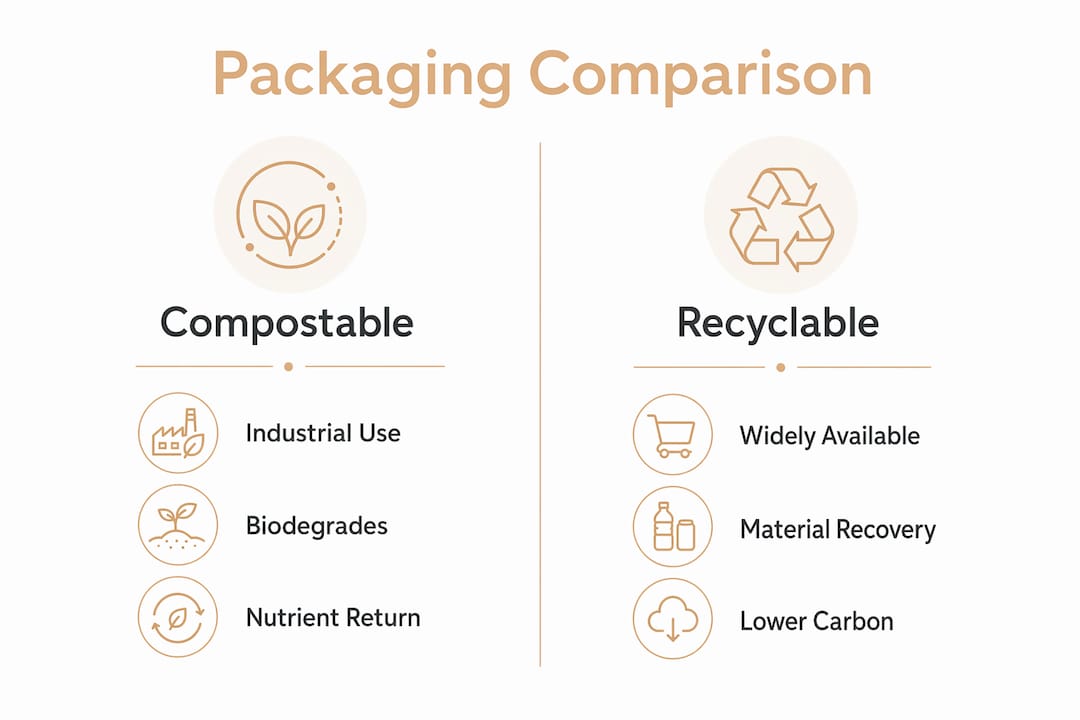
Compostable packaging breaks down into organic matter inside an industrial composting facility within six months, as required by ASTM D6400 or D6868 certification standards (no toxic residue), while recyclable packaging gets processed into raw material for new products through mechanical or chemical recycling. These are two distinct end-of-life systems, not two versions of the same thing. Choosing between them without understanding that difference leads to contamination, landfill diversion, and wasted sustainability investment.
Here is what separates them at a glance:
- Material composition: Compostable packaging uses bioplastics and plant-based materials such as PLA (polylactic acid), sugarcane fiber, and starch blends. Recyclable packaging uses conventional materials like PET, HDPE, aluminum, and paperboard.
- Certification standards: Compostable packaging must meet ASTM D6400 or D6868 to carry a commercial compostability claim. BPI (Biodegradable Products Institute) certification verifies compliance with those standards.
- Disposal infrastructure: Curbside recycling programs cover most U.S. households. Certified industrial composting facilities are far less common and rarely accept drop-offs from individual consumers.
- Environmental impact: Recyclable materials like aluminum and PET can re-enter production cycles repeatedly. Compostable materials return nutrients to soil, but only when properly processed.
- Contamination risk: Compostable plastics placed in recycling bins contaminate the recycling stream and often end up in landfills. Recyclable packaging contaminated with food residue faces the same fate.
- Best use cases: Compostables work well for food-contact packaging with unavoidable food residue. Recyclables suit most eCommerce shipping and dry-goods packaging where recycling access is reliable.
What makes compostable packaging different from everything else?
Compostable packaging is engineered to biodegrade under specific, controlled conditions. To carry a commercial compostability label in the United States, a product must meet ASTM D6400 or D6868, which require full breakdown within six months in industrial composting conditions, with no toxic residue, and decomposition at a rate consistent with the surrounding organic material.
BPI certification is the most recognized third-party verification of those standards. A BPI-certified label tells buyers and waste processors that the product has been independently tested against ASTM criteria, not just self-declared by the manufacturer.
The materials themselves vary widely:
- PLA (polylactic acid): Derived from corn starch or sugarcane; the most common compostable bioplastic for cups, lids, and films.
- CPLA: A crystallized form of PLA used for heat-resistant items like cutlery.
- Bagasse: Sugarcane fiber pulp used for plates, trays, and clamshell containers.
- Starch blends: Often used in flexible films and bags.
- Molded fiber: Paper-based material from recycled or virgin pulp, used for trays and protective inserts.
The best use case for compostable packaging is food-contact applications where food residue makes recycling impractical. Think compostable soup containers, produce bags, or coffee pods where the packaging and food waste go together into a composting stream.
The critical limitation is infrastructure. Industrial composting facilities operate at sustained temperatures above 140°F with controlled humidity and microbial activity. Most certified compostable packaging requires those controlled industrial conditions to degrade within six months. Home compost bins do not get hot enough or maintain the right moisture balance, so certified compostable items typically break down slowly or not at all in a backyard pile. There are currently no ASTM standard test methods for home composting of plastics.
Pro Tip: Before specifying compostable packaging for your product, confirm that your customers have verified access to an industrial composting facility. Without that access, the packaging’s sustainability claim cannot be realized.
How recyclable packaging actually works
Recyclable packaging relies on established collection, sorting, and reprocessing systems that most U.S. consumers already use. The materials most commonly accepted in curbside programs include:
- PET (polyethylene terephthalate): Bottles, jars, and some flexible films; widely accepted.
- HDPE (high-density polyethylene): Jugs, bottles, and rigid containers; one of the most recycled plastics in the U.S.
- Aluminum: Cans and foil; highly recyclable with strong market demand for recovered material.
- Paperboard and corrugated cardboard: Boxes, cartons, and mailers; accepted in virtually every curbside program.
- Glass: Bottles and jars; accepted in most programs, though collection economics vary by region.
Two main processing methods handle these materials. Mechanical recycling shreds, melts, and reforms material into pellets or sheets for new products. Chemical recycling breaks polymers down to their molecular building blocks, allowing production of virgin-quality material. Mechanical recycling dominates current U.S. infrastructure; chemical recycling is growing but still limited in scale.
Regional variation is a real factor. Multilayer flexible packaging, like many snack pouches and coffee bags, is technically recyclable in some markets but rejected by most curbside programs because sorting equipment cannot separate the layers efficiently. Consumers in cities with advanced materials recovery facilities (MRFs) have more options than those in rural areas.
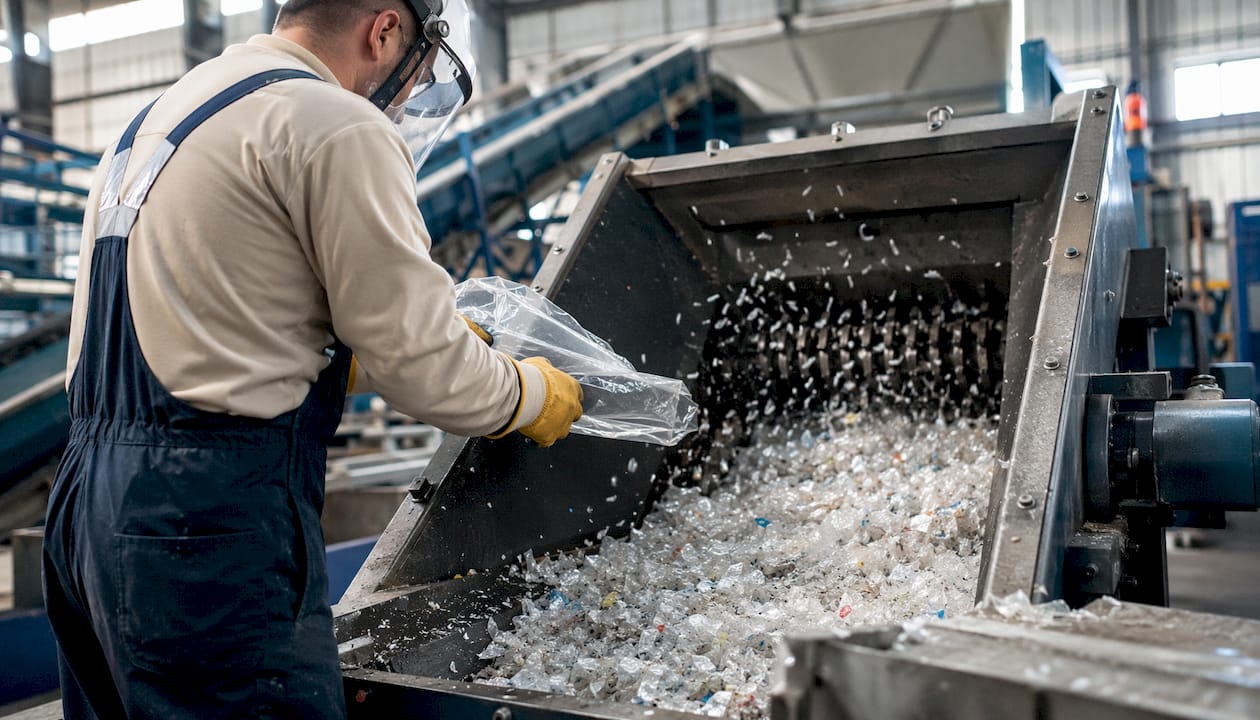
Contamination is the primary threat to recycling quality. Food residue, liquids, and non-recyclable materials mixed into recycling bins force processors to reject entire loads. Proper recycling requires rinsing containers, removing lids where required, and checking local program guidelines before placing anything in the bin.
How do compostable and recyclable packaging compare on environmental impact?
The honest answer is that neither type is universally better. The environmental outcome depends heavily on what actually happens to the package after use.

Recyclable materials, particularly aluminum and PET, have well-documented lifecycle advantages when they complete the recycling loop. Recovered aluminum requires a fraction of the energy needed to produce virgin aluminum. PET recycled into post-consumer waste (PCW) content reduces virgin resin demand and lowers the carbon footprint of new packaging. High-PCW recyclable materials reduce virgin resource use and improve lifecycle impact in ways that are measurable and repeatable.
Compostable packaging offers a different kind of benefit: it returns carbon and nutrients to soil rather than extracting new resources. But that benefit only materializes when the package reaches an industrial composting facility. Compostable items in landfills do not biodegrade properly because landfills lack the oxygen, heat, and moisture required. Under those anaerobic conditions, they can generate methane, a potent greenhouse gas, much like conventional plastics.
| Material Type | Carbon Footprint | Disposal Pathway | Contamination Risk |
|---|---|---|---|
| PET (recyclable) | Lower with high PCW content | Curbside recycling, MRF processing | Moderate (food residue) |
| Aluminum (recyclable) | Very low when recycled | Curbside recycling | Low |
| Paperboard (recyclable) | Low, especially with recycled fiber | Curbside recycling | Low to moderate |
| PLA (compostable) | Low at production; high if landfilled | Industrial composting only | High (if placed in recycling) |
| Bagasse (compostable) | Low at production | Industrial composting | Moderate |
| Multilayer flexible (recyclable) | Varies by structure | Limited curbside; store drop-off | High (sorting difficulty) |
Recyclable packaging generally delivers more reliable environmental outcomes across the U.S. because the infrastructure to process it exists at scale. Compostable packaging delivers its environmental benefit only in closed-loop systems where industrial composting is guaranteed.
How to dispose of compostable and recyclable packaging correctly
Getting disposal right is where good intentions either pay off or fall apart. The rules are specific, and the most common mistakes are predictable.
Compostable packaging disposal
- Place BPI-certified or ASTM-compliant compostable packaging in a municipal organics or food-waste collection bin, not the recycling bin.
- Check with your local waste hauler before assuming curbside organics programs accept compostable plastics. Many accept food scraps but not certified compostable packaging.
- Do not place compostable packaging in home compost unless the label explicitly states “home compostable.” Most certified compostable products require industrial conditions.
- Use the Find a Composter directory or contact your local solid waste authority to locate the nearest industrial composting facility.
Recyclable packaging disposal
- Rinse food and liquid residue from containers before placing them in the recycling bin.
- Flatten cardboard boxes to save space and prevent jamming in sorting equipment.
- Check your local program’s accepted materials list. Not every program accepts every resin type.
- Keep plastic bags and flexible film out of curbside bins. Most grocery stores operate drop-off programs for film plastics.
Common mistakes to avoid
- Placing compostables in recycling bins: Compostable plastics contaminate conventional recycling streams because their chemical properties and melting points are incompatible with petroleum-based plastics. A single contaminated batch can ruin an entire load.
- Assuming “biodegradable” means compostable or recyclable: It means neither. Biodegradable is a broad term with no enforceable standard in U.S. packaging law.
- Recycling greasy pizza boxes: The grease contaminates paper fiber. Tear off the clean top and recycle it; compost or trash the greasy bottom.
- Wishful recycling: Placing items in the recycling bin hoping they will be sorted correctly. If you are not sure, check first.
Clearing up the biggest misconceptions about compostable and recyclable materials
Consumers encounter a lot of green-sounding language on packaging, and much of it creates genuine confusion. Survey data shows that misunderstanding these labels causes frequent mis-sorting, particularly placing compostables in recycling bins.
Here are the most persistent myths, corrected:
- “Compostable means it will break down anywhere.” False. Certified compostable packaging requires industrial composting conditions. In a landfill, it behaves much like conventional plastic.
- “Compostable is the same as recyclable.” No. Compostable packaging should never enter the recycling stream. The two systems are incompatible.
- “Recyclable packaging is biodegradable.” No. Recyclable plastics like PET and HDPE do not biodegrade. They are designed to be mechanically or chemically reprocessed, not broken down by microorganisms.
- “The chasing arrows symbol means it’s recyclable.” Not necessarily. The symbol with a resin code identifies the plastic type but does not guarantee local acceptance. Always verify with your local program.
- “Made from plants” means compostable." Not automatically. Bio-based plastics can be engineered to be structurally identical to petroleum-based plastics and may not be compostable or biodegradable at all.
- “Eco-friendly” and “green” labels confirm sustainability." These are marketing terms with no regulatory definition in the U.S. Look for ASTM compliance or BPI certification instead.
- “Home compostable and commercially compostable are the same.” They are not. Home compostable products are designed for lower-temperature backyard conditions. Commercially compostable products require industrial facilities. The two certifications are distinct.
What experts say about choosing between compostable and recyclable packaging
The packaging sustainability community has reached a fairly consistent position on this question, and it cuts against the marketing narrative around compostables.
EcoEnclose, a sustainable packaging supplier with deep expertise in eCommerce applications, recommends that brands reserve compostable packaging for foodservice and closed-loop environments where industrial composting is verified. For most eCommerce shipping applications, recyclable packaging with high post-consumer waste content delivers more consistent and immediate environmental benefits.
The EPA’s guidance aligns with that view. BPI-certified compostable packaging is most appropriate for food-contact uses with food residues that would otherwise compromise recycling streams. Outside of those specific applications, the limited availability of industrial composting infrastructure in the U.S. means compostable packaging frequently ends up in landfills, where it delivers no environmental benefit.
The broader principle from sustainability analysts is direct: packaging sustainability depends on real-world recovery infrastructure, not on what the label says. A technically compostable package that ends in a landfill is less beneficial than a recyclable package that completes the recycling loop. Brands that choose packaging based on marketing appeal rather than verified end-of-life pathways are not actually reducing their environmental impact.
Do compostable and recyclable options cost the same?
Cost is a practical factor that often gets overlooked in sustainability conversations. The short answer is no: compostable packaging typically costs more than comparable recyclable options.
Bioplastic resins like PLA and CPLA are more expensive to produce than conventional PET or HDPE. The manufacturing processes for certified compostable materials are more specialized, and the supply chain is less mature, which keeps prices higher. For brands ordering at lower volumes, that premium can be meaningful.
Recyclable materials benefit from decades of industrial scale. PET, aluminum, and paperboard are produced in enormous quantities, which keeps per-unit costs competitive. Packaging made with post-consumer waste content can carry a slight premium over virgin-material versions, but the gap is narrowing as PCW supply grows.
There is also a hidden cost consideration for compostables: if your customers do not have access to industrial composting, the sustainability investment does not pay off. You pay more for a material that ends up in a landfill. Recyclable packaging, by contrast, has a much higher probability of reaching its intended end-of-life system simply because the infrastructure is more widely available.
For businesses evaluating flexible packaging options, the cost-per-unit difference between compostable and recyclable formats depends on material structure, print requirements, and order volume. At 500 units, the premium for compostable materials is proportionally larger than at 10,000 units.
How packaging labels shape consumer disposal decisions
Consumer behavior around packaging disposal is shaped more by label clarity than by environmental knowledge. People tend to recycle recognizable materials correctly more often than they correctly compost less familiar compostable products. The recycling bin is a known destination; the industrial composting facility is not.
This creates a structural disadvantage for compostable packaging at the consumer level. Even well-intentioned consumers place compostable items in recycling bins because the packaging looks similar to conventional plastic and the correct disposal path is unclear or inconvenient. Label confusion drives mis-sorting, which drives contamination, which drives landfill diversion.
Brands have a real opportunity here. Clear, specific disposal instructions printed directly on the package, not just a generic green symbol, improve disposal accuracy. Instructions like “Industrial compost only, not for home compost or recycling” give consumers the information they need at the moment of disposal. For recyclable packaging, labeling that specifies “Rinse and recycle” or references the How2Recycle program reduces contamination rates.
The decision about which material to use is also a consumer communication decision. Choosing recyclable packaging for a product sold through general retail channels is not a compromise on sustainability. It is a recognition that your customers are more likely to dispose of it correctly, which means the environmental benefit is more likely to be realized.
Key Takeaways
Compostable packaging delivers its environmental benefit only with verified industrial composting access, while recyclable packaging offers more reliable outcomes across the U.S. because the infrastructure to support it already exists at scale.
| Point | Details |
|---|---|
| ASTM standards define compostability | ASTM D6400 and D6868 require breakdown within six months in industrial composting conditions, with no toxic residue. |
| BPI certification verifies compliance | BPI-certified packaging has been independently tested against ASTM criteria, not just self-declared by the manufacturer. |
| Compostables contaminate recycling | Compostable plastics are chemically incompatible with conventional recycling streams and must never enter curbside recycling bins. |
| Infrastructure determines outcomes | A compostable package that reaches a landfill delivers no environmental benefit; recyclable packaging in areas with mature recycling performs more reliably. |
| Cost favors recyclable materials | Compostable packaging typically costs more per unit due to less mature supply chains and specialized bioplastic resins. |
Ready to choose packaging that actually performs?
At Impacked, we work closely with food, beverage, and lifestyle brands to select packaging materials that match both your sustainability goals and your customers’ real disposal options. Whether you need custom flexible packaging with recyclable structures or compostable options for food-contact applications, we help you make the choice that delivers results, not just a green label.
Our team handles everything from material selection and dieline design to full-color custom printing, with orders starting at 500 units. If you are ready to build packaging that makes an impact, get a quote and let’s get started.