

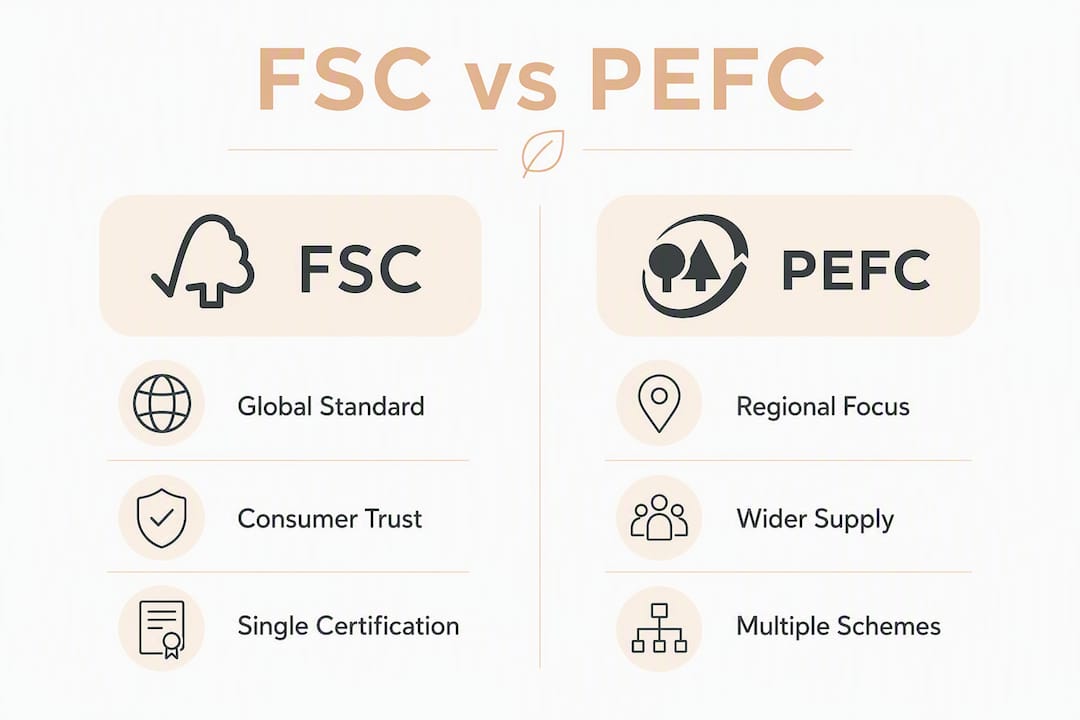
For consumer-facing retail packaging, FSC is the stronger choice for brand trust and label recognition. For institutional procurement and supply chains with broad geographic coverage, PEFC often delivers more flexibility and sourcing options.
Here is what that means in practice:
- Market recognition: FSC covers approximately 160 million hectares globally and is the label most retail consumers and major retailers recognize. PEFC covers approximately 330 million hectares and is widely accepted in government and institutional procurement, particularly through national programs like the Sustainable Forestry Initiative (SFI) in the U.S.
- Supply coverage: PEFC’s broader certified forest area means more domestic sourcing options for U.S. buyers, especially for paperboard and timber products. FSC’s tighter, globally consistent standard gives consumer brands a more defensible sustainability claim on-pack.
Dual certification is possible and increasingly common. Brands serving both retail and B2B buyers often work with suppliers holding both FSC and PEFC Chain of Custody (CoC) certificates, which lets them meet procurement requirements across multiple channels without switching suppliers.
Table of Contents
- What is FSC and how does it work?
- What is PEFC and how does it work?
- How do FSC and PEFC compare side by side?
- How to verify a certification claim step by step
- What U.S. brands need to know for procurement
- Strengths, criticisms, and how the gap has narrowed
- Key Takeaways
- Certified-material packaging, done with you from brief to box
- Primary sources and where to verify certification claims
What is FSC and how does it work?
The Forest Stewardship Council (FSC) is an international nonprofit that sets a single, globally consistent standard for responsible forest management. Its framework rests on 10 core Principles and Criteria, covering everything from biodiversity protection and workers’ rights to Indigenous peoples’ rights and environmental impact. Every certified forest operation and supply chain participant must meet those principles, regardless of country.
What makes FSC particularly credible for consumer-facing brands is the governance model. FSC’s standard-setting body includes environmental NGOs, social groups, and economic stakeholders, each with equal voting weight. That multi-stakeholder structure is why organizations like WWF and the Sierra Club consistently cite FSC as the more transparent and prescriptive of the major certification systems.
For packaging buyers, the FSC system works through three practical mechanisms:
- Forest Management (FM) certificates: — Awarded to forest operators who meet FSC’s 10 Principles. This is where the certified fiber originates.
Verification is straightforward. Every FSC certificate has a unique code (formatted as FSC-C######). You can check any supplier’s certificate status, scope, and expiry date in the FSC Public Certificate Search database in under two minutes. If a supplier cannot provide a valid certificate code, they cannot legally put the FSC logo on your packaging.
For brands sourcing FSC certified packaging such as folding cartons or printed boxes, the most common path is to work with a printer or converter that already holds a CoC certificate. That way, the FSC logo can appear on your finished pack without you needing to obtain your own certificate.
What is PEFC and how does it work?
The Programme for the Endorsement of Forest Certification (PEFC) operates differently from FSC at a structural level. Rather than setting one global standard, PEFC acts as an umbrella organization that reviews and endorses national forest certification systems that meet its international benchmark. If a national scheme passes PEFC’s assessment, its certified products can carry the PEFC label.

In the U.S., the relevant national scheme is the Sustainable Forestry Initiative (SFI). SFI is PEFC-endorsed, which means SFI-certified fiber qualifies as PEFC-certified fiber for supply chain and labeling purposes. For U.S. buyers sourcing domestic paperboard, kraft paper, or timber, this is significant: SFI-certified suppliers are plentiful, and their products flow directly into PEFC-labeled packaging.
The endorsement model has two practical consequences:
- Broader geographic coverage: — Because PEFC endorses existing national systems rather than building a new one from scratch, it has achieved approximately 330 million hectares of certified forest globally, roughly double FSC’s footprint. That scale translates to more sourcing options, particularly in Central and Eastern Europe and across North America.
PEFC’s CoC system mirrors FSC’s in structure: each company in the supply chain must hold a PEFC CoC certificate to make claims on products. The PEFC database allows certificate verification the same way FSC’s does.
For U.S. brands, PEFC’s strength is domestic supply depth. Government buyers, construction procurement, and institutional purchasers often accept PEFC (via SFI) because the certified supply base is large and the per-audit costs can be lower in some market segments. Group certification models are available under both FSC and PEFC, which is particularly useful for smaller suppliers or SMEs looking to reduce per-company audit costs while still enabling product claims.
How do FSC and PEFC compare side by side?
| Dimension | FSC | PEFC |
|---|---|---|
| Governance model | Single global standard; multi-stakeholder body (NGOs, social, economic) | Umbrella endorsement of national systems meeting PEFC benchmark |
| Certified forest area | ~160 million hectares | ~330 million hectares |
| Environmental & social rigor | Prescriptive global criteria; generally ranked higher by independent analysts | Varies by national system; improving via benchmarking |
| Chain-of-custody & labeling | FSC 100%, FSC Recycled, FSC Mix labels; strict logo-use rules | PEFC label; claim language tied to national system rules |
| Market recognition | Strong in retail, consumer goods, NGO procurement | Strong in institutional, government, and construction procurement |
| Certificate verification | FSC Public Certificate Search (certificate code FSC-C######) | PEFC certificate database (pefc.org) |
| Typical use cases | Consumer retail packaging, branded boxes, coffee bags | Timber procurement, government buying, construction, B2B supply |
| Regulatory acceptance | Accepted under EUTR and EUDR | Accepted under EUTR and EUDR |

Both systems rely on independent third-party audits and CoC tracking. Both are accepted under the EU Timber Regulation (EUTR) and the EU Deforestation Regulation (EUDR), which matters for U.S. brands exporting to European markets.
Practical buyer implications worth noting:
- FSC audits tend to be more intensive and can carry higher per-certificate costs, particularly for smaller operations
- PEFC (via SFI) often has a larger domestic certified supply base in the U.S., which can shorten lead times for paperboard and kraft substrates
How to verify a certification claim step by step
Verification is where many brands run into trouble, usually because they assume a supplier’s claim is enough. It is not. Here is the process that actually protects you at pack-out.
- Check the certificate in the official database — Search the FSC code at the FSC Public Certificate Search (info.fsc.org) or the PEFC certificate at pefc.org. Confirm the certificate is active, not expired or suspended.
Pro Tip: Add a line to your packaging brief or purchase order that reads: “Supplier must provide valid FSC/PEFC CoC certificate code, product scope confirmation, and written confirmation of authority to apply the [FSC/PEFC] logo to finished packaging prior to production approval.” This single requirement eliminates most last-minute label compliance problems.
For flexible packaging formats like pouches or roll film, the same CoC rules apply to any paper or board component. Pure film structures typically fall outside FSC/PEFC scope, but multi-material packs with paper elements do require CoC coverage for those components.
What U.S. brands need to know for procurement
Translating the FSC vs. PEFC comparison into procurement decisions comes down to a few practical questions. Work through this checklist before writing your next packaging brief or RFQ.
Procurement checklist:
- Where will your product be sold? Retail shelves and direct-to-consumer channels favor FSC. Government, institutional, and construction supply chains often accept PEFC/SFI.
- Does your retailer or buyer specify a certification by name? Check their supplier code of conduct before assuming either system qualifies.
- Is your supplier already CoC-certified? Ask for the certificate code and verify it before committing to a label claim on your artwork.
- Do you need dual certification? If you sell through both retail and institutional channels, ask whether your supplier holds both FSC and PEFC CoC certificates. Dual certification is practiced where brands need to meet multiple procurement preferences.
- Are you a small brand? Group certification options exist under both systems and can reduce per-company audit costs significantly.
Sample specification language for three buyer scenarios:
-
Consumer retail packaging (FSC required): “All paperboard and paper-based packaging components must be sourced from an FSC Chain of Custody-certified supplier (FSC-C######). The FSC logo must be applied by the CoC certificate holder at the point of final production. Supplier must provide certificate code and scope confirmation prior to artwork approval.”
-
Institutional or government procurement (PEFC/SFI accepted): “Fiber-based packaging materials must be certified under a PEFC-endorsed national standard (including SFI). Supplier must provide a valid PEFC CoC certificate number and confirm product scope coverage prior to order placement.”
-
Dual-channel brands (FSC + PEFC): “Preferred suppliers hold both FSC and PEFC Chain of Custody certificates. Where a single supplier cannot provide dual certification, the brand will source from two approved suppliers and maintain separate bill-of-materials records for each channel.”
Asking suppliers about their last audit date and whether their certificate covers your specific product category (folding cartons, kraft pouches, printed labels) is worth doing on every new project. Certificate scope mismatches are the most common reason brands cannot use a certification label at pack-out, even when their supplier is genuinely certified.
Strengths, criticisms, and how the gap has narrowed
Neither system is perfect, and understanding where each has been challenged helps you evaluate supplier claims more critically.
FSC strengths:
- Single global standard with prescriptive environmental and social criteria
- Stronger brand recognition with retail consumers and NGO-aligned procurement
- Publishes national risk assessments for controlled wood, reducing reliance on certificate holder judgment
- Consistently ranked higher by independent analysts for organizational transparency
PEFC strengths:
- Largest certified forest area globally (~330 million hectares), giving buyers more sourcing options
- National-system flexibility allows standards to reflect local conditions
- Strong institutional and government procurement acceptance, particularly via SFI in the U.S.
- Group certification models make it accessible for smaller operations
Common criticisms:
FSC has faced audit implementation concerns in some regions, where on-the-ground practices have not always matched the standard’s requirements. PEFC has historically drawn criticism for lower rigor in some national systems and less prescriptive social criteria compared to FSC. A Sierra Club and BuildingGreen analysis found that FSC’s standards and organizational transparency generally rank higher, while acknowledging that PEFC has tightened benchmarking and improved in many areas.
The gap has genuinely narrowed. Comparative analyses of FSC’s 2023 Principles & Criteria and PEFC’s 2018 Benchmark show that differences in risk mitigation approaches remain, but both systems now require independent third-party audits and have strengthened their CoC requirements. NGO scrutiny and market competition between the two schemes have pushed both to improve, which is a net positive for buyers.
For coffee brands curious about how third-party certifications affect buyer trust at the product level, the role of certifications in coffee offers a useful parallel perspective on how chain-of-custody and independent verification shape purchasing decisions.
Key Takeaways
FSC is the preferred choice for consumer retail packaging, while PEFC offers broader supply coverage and institutional acceptance, and dual certification is the most flexible option for brands serving both markets.
| Point | Details |
|---|---|
| FSC for retail trust | FSC’s single global standard and consumer recognition make it the default for branded retail packaging. |
| PEFC for scale and supply | PEFC’s extensive certified forest area gives U.S. buyers more domestic sourcing options, especially via SFI. |
| Verify before you print | Always request a supplier’s CoC certificate code and confirm scope in the official database before finalizing artwork. |
| Dual certification is available | Brands serving both retail and institutional buyers can work with suppliers holding both FSC and PEFC CoC certificates. |
| Impacked supports certified packaging | Impacked sources FSC-certified board and paper substrates and can help verify CoC coverage for custom printed packaging projects. |
Our perspective on certification choices in packaging
The FSC vs. PEFC question comes up regularly in our conversations with U.S. brands, and the honest answer is that most small and mid-sized brands are not choosing between the systems on principle. They are choosing based on what their retailer requires or what their current supplier already holds.
That is a reasonable starting point, but it creates a gap. We see brands finalize artwork with an FSC logo before confirming their printer’s certificate scope covers their specific product type. That single oversight can delay a launch by weeks. The fix is simple: make certificate code verification a standard step in your packaging brief, not an afterthought.
For smaller brands that cannot justify the cost of their own CoC certificate, working with a supplier who already holds one is the most practical path. Both FSC and PEFC allow this, and it is how most emerging brands access certified-material packaging without taking on the full audit burden themselves. The certification on the pack is still legitimate. The supplier’s certificate covers the claim.
What we find most useful to tell brands is this: the label on your packaging is a promise to your customer. Whether that promise is backed by FSC or PEFC, the verification steps are the same. Get the certificate code. Check the database. Confirm the scope. Everything else follows from there.
Certified-material packaging, done with you from brief to box
For brands that need custom printed boxes or flexible formats with FSC-certified substrates, Impacked handles the sourcing, CoC verification, and print production under one roof. We work with suppliers holding active FSC Chain of Custody certificates, confirm product scope before production begins, and support low minimum order quantities starting at 500 units so you can move quickly without overcommitting on volume.
Whether you are launching a retail product that needs an FSC logo on the carton or sourcing certified paperboard for a B2B supply chain, we can check your bill of materials, confirm certification coverage, and get your packaging into production with full design and dieline support. Get a quote and tell us your certification requirement. We will confirm what is possible and what your supplier needs to provide before artwork is approved.
Primary sources and where to verify certification claims
Use these official sources to verify supplier certificates, read the standards, and access independent analyses before making label claims.
| Source | What it provides |
|---|---|
| FSC Public Certificate Search | Search active FSC CoC and FM certificates by certificate code; confirm scope and validity |
| PEFC Certificate Database | Verify PEFC CoC certificates by certificate number; check national system endorsement status |
| EU Deforestation Regulation (EUDR) | Official EU regulation text; confirms which certification systems are accepted for due-diligence compliance |
| FSC Packaging Guidance | FSC’s own packaging-specific guidance on label types, CoC requirements, and claim language |
| Sierra Club / BuildingGreen Analysis (2025) | Independent comparison of FSC, PEFC, and SFI standards and organizational transparency |
| PEFC Dual Certification News | PEFC’s own coverage of dual FSC+PEFC certification practices and market adoption |
| ForestSource Certification Comparison | Side-by-side summary of FSC, PEFC, and SFI for buyers evaluating suitability by market |
Always verify a supplier’s certificate code in the official database before making any label claim on finished packaging. A certificate that has expired, been suspended, or does not cover your product category cannot support a legal certification claim, regardless of what the supplier’s marketing materials say.
This article is general information for educational purposes. For specific legal, procurement, or regulatory compliance questions, confirm current requirements with the relevant certification body or a qualified sustainability consultant.