

There is no single perfect eco-friendly packaging material for food. The right choice depends on your product’s oxygen and moisture barrier needs, its shelf life, and the disposal systems your customers can actually access. Materials like NatureFlex™ cellulose films, PureNil™0-style water-dispersible substrates, and BASF ecovio® certified compostable biopolymers each solve different problems. Impacked works with food brands to trial these materials at low minimum order quantities before committing to full production runs.
The core decision framework: match your material to barrier requirements first, then confirm processing compatibility, then verify that the end-of-life pathway exists where your customers live.
Three criteria to prioritize:
- Barrier: oxygen transmission rate (OTR) and water vapor transmission rate (WVTR) for your specific food
- Processing: can it run on your existing sealing and converting equipment?
- Disposal: is industrial composting, home composting, or curbside recycling actually available in your target markets?
Table of Contents
- What eco-friendly packaging materials for food are available?
- Food safety and performance: what to verify before you commit
- Can sustainable materials run on your existing equipment?
- End-of-life realities: what certifications actually mean in the U.S.
- How to choose the right material for your food product
- How to pilot sustainable packaging with a supplier
- New materials to watch and misconceptions to avoid
- Verdict and next steps for food brands
- Key Takeaways
- Practical sustainability beats packaging ideology
- How Impacked supports your sustainable packaging trial
- Useful sources and standards for technical follow-up
What eco-friendly packaging materials for food are available?
The main families differ significantly in barrier performance, mechanical strength, and end-of-life pathway. Here is a practical overview.
| Material Family | Typical Applications | Barrier Level | End-of-Life |
|---|---|---|---|
| Paper / paperboard | Dry goods, bakery, retail boxes | Low (moisture) | Recyclable (FSC-certified options) |
| Cellulose films (NatureFlex™) | Snacks, confectionery, fresh produce | Medium–high OTR | Industrial compostable / repulpable |
| PLA bioplastic | Cold cups, clamshells, light-barrier films | Low–medium | Industrial compostable |
| PHA bioplastic | Flexible films, coatings | Medium | Industrial / home compostable (grade-dependent) |
| BASF ecovio® (PBAT/PLA blend) | Coffee capsules, trays, flexible pouches | Medium–high | Industrial compostable (home compostable grades available) |
| rPET (recycled PET) | Trays, clamshells, bottles | High | Recyclable (stream-dependent) |
| PureNil™0-style water-dispersible | Dry snacks, confectionery pouches | Moderate (dry products) | Water-dispersible, plastic-free |
| Edible coatings | Fresh produce, confectionery | Low–moderate | Edible / zero waste |
| Barrier coatings / laminates | Coffee, frozen, wet foods | High | Varies by substrate |
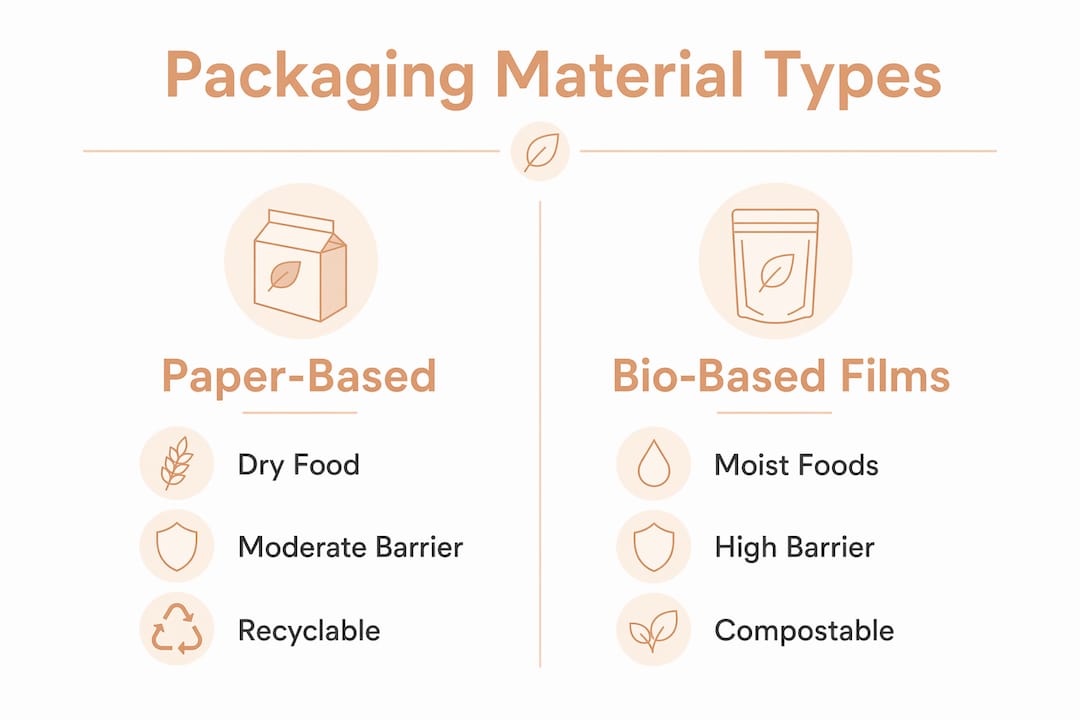
NatureFlex™ cellulose films are bio-based, transparent, and support repulping when correctly separated, making them well-suited for snack pouches and confectionery where brand clarity matters. Single-layer bio-based films, including PLA, often fall short on oxygen barrier for sensitive products. Laminating them with paper or another biopolymer is the standard fix for coffee, roasted nuts, and similar oxygen-sensitive foods.
PureNil™0-style substrates disperse rapidly in water, are direct food-contact capable for dry products, and leave no plastic residue. BASF ecovio® is a PBAT/PLA compound certified compostable to ASTM D6400 and EN 13432, with grades available for both rigid and flexible packaging applications.
Worth noting: paper-based laminates can complicate fiber recycling if the coating or adhesive is not compatible with repulping. Always confirm recyclability with your converter before making end-of-life claims.
Food safety and performance: what to verify before you commit
Require FDA food-contact compliance documentation and supplier migration testing for your specific food type before approving any material. This is non-negotiable, whether you are sourcing a cellulose film or a compostable biopolymer.
Key metrics to request from every supplier:
- OTR (oxygen transmission rate) and WVTR (water vapor transmission rate) at your storage temperature and humidity
- Seal temperature range and seal strength (critical for form-fill-seal lines)
- Puncture resistance and tensile strength for your fill weight
- Hot-fill, retort, or freezer tolerance if applicable
- Migration test reports for your food category (dry, fatty, acidic, or aqueous)
FDA food-contact pathways for bio-based materials typically follow 21 CFR regulations or a Food Contact Notification (FCN). GRAS listings apply to some edible coatings and natural wax treatments. Declarations of conformity from your supplier should reference the specific regulation and test conditions.
Pro Tip: Ask suppliers to provide migration test data at the temperature and humidity conditions that match your actual product, not generic lab conditions. A material that passes at 23°C may behave differently in a 40°C warehouse.

Many bio-based materials require lamination to meet the OTR needed for coffee packaging or roasted snacks. Lamination is standard practice for achieving the barrier performance that single-layer bio-based films cannot deliver alone.
Can sustainable materials run on your existing equipment?
Many modern biopolymers and cellulose films can run on standard converting lines, but you must confirm the seal window, web tension behavior, and heat-seal profile before committing to volume.
| Material | Typical Seal Temp | Compatible Process | Notes |
|---|---|---|---|
| NatureFlex™ cellulose | — | FFS, lamination | Confirm tension settings with supplier |
| BASF ecovio® flexible | — | Extrusion coating, blown film, FFS | Runs on PE/PP lines with parameter adjustment |
| BASF ecovio® rigid | Standard injection / thermoforming | Replaces PP, HiPS, ABS | Processable on standard machines |
| PLA films | 100°C | FFS, lamination | Narrow seal window; brittle at low temps |
| rPET trays | Standard thermoforming | Replaces virgin PET | Widely compatible |
| PureNil™0 substrates | Varies by grade | Pouch converting | Confirm with SmartSolve for your line |
BASF ecovio® rigid grades are processable on conventional injection-molding and thermoforming machines, which means brands switching from PP or HiPS trays do not necessarily need new capital equipment. Flexible ecovio® grades support extrusion coating, blown film, and lamination on existing PE and PP lines.
Pro Tip: Run a 100–500 unit pilot under your exact process conditions before placing a large order. Small-run digital printing options let you validate design and material performance simultaneously.
End-of-life realities: what certifications actually mean in the U.S.
End-of-life must be planned to match where your customers live. Industrial composting infrastructure in the U.S. is not universal, and a material certified compostable to ASTM D6400 will not break down in a backyard bin or a landfill.
Consumer confusion about bioplastic disposal reduces real sustainability gains. Brands that provide clear, specific sorting instructions on-pack retain consumer trust and achieve better actual end-of-life outcomes.
Certification checklist for supplier evaluation:
- ASTM D6400 / ASTM D6868: U.S. standard for industrial compostability of plastics and coated papers
- EN 13432: European industrial compostability standard (widely referenced by global suppliers)
- BPI Certified Compostable: U.S. third-party verification aligned with ASTM D6400
- TÜV Austria OK Compost HOME: Home compostability certification requiring breakdown at ambient temperatures, without industrial conditions
- FSC certification: Applies to paper and paperboard; confirms responsible forest sourcing
The distinction between home and industrial compostable certifications is critical. Industrial composting requires elevated temperatures and controlled conditions that a backyard bin cannot replicate. If your customers do not have access to a commercial composting facility, an industrial-only certified material may end up in landfill regardless of its label.
How to choose the right material for your food product
Prioritize barrier needs and shelf life first, then layer in processing capability and cost constraints.
| Material Type | OTR/WVTR | Mechanical Strength | Heat Tolerance | End-of-Life | Cost/MOQ |
|---|---|---|---|---|---|
| High-barrier cellulose laminates | High | Medium | Medium | Industrial compostable | Medium / flexible |
| Fiber-based mono-materials | Low | High | Low–medium | Recyclable | Low / flexible |
| Compostable rigid (ecovio®) | Medium–high | High | — | Industrial compostable | Medium |
| rPET trays | High | High | High | Recyclable | Low–medium |
| PureNil™0-style substrates | Moderate | Medium | Low–medium | Water-dispersible | Medium |
Product-to-material matching:
| Product Profile | Suggested Material Family | Key Caveat |
|---|---|---|
| Roasted snacks / coffee | High-barrier cellulose laminate or ecovio® flexible | Confirm OTR; may need degassing valve |
| Fresh produce | Perforated cellulose film or functionalized paper | Balance respiration with moisture control |
| Frozen meals | rPET tray or ecovio® rigid | Verify freeze-thaw cycle performance |
The decision sequence is straightforward: sample, test (shelf life plus migration), run a pilot, then scale. Skipping the shelf-life test is the most common and costly mistake small brands make.
How to pilot sustainable packaging with a supplier
Use a staged workflow: specification and sampling first, then a pilot run, then QA and shelf testing, then scale with agreed MOQs and lead times.
Supplier document checklist:
| Document | Why You Need It |
|---|---|
| Technical Data Sheet (TDS) | Confirms barrier, seal, and mechanical specs |
| FDA compliance letter | Confirms food-contact approval for your category |
| Migration test report | Validates safety for your food type and conditions |
| Compostability / recyclability certificate | Confirms end-of-life claim is third-party verified |
| LCA summary | Supports your brand’s sustainability claims |
| Seal-profile parameters | Required for equipment setup |
| Print proofs | Confirms color accuracy and surface adhesion |
| MOQ and lead time confirmation | Locks in commercial terms before scaling |
A practical example: a small snack brand sourcing a compostable pouch should request TDS data at 38°C/90% RH (a common accelerated shelf-life condition), not just ambient lab data. That single step can prevent a costly recall or reformulation.
Impacked supports low-MOQ trials starting at 500 units, with flexible packaging formats including pouches, tubes, and boxes, plus design and dieline support so brands can validate materials and graphics before scaling.
New materials to watch and misconceptions to avoid
Promising innovations are real, but they require matching to your product and your customers’ disposal reality.
Materials worth tracking:
- NatureFlex™-style high-barrier cellulose films: renewable, transparent, repulpable; strong fit for snacks and confectionery
- PureNil™0-style water-dispersible substrates: plastic-free, food-contact capable for dry products, disperses in seconds
- BASF ecovio® home compostable flexible grades: certified home compostable with high oxygen and moisture barrier for pouches and sachets
- Biomimetic barrier coatings: nature-inspired coatings that improve moisture and gas control on paper-based substrates without adding non-recyclable layers
- Hydropol™-style PVOH films: claims rapid disintegration in industrial composting and repulpability with paper; verify marine biodegradation claims against your market’s regulatory standards
Common misconceptions:
- “Compostable” does not mean home compostable. Most certified compostable films require industrial facilities.
- “Biodegradable” has no regulated U.S. definition for packaging. Without a certified standard, the claim is unverifiable.
- Clear labeling does not guarantee correct disposal. Consumer education and on-pack instructions are both required.
Always request LCA summaries and third-party certification documents before accepting a supplier’s marketing language at face value. Sustainability requires cradle-to-grave assessment that balances safety, cost, and real end-of-life paths.
Verdict and next steps for food brands
Match your material to barrier requirements, shelf life, and the disposal systems your customers can access. That framework applies whether you are packaging snacks for retail or catered wrap platters.
Three prioritized next actions:
| Step | Action |
|---|---|
| Map your needs | Define OTR/WVTR requirements, shelf life target, and fill conditions (wet, oily, acidic, frozen) |
| Request documentation | TDS, FDA compliance letter, migration test report, and relevant compostability or recyclability certificate |
| Run a pilot | Order 100–500 units, run shelf-life and migration tests under real conditions, then scale |
Get a quote from Impacked to start a pilot run with low MOQs and full material transparency.
Key Takeaways
Sustainable food packaging is context-dependent: the correct material matches barrier needs, processing capability, and the end-of-life infrastructure your customers can actually use.
| Point | Details |
|---|---|
| No single perfect material | Match material family to OTR/WVTR needs, shelf life, and local disposal systems. |
| Certifications differ significantly | ASTM D6400 and BPI confirm industrial compostability; TÜV OK Compost HOME is required for home compostability claims. |
| Lamination fills barrier gaps | Single-layer bio-based films often need lamination to meet OTR for coffee, snacks, and oxygen-sensitive foods. |
| Pilot before scaling | Run 100–500 unit trials with real shelf-life and migration testing before committing to full production. |
| Impacked supports low-MOQ trials | Impacked offers sustainable material options in pouches, tubes, and boxes starting at 500 units with design support. |
Practical sustainability beats packaging ideology
The brands we work with at Impacked that make the most progress are not the ones chasing the single “greenest” material. They are the ones who map their product’s actual barrier needs, request real test data from suppliers, and run small pilots before scaling. That approach surfaces trade-offs early, when they are cheap to fix.
We are committed to supporting that process: low MOQs, material transparency, and honest conversations about what a given substrate can and cannot do for your product. Compostable packaging is genuinely valuable when the disposal infrastructure exists. When it does not, a recyclable mono-material may deliver better real-world outcomes. The right answer depends on your product, your market, and your customers’ habits, not on a single certification badge.
How Impacked supports your sustainable packaging trial
Custom sustainable food packaging does not have to mean large upfront commitments. Impacked offers flexible packaging formats including stand-up pouches, roll film, tubes, and custom printed boxes with MOQs starting at 500 units, so you can validate materials and graphics before scaling.
Material options include recyclable, compostable, and FSC-certified fiber substrates. Every order includes design and dieline support, and we provide TDS documentation and certification references for the materials we offer. For barrier-sensitive products like coffee, we can walk you through laminate structures and degassing valve options that match your shelf-life target. Request a quote to start your pilot run today.
Useful sources and standards for technical follow-up
| Standard / Resource | What It Covers |
|---|---|
| ASTM D6400 | U.S. standard for industrial compostability of plastic packaging |
| ASTM D6868 | U.S. standard for compostability of coated papers and packaging |
| EN 13432 | European industrial compostability standard; widely referenced globally |
| TÜV Austria OK Compost HOME | Home compostability certification; requires breakdown at ambient temperature |
| BPI Certified Compostable | U.S. third-party verification aligned with ASTM D6400 |
| FSC Certification | Responsible forest sourcing for paper and paperboard |
| FDA 21 CFR (food contact) | U.S. food-contact material regulations and compliance pathways |
Key supplier technical pages for deeper research:
- NatureFlex™ product page (Futamura) for cellulose film TDS and barrier data
- BASF ecovio® product page for compostable biopolymer grades and processing parameters
- PureNil™0 technical page (SmartSolve) for water-dispersible substrate specifications
- Food Safety Magazine on LCA in packaging for lifecycle assessment methodology
Always download TDS documents directly from the supplier and request LCA summaries when making sustainability claims to retailers or consumers.