

Custom folding cartons are the most practical path to retail-grade shelf presence for brands that need flexibility, not just volume. If you’re evaluating suppliers right now, here’s the short version: specify SBS or recycled paperboard at 18–24pt, request a physical sample before committing to production, confirm the supplier offers design and dieline support, and target a minimum order quantity of 500 units or fewer for your first run. Impacked checks all of those boxes, with custom printed boxes starting at 500 units, express production as fast as two weeks, full-color digital and offset printing, and a single point of contact from concept to delivery.
The folding carton industry was estimated at $141.1 billion in 2024, which reflects just how central paperboard packaging is to consumer goods across food, beverage, beauty, and lifestyle. For brands entering or scaling in those categories, the format’s printability, recyclability, and flat-shipped efficiency make it the default choice.
Before you request a quote, confirm these specs:
- Minimum order quantity: 500 units or fewer for digital short runs
- Lead time: prototype in 1–2 weeks; production run in 2–4 weeks depending on finish
- Material: SBS (solid bleached sulfate), recycled paperboard, or E-flute corrugated
- Finishes: soft-touch lamination, gloss, spot UV, hot foil, embossing
- Sample policy: physical sample kit available before mass production
- Sustainability: FSC-certified or post-consumer-recycled content available
Request a sample or quote from Impacked to get started with your dieline and product dimensions.
Table of Contents
- What folding carton styles are right for your product?
- Which paperboard substrate fits your product and print goals?
- How do printing methods and finishes change cost and shelf impact?
- What artwork specs does your supplier need from you?
- How does the ordering process work, from sample to full production?
- What actually drives the price on a folding carton quote?
- Sustainable board choices and compliance for U.S. brands
- The “total package” approach: what experienced buyers do differently
- How to evaluate suppliers and why Impacked fits low-MOQ premium carton needs
- Key Takeaways
- What we’ve seen brands get wrong, and how to avoid it
- Impacked makes custom folding carton packaging straightforward
- Useful sources and further reading
What folding carton styles are right for your product?
Choosing the right box structure before you finalize artwork saves time, money, and rework. Each style has a specific operational fit, and the wrong choice can slow your packing line or underperform on shelf.

Straight tuck end (STE): Top and bottom flaps tuck in the same direction. Fast to assemble by hand, widely used for cosmetics, supplements, and small retail goods. Works well on automated cartoners.
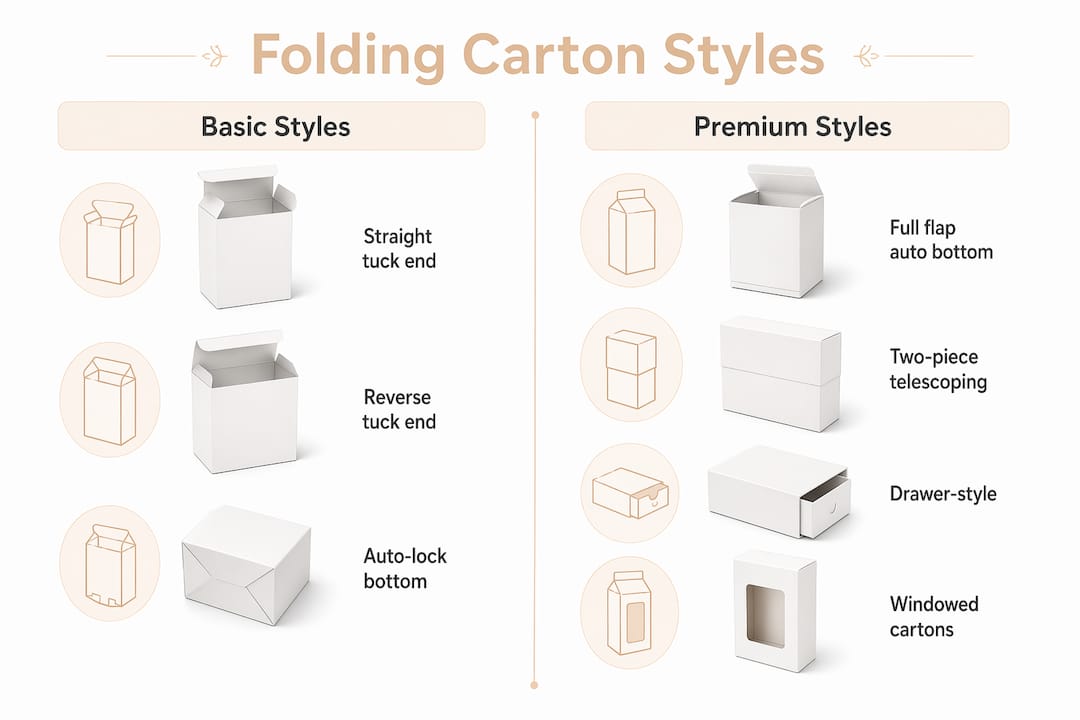
Reverse tuck end (RTE): Top and bottom flaps tuck in opposite directions. More secure closure than straight tuck, common for pharmaceuticals and food products. Also machine-compatible.
Auto-lock bottom (snap-lock): Bottom panels lock together without glue during assembly. Best for heavier products where a standard tuck would fail under load. Slightly slower to assemble but far more durable.
Full flap automatic bottom (FFAB): Pre-glued bottom that pops open flat. Fastest assembly on the line, ideal for high-volume e-commerce fulfillment. Ships flat, which keeps freight costs low.
Two-piece telescoping: Separate lid and base. Premium presentation for gift sets, luxury goods, and high-end cosmetics. Slower to pack, typically hand-assembled, and commands a higher per-unit cost.
Drawer-style (sliding box): Inner tray slides out of an outer sleeve. Strong shelf differentiation for electronics, candles, and premium food items. Usually hand-packed.
Windowed cartons: Any of the above styles with a clear PET or cellophane window die-cut into a panel. Lets consumers see the product inside, which is proven to increase purchase confidence for food and personal care.
| Style | Typical use case | Assembly method |
|---|---|---|
| Straight tuck end | Cosmetics, supplements, retail | Hand or machine |
| Reverse tuck end | Pharma, food, retail | Hand or machine |
| Auto-lock bottom | Heavy or dense products | Hand |
| Full flap automatic bottom | E-commerce, high-volume | Machine (pre-glued) |
| Two-piece telescoping | Luxury, gift sets | Hand |
| Drawer style | Premium food, electronics | Hand |
| Windowed carton | Food, personal care | Hand or machine |
Which paperboard substrate fits your product and print goals?
Material choice drives three things simultaneously: protection, print quality, and your sustainability story. Getting the substrate right before you finalize the dieline prevents costly reprints and compliance issues.

SBS (solid bleached sulfate): The premium standard for retail folding cartons. Bright white surface on both sides, excellent ink holdout, and the best base for high-end finishes like foil and soft-touch lamination. Typical weights run medium thickness suitable for folding cartons. Higher cost than recycled options, but print quality is noticeably superior.
Coated unbleached kraft (CUK): Natural brown interior with a coated white face. Strong, moisture-resistant, and popular for food and beverage brands that want an eco-aesthetic without sacrificing print quality on the exterior.
Recycled chipboard / folding boxboard (FBB): Made from post-consumer or post-industrial fiber. Lower cost, supports recycled-content claims, and widely available with FSC certification. Print quality is good but not equal to SBS for fine detail or metallic finishes.
E-flute corrugated: Micro-flute board that adds cushioning for fragile or heavier products. Printable surface, but not ideal for fine-detail litho printing without a laminated liner. Best for shipping cartons that also serve as retail display.
Grain direction matters. Board grain should run parallel to the carton’s primary fold lines. Folding against the grain causes cracking along score lines, which is one of the most common and preventable production defects.
| Substrate | Strength | Print quality | Recyclability | Cost tendency |
|---|---|---|---|---|
| SBS | Medium | Excellent | Yes | Higher |
| CUK | High | Good | Yes | Medium |
| Recycled chipboard | Medium | Good | Yes | Lower |
| E-flute corrugated | High | Moderate | Yes | Medium |
How do printing methods and finishes change cost and shelf impact?
Print and finish decisions are where your brand identity either lands or gets lost. They also have the biggest influence on per-unit cost outside of quantity.
Digital vs. offset printing
Digital printing removes plate setup costs and is the practical choice for prototypes, short runs under a few thousand units, and brands managing multiple SKUs or seasonal designs. Full CMYK color, fast turnaround, and no tooling fees make it the default for low-MOQ orders. For large-volume, uniform runs, offset (and rotogravure for flexible formats) reduces per-unit cost despite higher upfront plate costs. Digital printing is generally competitive for short runs, while offset printing is preferred for larger quantities depending on design complexity.
Surface finishes
- Matte/soft-touch lamination: Velvety tactile feel, premium perception, scratch-resistant. Pairs well with spot UV for contrast effects.
- Gloss lamination: High-shine, vibrant color pop, moisture-resistant. The most common protective finish.
- Aqueous varnish: Water-based, food-contact-friendly, lower cost than lamination. Good for food packaging where full lamination isn’t needed.
- Spot UV: Gloss coating applied selectively over matte or soft-touch base. Creates visual contrast and draws the eye to logos or key graphics.
- Hot foil stamping: Metallic or holographic foil applied under heat and pressure. Finishes like foil and soft-touch lamination create tactile and visual differences that translate directly into perceived premium quality on shelf.
- Embossing/debossing: Raises or recesses a design element into the board. Adds dimension without ink or foil, often used for logos.
- Window patching: Clear PET film heat-sealed over a die-cut opening. Adds cost and lead time but significantly increases purchase intent for food and personal care.
Pro Tip: Never place a foil stamp or emboss directly over a crease line. The pressure required for foil application can crack the board along the score, ruining the finish and weakening the carton’s structural integrity. Keep embellishments at least 3mm clear of any fold.
What artwork specs does your supplier need from you?
Sending production-ready files the first time eliminates the most common source of delays. Here’s what every supplier needs before they can produce an accurate sample or quote.
Core artwork requirements:
- Dieline: Accurate, supplier-approved dieline in vector format (AI or EPS). Never build artwork on a generic template without confirming it matches the supplier’s production tolerances.
- Bleed: Minimum 3mm (0.125") on all edges that will be cut or folded.
- Safe zone: Keep all critical text and logos at least 3mm inside the trim line.
- Color profile: CMYK. For offset, specify SWOP or GRACoL if your supplier requires it.
- Resolution: 300 dpi minimum for all raster images at final print size.
- File format: Print-ready PDF/X-1a or packaged Adobe Illustrator file with all fonts outlined and links embedded.
Dieline accuracy directly affects assembly speed, carton durability, and packing efficiency. Score lines, glue areas, and grain direction must all be correct before artwork is placed. A dieline error caught at the file stage costs nothing; the same error caught after production costs the entire run.
| File format | When to use |
|---|---|
| PDF/X-1a | Standard print-ready submission; preferred by most suppliers |
| Packaged AI (Illustrator) | When supplier needs to adjust dieline or make structural edits |
| EPS (vector dieline only) | Sending the structural dieline separately from artwork |
| High-res TIFF | Photographic elements embedded in a packaged file |
What to include with every quote request: dieline file, dieline-marked artwork, Pantone or CMYK color references, pack quantity, packing orientation (how the product sits inside the carton), and any finish specifications.
How does the ordering process work, from sample to full production?
Planning your timeline around the actual production steps prevents launch delays. Here’s the standard flow for custom folding carton packaging:
- Submit brief and dieline: Share product dimensions, quantity, material preference, and finish requirements. Impacked’s team reviews for manufacturability.
- Receive digital proof: Supplier confirms dieline, color separations, and finish placement. Review carefully for text, bleed, and color accuracy.
- Order physical sample: Requesting a physical sample kit before production is the single best way to catch print registration issues, finish behavior, and assembly problems that digital proofs miss. Sample fees are common; many suppliers credit them against the production order.
- Approve sample and confirm production order: Sign off on the physical sample, confirm quantity, and place the production order.
- Production run: Digital short runs typically complete in 2 weeks. Offset runs with specialty finishes may run 3–4 weeks.
- Quality control and flat shipment: Knocked-down cartons ship flat, allowing thousands of units to occupy the space of a few hundred assembled boxes. This produces significant freight savings and reduces storage footprint at your facility.
- On-site assembly or pre-glued delivery: Auto-bottom styles arrive pre-glued and ready to pop open. Tuck-end styles ship flat for hand or machine assembly.
MOQ and sample policy to confirm with any supplier:
- Minimum order quantity for digital runs (Impacked offers flexible order quantities)
- Sample fee and whether it’s credited to production
- Rush production availability and associated fees
- Freight options: standard ground, expedited, LTL pallet for large orders
What actually drives the price on a folding carton quote?
Per-unit price on folding cartons is a function of several variables working together. Understanding each one lets you compare quotes on equal terms.
- Quantity: The single largest lever. Per-unit cost drops significantly as quantity increases because setup and tooling costs are spread across more units.
- Die-cut tooling: Offset and specialty runs require a physical cutting die, a one-time setup cost. Digital runs typically use a laser or existing die, eliminating this charge.
- Substrate and board weight: Heavier board (higher gsm or points) costs more per unit. SBS costs more than recycled chipboard at the same weight.
- Finishing effects: Each added finish (foil, embossing, spot UV, soft-touch lamination) adds cost and often adds lead time. Foil and embossing require separate tooling.
- Box complexity: More panels, unusual shapes, or complex glue patterns increase assembly time and waste, both of which add cost.
- Rush fees: Express production typically carries an additional surcharge depending on the supplier and run size.
To compare quotes fairly: request identical dielines, the same substrate spec (gsm or point weight), identical finish, and ask each supplier to include freight to your door. A quote that looks 20% cheaper before freight can easily become the more expensive option after shipping.
| Quantity band | Relative per-unit cost | Typical setup/tooling note |
|---|---|---|
| 500–1,000 units | Highest per unit | Digital: no plate cost; offset: tooling applies |
| — | Moderate | Tooling cost amortized across more units |
| — | Lowest per unit | Full offset economics; tooling fully amortized |
Sustainable board choices and compliance for U.S. brands
Sustainability in folding carton packaging is no longer a differentiator. For many retail buyers and food brands, it’s a baseline requirement.
Sustainable material options:
- FSC-certified board: Chain-of-custody certification confirms the fiber comes from responsibly managed forests. Shifting to FSC-certified or recycled paperboard is a straightforward method for brands to improve environmental credentials without compromising protection.
- Post-consumer-recycled (PCR) content: Recycled chipboard and kraft options with verified PCR percentages support on-package recycling claims.
- Recyclable construction: Folding cartons made from paperboard without plastic lamination are curbside-recyclable in most U.S. municipalities. Avoid PET window patches if recyclability is a priority claim.
Compliance items to confirm with your supplier:
- FDA food-contact suitability: For food and beverage packaging, specifying FDA-compliant substrates and low-migration inks is a required practice. Request a written statement of compliance and material spec sheet.
- Low-migration inks: Required for direct or indirect food contact. Ask for documentation.
- Recyclability claims: The FTC Green Guides govern what you can claim on-package. “Recyclable” is substantiated when the packaging is accepted by programs serving a substantial majority of U.S. households. Confirm with your supplier before printing the claim.
Pro Tip: Always request a material spec sheet and a labeled physical sample before mass production. The spec sheet should state board grade, gsm, FSC certification number, and ink system. A sample with a material label lets you verify the claim before it appears on your finished product.
The folding carton format is 100% recyclable when constructed from paperboard without non-paper coatings, which makes it one of the most defensible sustainability claims in retail packaging.
The “total package” approach: what experienced buyers do differently
Most production problems in folding carton projects originate in the first 10% of the process, not the last. Brands that coordinate structure, material, and artwork before finalizing files avoid the majority of costly errors.
Manufacturing checks that catch problems early:
- Confirm grain direction runs parallel to the primary fold lines before building artwork.
- Verify crease allowance is built into the dieline, not assumed. A tight dieline with no crease allowance produces cartons that won’t close cleanly.
- Check glue area clearance: artwork that bleeds into the glue flap prevents proper adhesion and causes assembly failures on the line.
- Confirm the dieline accounts for the board caliper (thickness). Thicker board requires wider crease channels; ignoring this causes cracking.
Sampling strategy:
Use digital printing for prototypes and first samples. It removes plate costs, shortens the sample cycle, and lets you test multiple colorways or SKUs without committing to offset tooling. Once the physical sample is approved, offset becomes viable for larger runs where per-unit economics justify the setup cost.
The practical implication: send your dieline to your supplier for a manufacturability review before you invest in finished artwork. It costs nothing and prevents the most expensive category of rework.
How to evaluate suppliers and why Impacked fits low-MOQ premium carton needs
A supplier evaluation doesn’t need to be complicated. Five questions separate capable partners from those who will slow your launch.
Supplier checklist:
- MOQ policy: Can they run 500–1,000 units without a prohibitive per-unit premium?
- Sample availability: Do they offer physical samples, and is the fee credited to production?
- Dieline and design support: Will they review your dieline for manufacturability, or do they just print what you send?
- Material spec sheets: Can they provide GSM, board grade, FSC certification number, and ink compliance documentation?
- Lead time transparency: Do they quote prototype and production lead times separately, with express options clearly priced?
Red flags to watch for: vague MOQ language (“minimums vary”), no physical sample option, missing material certifications, and dieline support that amounts to “send us your file and we’ll print it.”
Impacked addresses each of these directly. Low MOQs starting at 500 units make it practical for brands to test a design before scaling. Design and dieline support is part of the project flow, not an add-on. Express production runs as fast as two weeks. Sustainable material options, including FSC-certified and recyclable board, are available with documentation. And a single point of contact manages the project from brief to delivery, which eliminates the coordination overhead that typically slows multi-vendor packaging projects.
For brands in food, beverage, pet food, or lifestyle categories, Impacked’s markets served page outlines the specific verticals and compliance considerations they support.
Next steps for placing an order:
- Gather your product dimensions and target pack quantity.
- Prepare or request a dieline (Impacked can assist if you don’t have one).
- Submit a quote request with your dieline, finish preferences, and timeline.
- Review the digital proof and order a physical sample.
- Approve the sample and confirm production.
Key Takeaways
Custom folding cartons deliver retail-grade shelf impact at low MOQs when you specify the right substrate, confirm dieline support, and request a physical sample before committing to production.
| Point | Details |
|---|---|
| Start with the dieline | Confirm grain direction, crease allowance, and glue areas before building artwork to avoid costly rework. |
| Match substrate to use case | SBS for premium print quality; recycled chipboard or kraft for cost and sustainability claims. |
| Request a physical sample | Digital proofs miss assembly and finish issues; a physical sample kit catches them before mass production. |
| Confirm MOQ and lead time | Impacked offers flexible order quantities with express production as fast as two weeks, making low-volume testing practical. |
| Impacked as a supplier fit | Single point of contact, design/dieline support, FSC-certified materials, and low MOQs make Impacked a strong match for brands needing premium cartons without large minimum commitments. |
What we’ve seen brands get wrong, and how to avoid it
The most common mistake we see is brands sending finished artwork before the dieline has been reviewed. A logo that looks perfect in a flat file can land directly over a crease line or glue flap, requiring a full artwork revision after the sample comes back. The fix is simple: share your dieline with your supplier first, get a manufacturability sign-off, then build the artwork.
The second pattern is underestimating how much a physical sample changes the decision. Brands that skip the sample to save time almost always spend more time resolving production issues after the run. A sample that costs a few hundred dollars prevents a reprint that costs multiples of that.
We work as an extension of your team at Impacked, which means one person manages your project from the initial brief through delivery. No handoffs between sales, design, and production teams. If you’re ready to move forward, get a quote and attach your product dimensions and any existing dieline files.
Impacked makes custom folding carton packaging straightforward
Brands that need premium folding carton packaging without large minimum orders or long production cycles have a direct path with Impacked.
Here’s what working with us looks like in practice:
- Custom folding cartons starting at 500 units, with full-color digital and offset printing
- Express production as fast as two weeks for qualifying orders
- Design and dieline support included in the project flow, not billed separately
- Sustainable materials: FSC-certified board, post-consumer-recycled content, and recyclable construction available with documentation
- Single point of contact from brief to delivery, across food, beverage, pet food, and lifestyle categories
Whether you’re launching a new SKU, testing a seasonal design, or scaling an existing line, Impacked’s custom printed boxes service is built to move at your pace. Ready to see what your carton looks like? Request a quote or sample and include your product dimensions, target quantity, and any finish preferences.
Useful sources and further reading
The references below support the technical claims in this article and are worth bookmarking for spec verification, certification lookup, and production planning.
- Folding carton — Wikipedia: Background on the format’s history, construction, and logistics advantages including flat-shipped efficiency.
- Folding Carton Packaging — Smurfit Kappa: Technical overview of folding carton grades, print options, and recyclability.
- Folding Cartons — Graphic Packaging: Structural design and sustainability framing for food, beverage, and consumer goods categories.
- Custom Folding Cartons — GUKA Packaging: Practitioner guidance on dieline accuracy, total-package approach, and physical sampling.
- Folding Cartons — Taylor: FSC and recycled-content options with sustainability framing.
- Custom Folding Cartons — Letai Packaging: Digital printing for short runs, food-contact compliance, and low-MOQ economics.
- Impacked — Custom Printed Boxes: Impacked’s core folding carton and box offering with MOQ, lead time, and finish details.
- Impacked — Get a Quote: Primary page for submitting a quote or sample request with your project specs.
| Source | Best for |
|---|---|
| Wikipedia — Folding carton | Format overview, flat-shipping logistics |
| GUKA Packaging | Dieline rules, sampling strategy, total-package approach |
| Letai Packaging | Digital printing, food-contact compliance |
| Taylor Packaging | FSC certification, recycled-content documentation |
| Impacked — Get a Quote | Submitting your quote or sample request |