

Yes, you can get fully custom printed packaging with low minimum order quantities. Impacked offers short-run custom packaging starting at 500 units across pouches, flexible bags, folding cartons, tubes, and boxes — purpose-built for brands that need to move fast without locking up capital in oversized inventory. For some formats like folding cartons and custom printed boxes, certain suppliers offer starting MOQs as low as 100 units using digital workflows. Request a quote and include your product dimensions, desired format, target quantity, and timeline to get started.
Your fastest paths to custom packaging at low volumes:
- Sample first: Request a physical sample before committing to a production run — confirm fit, finish, and print quality.
- Short run production: Order as few as 100 units for folding cartons or boxes, or 500–1,000 units for pouches and other formats, to test a new SKU or seasonal design with minimal inventory risk.
- Express production: Impacked offers production as fast as 2 weeks when your artwork is approved and specs are confirmed.
Pro Tip: Before you contact any supplier, write down three things: your product’s exact dimensions, your target quantity, and your hard deadline. Suppliers quote faster and more accurately when you lead with specifics rather than asking for a general price range.
Table of Contents
- What does low MOQ packaging mean for your brand?
- What MOQ ranges should you expect by packaging format?
- What does the ordering process actually look like?
- How do you choose the right low-MOQ packaging partner?
- Why Impacked fits startups that need low MOQs
- Key Takeaways
- What we have learned from working with early-stage brands
- Custom packaging that fits your scale and your timeline
- Further reading and useful sources
What does low MOQ packaging mean for your brand?
“Low MOQ packaging” refers to custom printed packaging available in smaller minimum order quantities than traditional offset or rotogravure production typically allows. In the packaging industry, the standard term is short-run packaging, and it describes orders where digital or hybrid printing workflows replace conventional plate-based methods to make small batches economically viable.
For startups and growing brands, the practical value is straightforward. You can launch a new SKU, test a seasonal design, or supply a retail pilot without ordering 10,000 units of something that might need to change after your first round of customer feedback.
The tradeoffs are real, though. Short runs cost more per unit than long runs, because setup costs are spread across fewer pieces. A long run reduces unit price but raises your commitment — and the risk that artwork changes, formula updates, or slow sales leave you with obsolete stock. Short runs are the right call when uncertainty is high: new launches, seasonal programs, limited editions, influencer kits, and retail testing. Long runs make sense when demand is stable and your design is locked.
The smarter comparison metric is total cost of ownership, not unit price. Gartner’s total cost of ownership framework recommends factoring in setup fees, freight, storage and carrying costs, and expected waste or obsolescence alongside the per-unit price. A short run at $1.80 per unit often beats a long run at $0.90 per unit once you account for six months of warehouse space and the 15% of inventory that never ships.
- Cash flow: Smaller orders tie up less working capital.
- Speed to market: Short runs ship faster and let you iterate on design after real feedback.
- Inventory risk: You hold less stock, so obsolescence costs stay low.
- Retailer testing: Many buyers want a small initial order before committing to a full program.
Pro Tip: Run a two-scenario comparison: get quotes for one short run and one scaled long run, then add setup, freight, storage, and expected obsolescence to both totals. The scenario with the lower risk-adjusted cost wins — and it is often the short run for brands under 18 months old.
What MOQ ranges should you expect by packaging format?
MOQ ranges vary significantly by format and printing method. The table below reflects conservative U.S.-market guidance for custom printed packaging.
| Format | Typical MOQ Range | Common Print Method |
|---|---|---|
| Custom printed folding cartons | 100–5,000 units | Digital or offset |
| Stand-up pouches / flexible bags | 500–5,000 units | Digital or rotogravure |
| Packaging tubes | 500–1,000 units | Digital or offset |
| Custom printed boxes | 100–5,000 units | Digital or offset |
| Roll film / flexible roll stock | 1,000–10,000+ units | Rotogravure or flexo |
| Cold cups | 500–5,000 units | Digital or offset |
The printing method is the biggest lever. Digital printing avoids physical plates and dies entirely, which is what makes small batches economically viable. Setup costs are minimal, turnaround is faster, and you can run multiple SKUs or colorways in the same production window. Some suppliers produce fully custom packaging from as few as 100 units for folding cartons and rigid boxes using digital workflows, with full finishes and inserts available at those volumes.
Conventional methods — flexo, offset, and rotogravure — require physical plates or cylinders. Those upfront tooling costs are amortized across the run, so they become cost-effective only at higher volumes. Flexography, for example, is the dominant method for flexible packaging at scale, but the plate costs make it expensive for runs under a few thousand units.
Premium finishes affect minimums too. Foil stamping, embossing, and specialty laminates often require additional tooling, which pushes the practical minimum higher regardless of the base printing method.
Formats easiest to order in very low quantities:
- Custom printed folding cartons (digital workflows widely available; MOQs can start as low as 100 units)
- Stand-up pouches at 500 units with a digital-capable supplier like Impacked
- Packaging tubes at 500 units
Formats that commonly require higher MOQs:
- Roll film and flexible roll stock (rotogravure setups favor larger runs)
- Heavily finished rigid boxes with foil or embossing
What does the ordering process actually look like?
Understanding the full ordering flow before you contact a supplier saves time and prevents budget surprises.
The typical steps:
- Brief submission: Share your product dimensions, format, quantity, timeline, and any sustainability requirements.
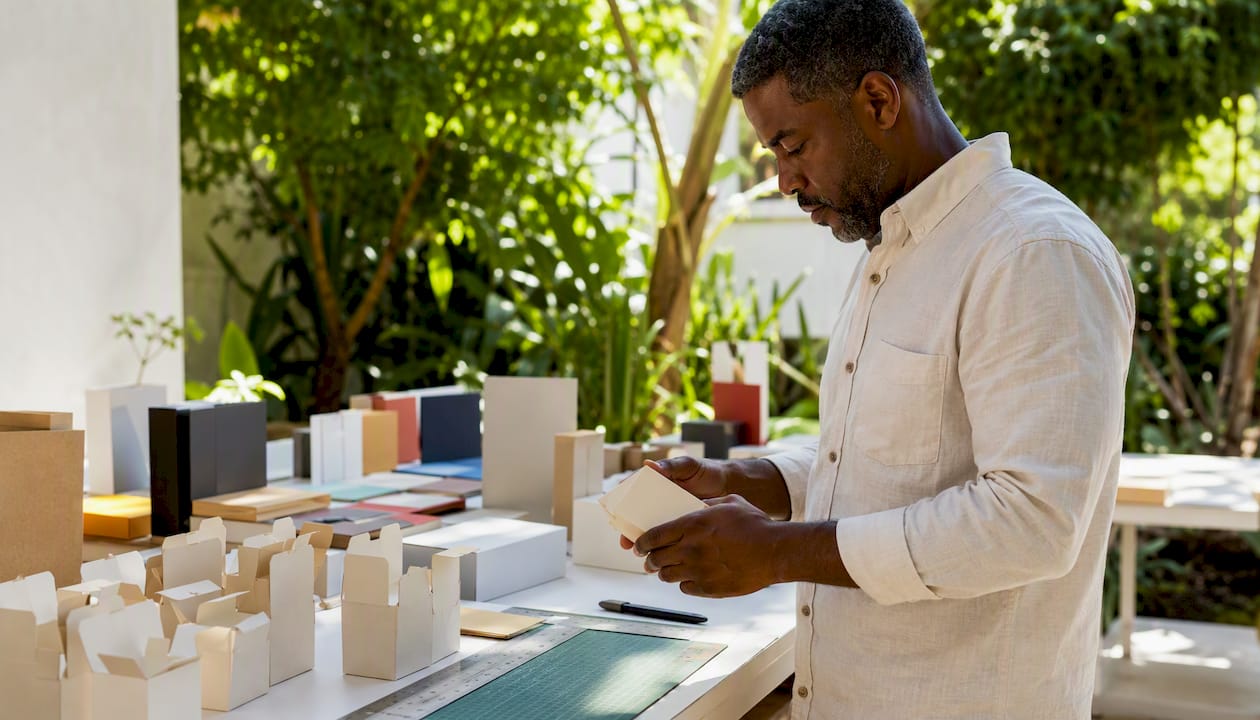
- Dieline / template: The supplier provides a dieline file. You (or your designer) place artwork on it, respecting bleed, safe zone, and color profile specs.
- Digital proof or physical sample: The supplier generates a digital mockup or produces a physical sample for your approval.
- Approval: You sign off on the proof. Any revision restarts the clock on that stage.
- Production: The order enters the print queue. Express options (2-week production) are available from some suppliers when artwork is pre-approved.
- Shipping: Finished goods ship to your warehouse or fulfillment center.
Cost components to budget for:
- Unit price (varies by format, quantity, and print method)
- Setup or plate fees (minimal or zero with digital printing; significant with flexo or rotogravure)
- Sample fee (typically charged per sample set)
- Proofing costs (digital proofs are usually included; physical proofs may carry a fee)
- Finishing costs (lamination, coatings, special effects)
- Freight and receiving
- Storage and carrying costs if you order more than you need near-term
Lead times for short-run jobs vary. Physical samples typically take 1–2 weeks. Production runs for low-MOQ digital orders often run 2–4 weeks after proof approval, with express options available when specs are clean and artwork is ready on day one. Conventional print methods add time because of plate production.
Pro Tip: The fastest way to cut sample time is to provide a precise, supplier-ready dieline with defined Pantone color swatches and correct bleed settings before you submit. Request a digital mockup first — it costs less and catches layout errors before a physical sample is produced.
How do you choose the right low-MOQ packaging partner?
The right supplier is not always the one with the lowest headline unit price. Evaluate on these criteria before you commit.
Evaluation checklist:
- MOQ by format (confirm the actual minimum, not the advertised one)
- Printing methods available (digital vs. conventional)
- Lead time transparency (are production windows published or vague?)
- Sample policy (is a physical sample available, and what does it cost?)
- Quality control process (how are defective runs handled?)
- Sustainability options (recyclable, compostable, FSC-certified materials)
- Single point of contact vs. handoffs between departments
- Reorder process and pricing
Questions to ask every supplier:
- What is your actual MOQ for the specific format I need?
- Do you charge plate or setup fees, and how much?
- What is your sample turnaround time and cost?
- What file formats and color profiles do you require?
- What is your proofing process — digital only, or physical?
- What are your minimum roll lengths for flexible packaging?
- Do you offer reorder discounts, and at what volume?
- How do you handle defective or off-spec runs?
- What are your shipping and palletization requirements?
- What sustainability certifications do you hold?
Red flags to watch for:
- Vague or unpublished lead times
- Setup fees that appear only after you request a quote
- No sample photos or physical sample option
- A single generic contact email with no named account manager
- Sustainability claims with no certifications to back them
Compare total landed cost, not unit price. Add freight, receiving, storage, and the realistic cost of unsold inventory to both a short-run and a long-run quote before deciding. When setup costs are treated as a fixed expense amortized across units you will actually use, the theoretical discount from a larger run often disappears.
Why Impacked fits startups that need low MOQs

Impacked is built for exactly the scenario most startups face: you need premium custom packaging, you are not ready to order very large quantities, and you cannot afford to wait a long time to see a sample.
Core capabilities:
- MOQs starting at 500 units across flexible packaging formats, tubes, boxes, and cold cups. For folding cartons and custom printed boxes, some suppliers offer MOQs as low as 100 units with digital workflows.
- Full-color digital and rotogravure printing for food, beverage, coffee, pet food, seafood, and lifestyle brands
- Express production options as fast as 2 weeks after proof approval
- Sustainable material options: recyclable, compostable, and FSC-certified where applicable
- Dieline templates and design support included in the project workflow
- A single point of contact from brief to delivery — no handoffs, no confusion
Impacked’s custom folding carton and flexible packaging workflows are designed to keep small-batch projects moving. The single-contact model matters more than it sounds: when you have a question about a proof at 4 PM on a Thursday, you reach the person who knows your project, not a support queue.
Sample policy and proofs: Physical samples are available before production. Request one through the Get a Quote page and specify that you want a sample as your first step.
Pro Tip: When you submit your brief to Impacked, include your sustainability requirements upfront. Specifying recyclable or compostable materials at the brief stage prevents a late-stage redesign and keeps your timeline intact.
| Capability | Impacked |
|---|---|
| Starting MOQ | 500 units (100 units for folding cartons and custom printed boxes with select suppliers) |
| Express production | As fast as 2 weeks |
| Sustainable materials | Recyclable, compostable, FSC-certified |
| Design / dieline support | Included |
| Single point of contact | Yes |
| Formats covered | Pouches, flexible bags, tubes, boxes, cartons, cold cups, roll film |
Key Takeaways
Low MOQ packaging is most cost-effective when you evaluate total landed cost, choose digital printing for runs under 5,000 units, and work with a supplier that offers samples, transparent lead times, and a single point of contact.
| Point | Details |
|---|---|
| MOQ varies by format | Folding cartons and custom printed boxes can start at 100 units; pouches, tubes, and cold cups generally start at 500 units; roll film typically requires 1,000+ units. |
| Digital printing enables short runs | Digital workflows eliminate plate costs, making small batches viable without sacrificing print quality. |
| Total cost beats unit price | Add setup, freight, storage, and obsolescence to both scenarios before choosing run length. |
| Ask the right questions | Confirm actual MOQ, plate fees, sample cost, and defect policy before committing to any supplier. |
| Impacked starts at 500 units | Impacked covers pouches, cartons, tubes, boxes, and more with express options and sustainable materials. |
What we have learned from working with early-stage brands
Most startups come to us after a frustrating experience with a supplier that quoted a low MOQ and then added plate fees, long lead times, and a minimum roll length that tripled the effective order size. The advertised number and the real number are often different.
At Impacked, we work closely with founders and brand managers from the first brief through sample approval and into production. The single point of contact is not a marketing phrase — it is how we keep small-batch projects from falling through the cracks between departments. A small pouch order gets the same attention as a large run, because the brands placing those small orders today are the ones scaling with us tomorrow.
Custom packaging that fits your scale and your timeline
Startups that need short-run custom packaging face a real gap in the market: most traditional suppliers are optimized for volume, not flexibility. Impacked closes that gap with MOQs starting at 500 units, express production as fast as 2 weeks, and a full-service model that covers everything from dieline support to sustainable material selection. For select formats like folding cartons and custom printed boxes, some digital suppliers provide starting MOQs of 100 units.
Ready to move from concept to custom packaging? Use this brief template when you reach out:
- Format: (pouch, box, carton, tube, roll film)
- Dimensions: (length × width × depth or gusset)
- Quantity: (starting order and expected reorder volume)
- Timeline: (target in-hands date)
- Sustainability needs: (recyclable, compostable, FSC-certified, or standard)
Submit your brief at Get a Quote and an Impacked specialist will respond with a quote and sample options. If you are working on flexible packaging or custom printed boxes, those product pages include format specs and material options to help you finalize your brief before you submit.
Further reading and useful sources
- Gartner — Total Cost of Ownership: Framework for evaluating total landed cost, including setup, freight, storage, and obsolescence.
- Flexography — Wikipedia: Technical overview of flexographic printing and why it favors higher-volume runs.
- Flexible Packaging — Impacked: Format and material options for pouches and flexible films, with sample and ordering guidance.
- Custom folding cartons — Impacked: Process overview for small-batch carton projects, including dieline support and single-contact delivery.
- Printed Flexible Packaging: A Brand’s Guide — Impacked: Comparison of digital, rotogravure, and flexo printing for small-volume food and beverage orders.