

Printed flexible packaging covers digitally printed films, foils, and laminates used to create pouches, bags, sleeves, and roll stock that carry your brand directly on the shelf. For small and medium brands in the United States, digital printing has changed the economics entirely. You no longer need a massive production run to get premium, full-color custom packaging. Here is what the format offers and how to use it well:
- Lower minimum order quantities: Digital printing allows economically viable production runs starting at around 1,000 units, much lower than the 10,000 or more typically required for rotogravure
- Faster turnaround: Roll stock is generally ready more quickly than finished pouches after artwork approval
- SKU flexibility: No plates or cylinders means you can run multiple designs or limited editions without added tooling costs
- On-demand production: Digital flexible packaging supports just-in-time supply chains, cutting inventory risk
- Sustainability: Flexible packaging requires less water and energy to produce and transport than rigid alternatives
Industry organizations like the Flexible Packaging Association set standards and track market trends for U.S. brands. Technology providers like HP, through the HP Indigo press line, and converters like ProAmpac have built dedicated digital programs that make short-run flexible packaging commercially viable at scale.
Table of Contents
- What types of flexible packaging and materials work best for digital printing?
- How does digital printing compare to flexographic and rotogravure methods?
- Which industries use digitally printed flexible packaging most?
- What are the real advantages of digital printing for flexible packaging?
- How do you choose the right flexible packaging partner in the United States?
- Impacked brings custom printed flexible packaging within reach for growing brands
- Key Takeaways
What types of flexible packaging and materials work best for digital printing?
The format you choose shapes everything from your fill line setup to your shelf presence. The most common types are:
- Stand-up pouches: Freestanding bags with a bottom gusset, ideal for snacks, coffee, and supplements
- Flat pouches and sachets: Single-serve or sample formats for sauces, cosmetics, and pharmaceuticals
- Zipper bags: Resealable formats popular in pet food, frozen goods, and snack categories
- Sleeves: Wraparound printed film applied over a rigid container for a premium look
- Roll stock: Continuous printed film fed into form-fill-seal machinery; it has no function without automation, but it delivers speed and unit-cost efficiency at scale
Material selection directly affects both print quality and product protection. The table below covers the most common substrates:
| Material | Key Properties | Best For |
|---|---|---|
| PET (polyester) | Excellent clarity, stiffness, printability | Outer layer, high-detail graphics |
| PE (polyethylene) | Flexible, heat-sealable, food-safe | Inner sealant layer |
| PP (polypropylene) | Moisture resistance, good machinability | Snacks, dry goods |
| Aluminum foil | Near-absolute oxygen and light barrier | Coffee, pharmaceuticals, long shelf life |
| Metallized film | Improved barrier with less material than foil | Cost-effective barrier for snacks |
| Laminates (multi-layer) | Combined barrier, strength, and seal properties | Most food and beverage applications |
Film selection also determines how well ink adheres and how consistent color reproduction will be across a run. Thinner films require tighter tension control during printing to avoid registration drift.
How does digital printing compare to flexographic and rotogravure methods?
The right printing method depends on your volume, timeline, and how often your artwork changes. Here is how the three main approaches stack up:
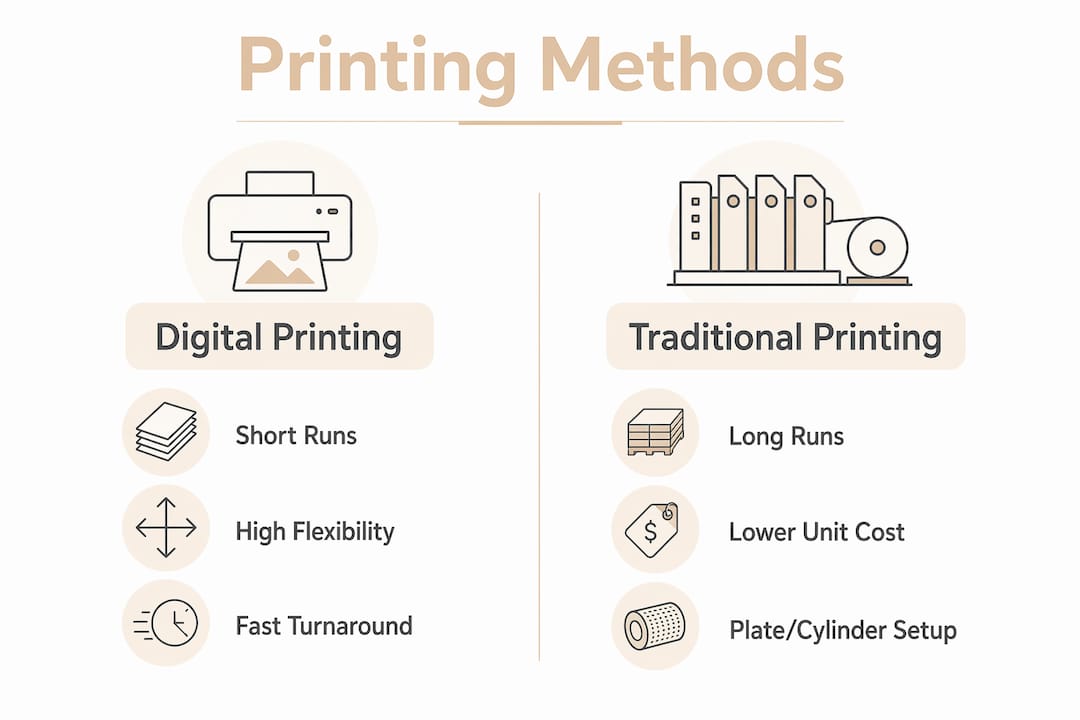
Digital printing uses no plates or cylinders. Every job is sent directly from a file to the press, which makes short runs and design changes fast and cost-effective. Flexographic printing remains the most widely used method globally for flexible packaging, valued for its versatility across substrates and efficiency in medium runs. Rotogravure delivers the highest consistency at very high volumes but requires engraved cylinders that add significant setup cost.
Digital pros:
- No plate or cylinder costs, so design changes cost nothing extra
- Cost-effective for runs under roughly 15,000 linear feet
- Faster lead times and lower inventory commitment
- Supports personalization, serialization, and limited editions
Digital cons:
- Most digital presses are limited to a 30-inch web width, which rules out larger format impressions
- Per-unit cost rises at high volumes, where flexo or rotogravure become more efficient
- Color gamut and substrate compatibility vary by press technology
Traditional printing pros:
- Lower per-unit cost at high volumes
- Wider web widths available
- Proven consistency for long, stable runs
Traditional printing cons:
- Plate and cylinder setup costs make short runs expensive
- Longer lead times due to prepress preparation
- Limited flexibility for SKU changes or seasonal artwork
Pro Tip: Film and machine compatibility is the most overlooked factor when transitioning to digital flexible packaging. Carefully match your film structure to the digital press specifications before committing to a production run. Mismatched materials can cause tension inconsistencies and static buildup, both of which degrade print registration and increase waste.
Which industries use digitally printed flexible packaging most?
Digital flexible packaging fits any category where branding, freshness, and format variety matter. The industries that rely on it most heavily include:
- Food (snacks, coffee, dry goods): Stand-up pouches and roll stock dominate; coffee packaging in particular benefits from high-barrier laminates and premium graphics
- Pet food and treats: Resealable zipper bags with bold, full-color printing drive purchase decisions at retail; pet food packaging often requires puncture-resistant films
- Seafood and perishables: Vacuum-compatible films with oxygen barriers extend shelf life; seafood packaging demands both barrier performance and regulatory compliance
- Beverages: Spouted pouches and sachets for liquid products require precise heat-seal integrity
- Cosmetics and personal care: Sample sachets and flat pouches allow brands to test new SKUs with minimal inventory risk
- Pharmaceuticals and supplements: Child-resistant formats and high-barrier films meet FDA requirements while supporting serialization
Each of these categories benefits from digital printing’s ability to run multiple SKUs in a single production session without stopping to change plates.
What are the real advantages of digital printing for flexible packaging?

Digital printing’s biggest operational advantage is the ability to produce short runs profitably. Digital printing minimum order quantities are typically around 1,000 units, compared to 10,000 or more for rotogravure, so a brand launching a new flavor or seasonal design does not have to commit to months of inventory. Turnaround times of 10 business days for roll stock and 15 business days for finished pouches make it possible to respond to market changes quickly.
SKU proliferation is another area where digital printing pays off. Because there are no plates or cylinders to swap between jobs, running five different label variants costs the same setup as running one. ProAmpac’s product team has noted that digital printing enables personalization and serialization that conventional processes simply cannot match at comparable cost.
From a sustainability standpoint, flexible packaging uses less water and energy to manufacture and transport than rigid alternatives, and it generates fewer greenhouse gases on its way to market. Digital printing compounds that advantage by reducing overproduction. When you only print what you need, you eliminate the waste that comes from obsolete inventory.
Brands managing their supply chains with a just-in-time approach find digital flexible packaging especially useful. Smaller, more frequent orders replace large safety stock, freeing up cash and warehouse space. For brands working with sustainable fulfillment partners, this alignment between packaging format and logistics strategy can reduce the overall environmental footprint of a product line.
How do you choose the right flexible packaging partner in the United States?
The supplier you choose shapes your timeline, your quality, and your ability to scale. When evaluating options, check for these capabilities:
- Digital printing in-house: Confirm the supplier runs their own digital presses rather than outsourcing, which adds lead time and reduces quality control
- MOQ alignment: Look for partners who can match your current volume without forcing you into excess inventory; starting at 1,000 units is realistic with most digital printing suppliers
- Material range: A strong partner offers PE, PET, PP, foil, and laminate options so you can match the film to your product’s barrier needs
- Turnaround commitment: Ask for documented lead times, not estimates; 10–15 business days for digital runs is a reasonable benchmark
- Sustainability certifications: FSC-certified materials, recyclable structures, and compostable options are increasingly expected by retailers and consumers
- Single point of contact: Fragmented communication between sales, prepress, and production adds errors and delays; one dedicated contact from design to delivery is a real operational advantage
- Prepress and dieline support: Suppliers who provide design assistance and dieline templates reduce the back-and-forth that delays first orders
- U.S. regulatory knowledge: Your partner should understand FDA food contact regulations, the Fair Packaging and Labeling Act, and relevant state-level requirements for your category
For brands exploring custom packaging solutions that integrate with their fulfillment operations, it is worth confirming that your packaging supplier’s lead times align with your order cycle before signing on.
Impacked brings custom printed flexible packaging within reach for growing brands
Printed flexible packaging used to require large volume commitments and long lead times that put premium custom packaging out of reach for smaller brands. Impacked changes that equation directly.
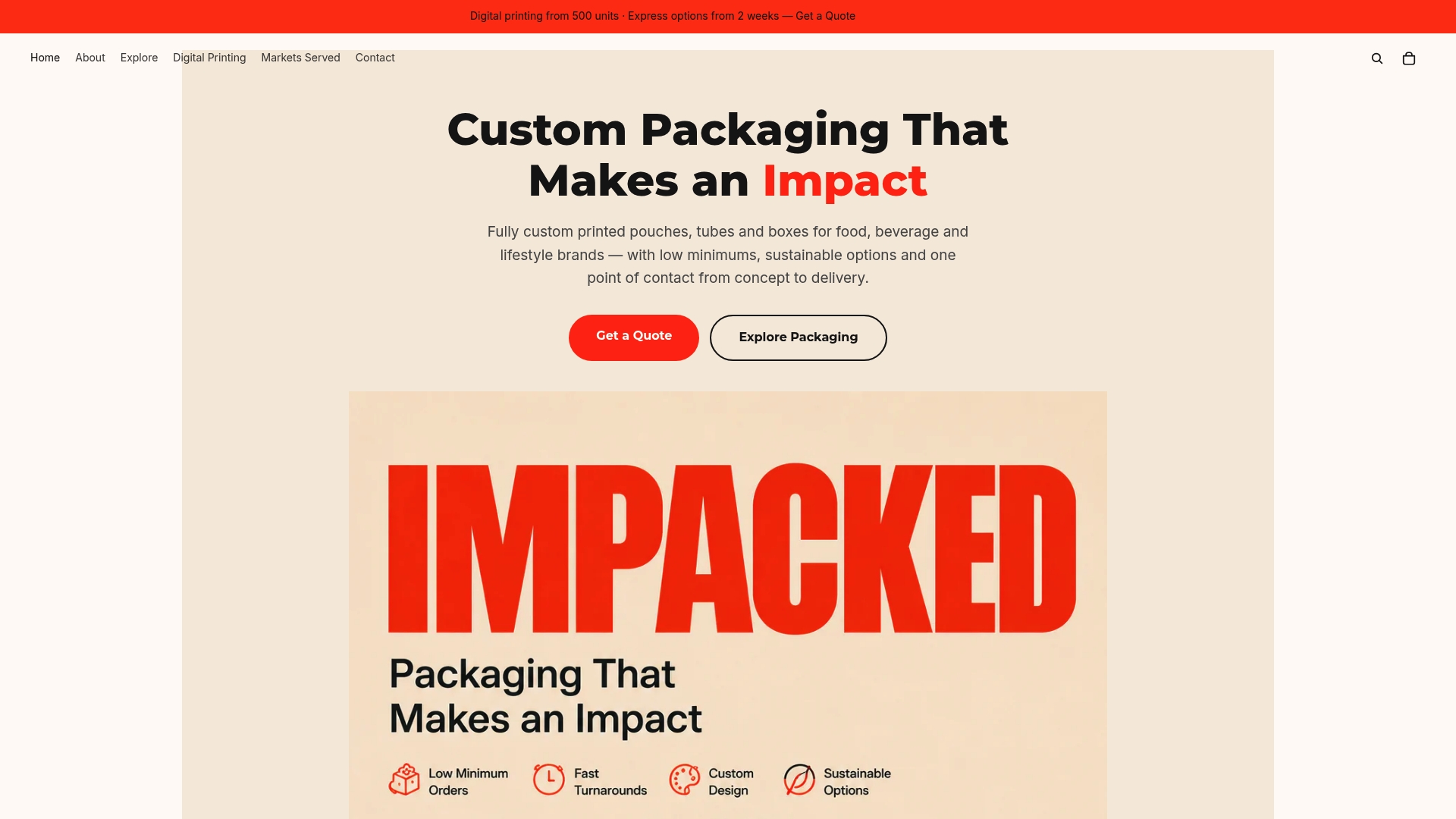
With digital printing and rotogravure options, minimum orders starting at 1,000 units, and production as fast as two weeks, Impacked works as an extension of your team rather than a distant vendor. We handle stand-up pouches, flexible bags, tubes, boxes, and roll film across food, beverage, pet food, seafood, and lifestyle categories. Every project includes design and dieline support, a single point of contact, and access to recyclable and compostable materials. Ready to see what your packaging could look like? Get a quote and we will build a solution around your product, your timeline, and your brand.
Key Takeaways
Digital printing makes custom flexible packaging accessible to brands at any scale, with MOQs as low as 1,000 units and turnarounds as fast as 10 business days for roll stock.
| Point | Details |
|---|---|
| Digital MOQs vs. traditional | Digital printing starts around 1,000 units; rotogravure requires 10,000 or more to be cost-effective. |
| Turnaround benchmark | Roll stock ships in as few as 10 business days; finished pouches typically take 15 business days after artwork approval. |
| Sustainability advantage | Flexible packaging uses less water and energy to produce and transport than rigid packaging formats. |
| SKU flexibility | No plates or cylinders means multiple designs run in one session with no added tooling cost. |
| Impacked’s offer | Orders start at 1,000 units with a single point of contact, design support, and sustainable material options. |