

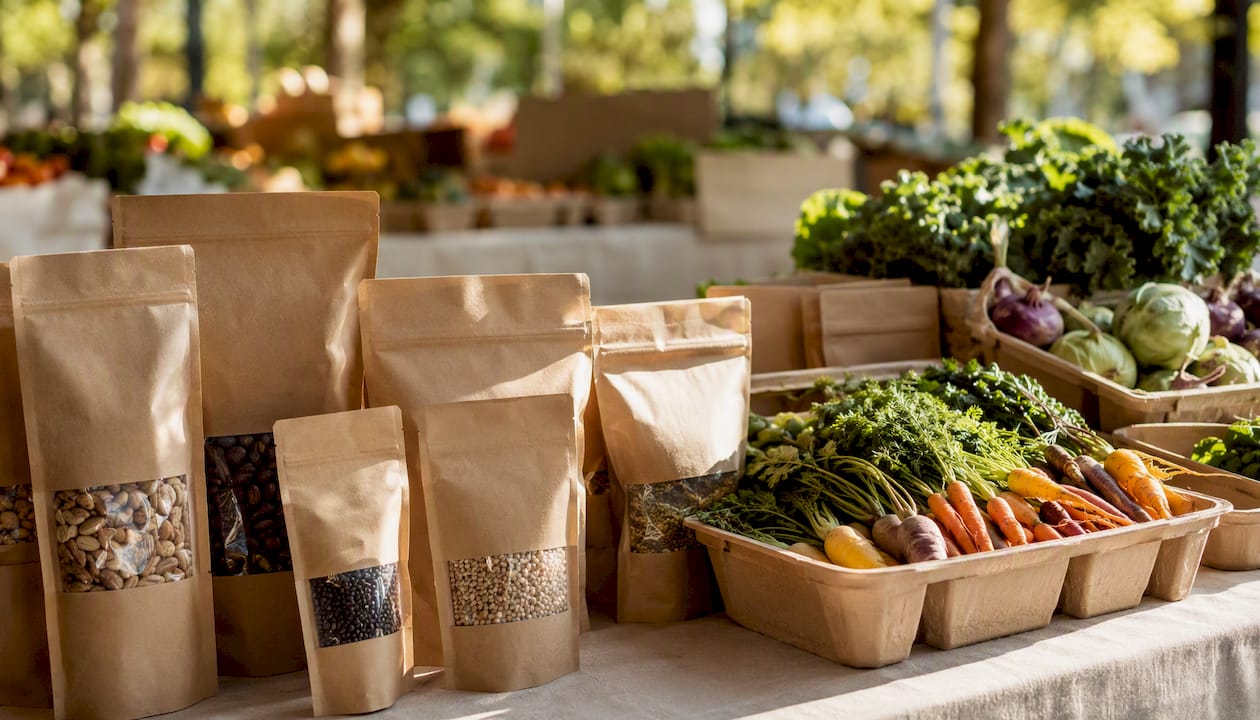
For most farmers market stalls, two formats cover the majority of products well: clear poly or cellophane bags for baked goods, fresh herbs, and snacks, and kraft stand-up pouches with a die-cut window for dry mixes, granola, coffee, and spice blends. Add glass jars for preserves and honey, and you have a cohesive, professional-looking booth without overcomplicating your inventory. Each of these formats balances product visibility, reasonable per-unit cost, and enough durability to survive a market day.
- Clear poly/cellophane bags: Low cost, high visibility, and widely available off the shelf. Customers see exactly what they are buying, which drives impulse purchases at a busy stall.
- Kraft pouches with a window: Combine an artisan look with practical shelf presence. Windowed kraft pouches typically run at a reasonable wholesale cost compatible with small vendors and work well for anything dry.
- Glass jars: Reusable, premium-feeling, and ideal for preserves, sauces, and honey. Higher per-unit cost, but customers often perceive higher value and return the jars.
For vendors who want printed, brandable, sustainable packaging without a large upfront commitment, Impacked offers custom flexible packaging with minimums starting at 500 units, design support, and compostable or recyclable material options.
Key Takeaways
The most practical approach to farmers market packaging is to start with one or two formats that maximize visibility and fit your margins, test samples before committing to volume, and upgrade to custom printing once you know what works.
| Point | Details |
|---|---|
| Start with two formats | Clear bags for baked goods and windowed kraft pouches for dry goods cover most stall products efficiently. |
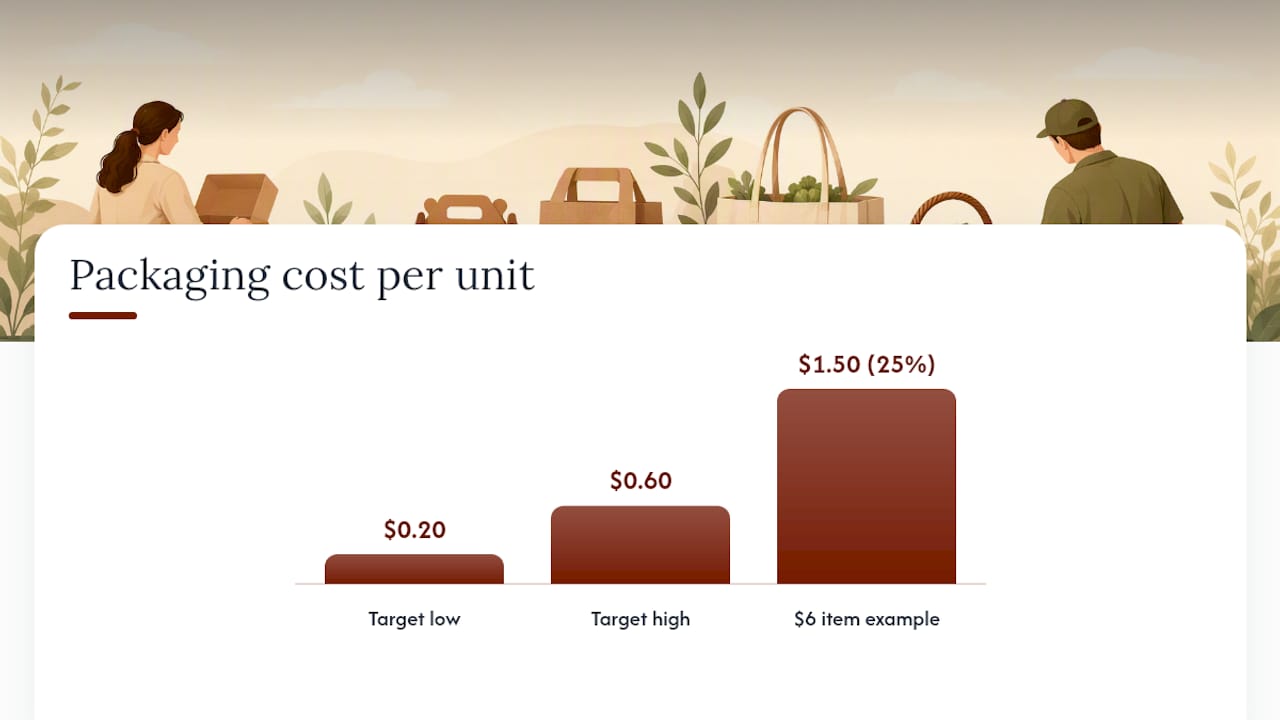
| Target $0.20–$0.60 per unit | Keeping packaging cost in this range protects margins on most low-price market items. |
| Verify sustainability claims | BPI certification confirms industrial compostability; check local composting infrastructure before making claims. |
| Label every package correctly | Include product name, ingredients, allergens, net weight, and vendor location at minimum on every item. |
| Impacked for custom upgrades | Low MOQ from 500 units, sustainable material options, and design support make custom printing accessible for small vendors. |
Table of Contents
- What packaging types work best for farmers market vendors?
- Which materials are actually sustainable for market packaging?
- How do you choose the right packaging for your stall?
- What do you need on your label to sell legally at a farmers market?
- How do you order packaging with low minimums and fast turnaround?
- How do you keep produce safe and presentable from farm to stall?
- Why small-batch custom packaging is worth the investment
- Custom packaging for market vendors, starting at 500 units
- Sources
What packaging types work best for farmers market vendors?
Matching your format to your product is the single most practical decision you will make at the stall. The wrong container does not just look off; it can damage product, confuse customers, or eat into your margins.
| Format | Sustainability | Visibility | Durability | Cost / MOQ / Lead Time | Best Use |
|---|---|---|---|---|---|
| Clear poly/cellophane bags | Recyclable (check #4 LDPE) | High | Low-medium | Low / 500+ / 1–2 wks | Baked goods, herbs, snacks |
| Kraft pouches with window | Recyclable/compostable options | Medium-high | Medium | Medium / 500+ / 2–4 wks | Dry mixes, granola, coffee, spice blends |
| Molded-fiber clamshells | Compostable (BPI-certified options) | Medium | Medium | Medium / 500+ / 2–4 wks | Berries, cherry tomatoes, mushrooms |
| Bakery boxes (kraft/white) | Recyclable paperboard | Low (opaque) | Medium-high | Medium / — / 1–3 wks | Pies, cakes, pastries |
| Glass jars/bottles | Reusable, infinitely recyclable | High | Low (fragile) | High / — / immediate | Preserves, honey, sauces |
| Reusable rigid crates | Reusable polypropylene | Medium | Very high | High upfront / low ongoing | Bulk produce transport and display |
| Paper bags (flat or SOS) | Recyclable | Low | Low | Low / — / 1 wk | Secondary carry bags, wrapping |
Good packaging must protect the product, communicate your brand, and support your environmental goals, as outlined in the Farmers Market Toolkit’s labeling guidance. Choosing a format that fails on even one of those roles costs you more than the packaging itself.
Pro Tip: Start with just one or two formats and use them consistently across your whole table. A unified look reads as professional and intentional, even if the packaging is simple.
Which materials are actually sustainable for market packaging?
The word “sustainable” covers a wide range of materials with very different real-world outcomes. Here is what each category actually means for your stall and your customers.
Paper and paperboard are the most practical starting point. They are widely recyclable in U.S. curbside programs, and the global sustainable packaging market shows paper and paperboard growing faster than most other material segments, driven largely by food and beverage applications. Kraft paper in particular fits the farmers market aesthetic naturally.
Compostable bioplastics (PLA and PBAT) look like plastic but are designed to break down under specific conditions. The critical distinction: most require industrial composting at temperatures above 140°F. A BPI-certified compostable bag in a home compost pile or a landfill will not break down as intended. Look for the BPI certification (Biodegradable Products Institute) for industrial compost, or the OK Compost Home mark if you want a material that breaks down in a backyard pile.
Recyclable plastics (PET, HDPE, LDPE) are familiar and low-cost, but recyclability depends entirely on local infrastructure. LDPE (#4) bags are accepted at many grocery store drop-off points, not curbside. PET (#1) clamshells are more broadly recyclable. For vendors who want to make a credible sustainability claim, the USDA BioPreferred program provides a label for bio-based products that meet verified content thresholds.
Glass is infinitely recyclable and reusable, but weight and fragility add real transport risk. For preserves and honey, the premium perception often justifies the cost.
The trade-off that catches vendors off guard: clear mono-plastics show product beautifully but carry a weaker sustainability story. Opaque kraft looks sustainable but hides the product. Windowed kraft pouches split the difference, and eco-friendly packaging materials in compostable or recyclable films can now achieve that same windowed look with a cleaner end-of-life story.
The global sustainable packaging market was estimated at USD 272.93 billion in 2023 and is projected to grow steadily through the decade. Customers at farmers markets are ahead of that curve; they notice and reward vendors who make credible material choices.
Pro Tip: Before committing to compostable packaging, check whether your city or county has an industrial composting facility that accepts food-contact materials. If it does not, a recyclable paper option may be the more honest choice for your customers.
How do you choose the right packaging for your stall?
The four-criteria framework used by experienced vendors keeps decisions simple and defensible: visibility, professional presentation, practical construction, and reasonable cost.
Run every packaging candidate through these four questions before you order:
- Will it show the product? Customers at a busy market make split-second decisions. Transparent or windowed packaging lets product quality sell itself.
- Does it look intentional and professional? Mismatched formats, handwritten labels on plain bags, and flimsy containers all signal low effort. Consistent format and a clean label fix this at minimal cost.
- Will it survive the trip? Consider how the product travels from your farm to the stall, how it sits in a cooler or crate, and how a customer carries it home. A leaking jar or a crushed bakery box is a lost repeat customer.
- Does it fit your margins? Targeting $0.20–$0.60 per unit for most low-price items keeps packaging from eroding profit. Spending $1.50 on packaging for a $6 item consumes roughly 25% of revenue before you account for any other cost.
On supplier questions, always ask: What is the minimum order quantity? Do you offer samples before a full run? What is the lead time for custom printing versus stock items? Do you carry FSC-certified or BPI-certified materials? Is express production available?
Pro Tip: Order a sample run of 50–100 units before committing to 500 or more. Fill them with your actual product, stack them, refrigerate them overnight, and carry them in a tote bag. Real-world testing surfaces problems that a spec sheet never will.
What do you need on your label to sell legally at a farmers market?
Most small farmers market vendors are exempt from federal mandatory nutrition labeling, but that exemption does not mean labels are optional or that any claim goes. The Farmers Market Toolkit’s packaging and labeling guidance is clear: verified allergen, ingredient, and certification information increases product value and requires proper validation.
At minimum, every packaged product should carry:
- Product name (common or usual name)
- Vendor or farm name and location (city and state at minimum)
- Ingredient list in descending order by weight
- Net weight or count
- Allergen declaration for the Big Nine (milk, eggs, fish, shellfish, tree nuts, peanuts, wheat, soybeans, sesame)
- Any certification claims (organic, non-GMO, BPI-certified compostable) backed by the issuing agency’s documentation
Nutrition panels are not required for most small vendors, but making nutrient claims (“high in fiber,” “low sodium”) without a verified analysis triggers FDA labeling rules. Stick to descriptive language about ingredients and process rather than health claims unless you have the lab data to back them.
For perishables, add a use-by or best-by date and basic storage instructions (“refrigerate after opening,” “keep frozen”). State-specific cottage food laws vary significantly; always confirm requirements with your local health department before your first market.
Pro Tip: Design one clean label template in Canva and print it on Avery 8163 or 5163 sheets at home. Use a font no smaller than 8pt for ingredient text and test readability at arm’s length. Consistent, legible labels do more for perceived professionalism than any premium box.
How do you order packaging with low minimums and fast turnaround?
Off-the-shelf packaging from food service suppliers like WebstaurantStore ships quickly with no minimum, which makes it a practical starting point for new vendors. Custom-printed packaging requires more planning.
Typical MOQ bands for custom printing run at 500, 1,000, or 2,500 units depending on the supplier and print method. Digital printing tends to support lower minimums and shorter runs; rotogravure and offset printing offer better per-unit economics at higher volumes but require larger commitments. Lead times for custom orders generally run 2–4 weeks for digital and 4–8 weeks for gravure, plus shipping time from overseas production.
Before approving any full run, request a physical sample and a dieline. A dieline is the flat template showing exactly where your artwork will print, fold, and seal. Approving without one is how vendors end up with logos cut off at the seam or text that disappears into a gusset fold.
Key questions to ask during a quote: Can you provide a pre-production sample? What is your proofing process? Do you offer FSC-certified or BPI-certified material options? What is the express production timeline if I need faster turnaround?
Impacked supports vendors and small brands with custom packaging starting at 500 units, design and dieline support, sustainable material options, and express production as fast as two weeks. For vendors exploring pouch samples before committing to a full run, requesting samples early in the process is straightforward.
How do you keep produce safe and presentable from farm to stall?
Packaging only works if it survives the journey. A few practical habits protect both product quality and your booth’s visual appeal.
At the booth:
- Use risers to create height variation and group formats together so the table reads as organized rather than cluttered.
- Keep windowed pouches and clear bags facing forward so product is visible from across the aisle.
- Restock from the back; never pile new product on top of handled items.
Transport and storage:
- Polypropylene corrugated crates offer moisture resistance, stackability, and reusability that reduce damage during transit. They are worth the upfront cost for vendors moving significant produce volume weekly.
- Pack berries and delicate items in molded-fiber clamshells, then layer clamshells in a rigid crate with no more than two layers deep.
- Keep jars and liquid items in a separate, padded bin with a lip to contain any leaks.
- Greens need ventilation; perforated bags or vented clamshells prevent condensation and wilting.
Day-of checklist:
- Extra labels and a marker for last-minute price changes
- Tape and scissors
- A cooler with ice packs for anything perishable
- Tissue paper or liners for bakery items
- A small supply of secondary carry bags for customers
Pro Tip: Print a simple “keep refrigerated” or “best enjoyed within 3 days” instruction directly on your label or as a small sticker. Customers who store product correctly come back; customers who don’t, often blame the product.
Why small-batch custom packaging is worth the investment
There is a version of the packaging conversation that focuses entirely on cost minimization, and it misses the point. Packaging at a farmers market is not just containment; it is the first signal a customer reads before they taste anything.
Vendors who invest modestly in consistent, branded packaging, even at 500 units with a simple two-color print, tend to see a meaningful difference in how customers handle and perceive the product. A kraft pouch with a clean logo and a clear window communicates care and craft. A plain bag with a handwritten sticker communicates improvisation, regardless of how good the product inside actually is.
The four criteria (visibility, presentation, construction, and cost) are not in conflict when you approach them in the right order. Start with visibility and presentation, because those drive the sale. Then confirm construction holds up under real transport conditions. Finally, work backward to a per-unit cost that fits your margins. Starting from cost and working forward almost always produces packaging that undersells the product.
Small-batch custom runs also give you the flexibility to test a design before committing to thousands of units. A 500-unit run at a slightly higher per-unit cost is a reasonable investment in learning what resonates with your customers before scaling up.
Custom packaging for market vendors, starting at 500 units
Vendors who are ready to move beyond off-the-shelf bags and toward packaging that actually represents their brand have a practical option in Impacked. We work with small and growing food brands on custom flexible packaging and digital printing with minimums starting at 500 units, so you are not locked into a 5,000-unit commitment before you know a design works.
Our material options include recyclable and compostable films, FSC-certified paperboard, and barrier pouches suited to dry goods, fresh produce, and prepared foods. Design support and dieline review are part of the process, and express production timelines as fast as two weeks are available for urgent orders. Whether you are sourcing stand-up pouches for a granola blend, windowed kraft bags for a spice line, or sustainable food packaging that holds up to the scrutiny of a market-savvy customer base, we can help you get there without a large upfront commitment.
Request a quote or samples to see material options, pricing, and lead times for your specific product.
Sources
- Packaging and Labeling for your Farmers Market Food Business
- Best Food Packaging Ideas for Farmers Market Vendors
- How to Choose the Best Produce Containers for Farmers Markets - SeaCa Plastic Packaging
- The Global Sustainable Packaging Market — ResearchAndMarkets