

A one-way degassing valve does one thing well: it lets CO2 escape from freshly roasted coffee while blocking oxygen and moisture from getting back in. For most U.S. roasters sealing bags within 24 hours of roast, or packaging anything above 8 oz for retail, a valve is not optional — it is the difference between a bag that arrives fresh and one that bloats, ruptures, or stales before it reaches the customer.
Quick action points:
- Use a valve for retail bags above 8 oz, any whole-bean or ground coffee sealed within 24 hours of roast, and all export or long-shelf-life SKUs.
- Skip the valve for single-serve portions, very short local distribution with a 2–3 day sell-through, or nitrogen-flushed vacuum packs where degassing is complete before sealing.
- For custom valve-equipped pouches with low MOQs, Impacked’s coffee packaging offers recyclable and compostable film options starting at 500 units, with food-contact materials that align with FDA expectations and film laminates tested to ASTM standards.
Table of Contents
- How do coffee bag valves actually work?
- When should you use a valve on your coffee bags?
- What valve specs should you request from suppliers?
- How do you source valve-equipped bags in the U.S.?
- Key Takeaways
- The case for getting valve specs right before you print
- Custom valve-equipped coffee bags, built around your brand
- Useful sources for roasters
How do coffee bag valves actually work?
A degassing valve, technically called a one-way pressure-relief valve, is a small disc or diaphragm assembly heat-sealed or adhesive-bonded to the bag’s outer film. The core components are a housing (usually polypropylene), a flexible disc or membrane, and in many versions a filter media layer that keeps fine coffee particles from clogging the port.
When internal CO2 pressure builds past the valve’s cracking threshold, the disc lifts slightly and gas vents to the outside. The moment pressure equalizes, the disc reseats against the housing, sealing the port. That reseating action is what keeps oxygen out. According to America’s Test Kitchen, the valve continues to benefit consumers after purchase: resealing the bag after opening lets residual CO2 displace oxygen and maintain a protective atmosphere inside.
Without a valve, freshly roasted coffee generates enough CO2 to bloat and potentially rupture a sealed bag within hours. Valves prevent that structural failure while also slowing oxidation, preserving volatile aromatics, and extending shelf life compared to valveless packs. Food-contact compliance falls under FDA regulations for indirect food additives; reputable valve suppliers provide documentation confirming their materials meet those requirements.
When should you use a valve on your coffee bags?
As ePac explains, valves are not universally necessary. The right call depends on five variables: package size, roast-to-pack timeline, grind state, expected shelf life, and distribution distance.
Use a valve when:
- You seal bags within 24–48 hours of roast
- Your retail bags are 8 oz or larger
- You are shipping ground coffee (which degasses faster than whole beans, typically within 2–3 days versus 5–7 days for whole beans)
- Shelf life targets exceed 3 months
- You are exporting or shipping across the country
Consider going valveless when:
- You sell locally with a sell-through under one week
- Coffee is rested 7–10 days post-roast before sealing (degassing largely complete)
- You use nitrogen flush or vacuum sealing with modified atmosphere packaging (MAP)
- Single-serve portions where the consumer uses the full bag immediately
Barista Magazine’s analysis of valveless formats notes that valveless bags are gaining traction for short-run and local sales, but valves remain the standard for exports and longer shelf lives. For a 1-lb retail bag going to a distributor, a valve is still the right call.
Quick decision checklist:
- Are you sealing within 48 hours of roast? → Valve required.
- Is the bag 8 oz or larger? → Valve strongly recommended.
- Is the expected shelf life more than 60 days? → Valve required.
- Are you shipping ground coffee more than 500 miles? → Valve required.
- None of the above? → Evaluate MAP or vacuum fill as alternatives.
What valve specs should you request from suppliers?
Valve size, cracking pressure, and material are the three specs that matter most on an RFQ. PackagingBest’s technical guide covers all six variables that determine valve choice and provides the cracking-pressure range most suppliers work within: a standard low cracking pressure suitable for coffee degassing. Ask any supplier to certify the cracking pressure on their spec sheet and confirm the valve reseats immediately after pressure release.
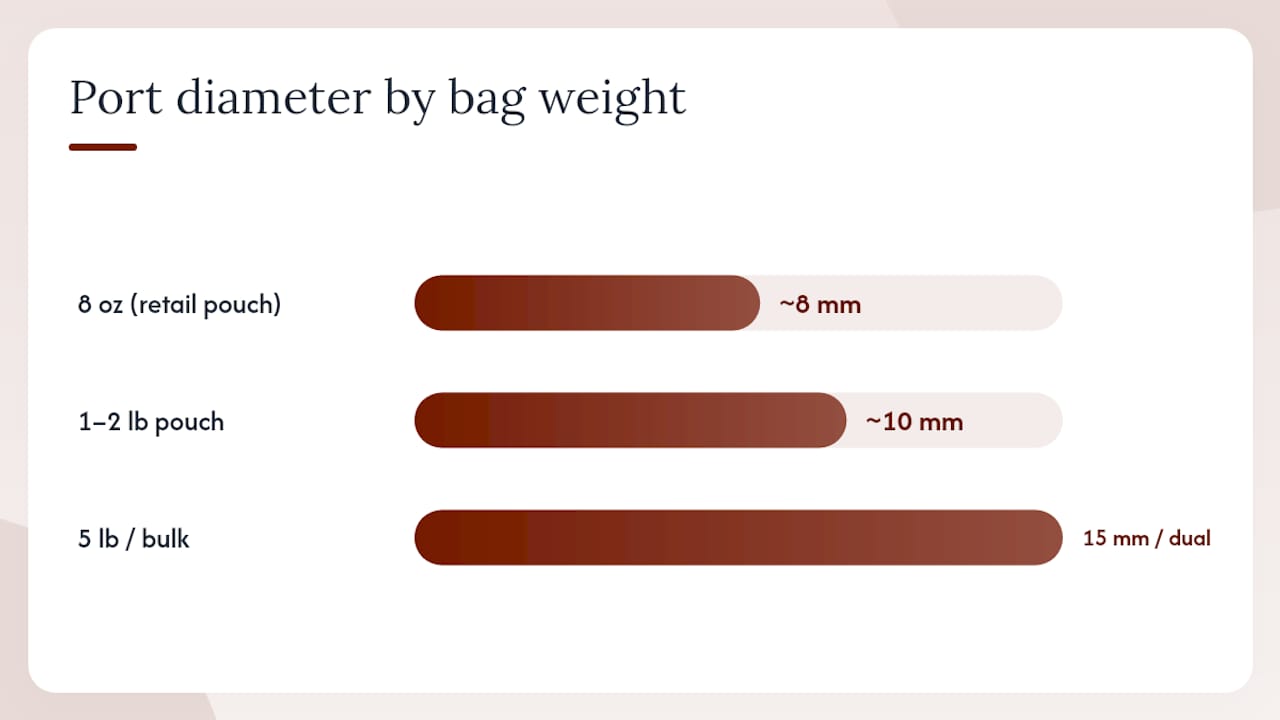
Port size by bag fill weight:
| Bag Fill Weight | Recommended Port Diameter | Notes |
|---|---|---|
| 8 oz | ~8 mm | Standard for most retail pouches |
| 1–2 lb | ~10 mm | Higher flow rate for larger headspace |
| 5 lb / bulk | 15 mm or dual valve | Handles rapid initial degas volume |
Material options:
- PE/PP valves: Most common, cost-effective, food-contact compliant. Recyclable when the film is also PE/PP (check end-of-life compatibility).
- PLA/biopolymer valves: Compostable options exist; confirm industrial vs. home compostability certification before making claims.
- Filter membrane: Nylon or polyester filter layer inside the valve housing prevents ground coffee fines from blocking the port. Required for pre-ground SKUs; optional for whole bean.
Attachment methods:
- Heat-seal integration: Built into the pouch during lamination; cleanest cosmetic result, no adhesive failure risk.
- Pressure-sensitive adhesive (PSA): Applied post-lamination; compatible with most film types but requires surface energy testing.
- In-line applicator bonding: Applied during form-fill-seal; fastest for high-volume lines.
For flexible film laminates, confirm the valve adhesive is rated for the specific film surface energy — matte finishes and high-barrier metallized films can reduce adhesion strength.
How do you source valve-equipped bags in the U.S.?
For most small-to-mid roasters, the fastest path is ordering custom pre-made pouches with valves pre-installed. Rovema’s production guidance reinforces that roast-to-pack timing often drives the valve spec decision, so locking in your timeline before requesting samples is worth doing.
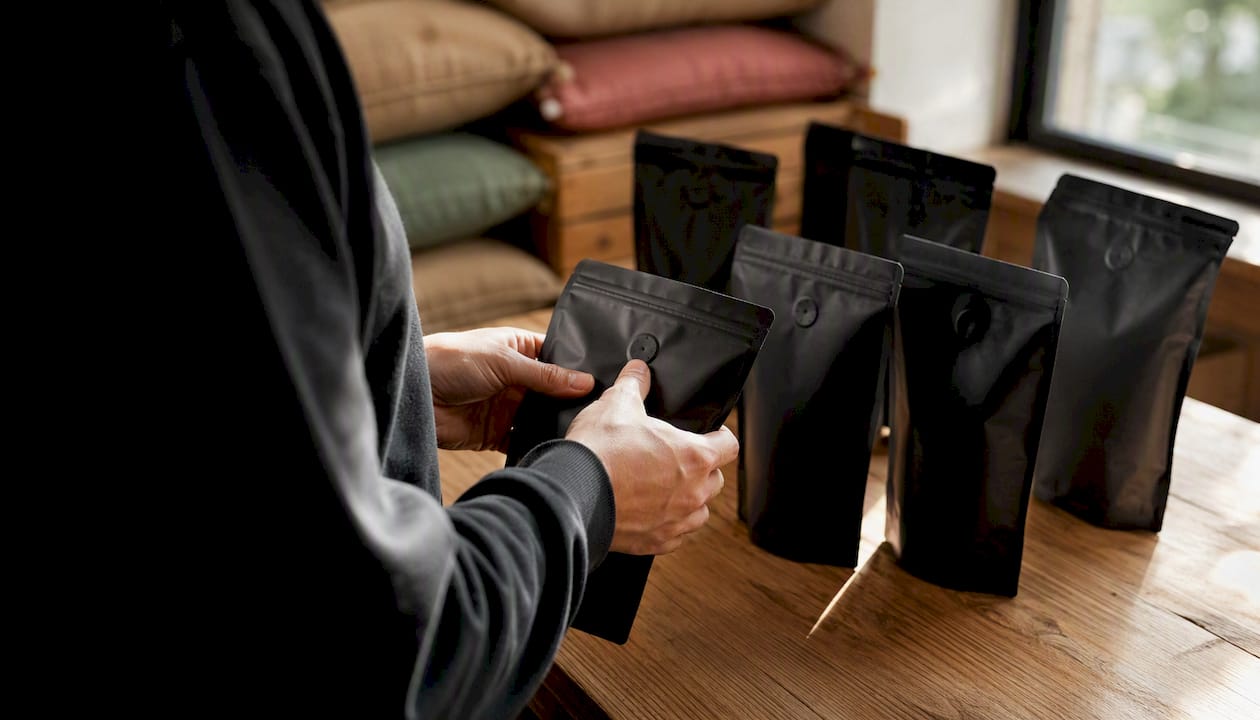
What to expect on MOQ and lead times:
| Order Type | Typical MOQ | Lead Time | Price Shape |
|---|---|---|---|
| Stock valve pouches (no print) | 500 units | 1–2 weeks | Lowest per-unit cost |
| Custom printed, pre-installed valve | 500 units | 3 weeks | Mid-range; driven by print complexity |
| Express custom (digital print) | 500 units | 2 weeks | Premium for speed |
Impacked offers custom valve-equipped coffee pouches starting at 500 units, with express production as fast as 2 weeks for digital print runs. That low MOQ matters when you are testing a new SKU or seasonal blend before scaling.
What to request with every sample order:
- Coffee bag valve: what it is and how it helps - America’s Test Kitchen
- Why Coffee Bags Have Vents: The Valve Truth Roasters Miss - PackagingBest
- Coffee Valve - Plitek
- Degassing valves: what are they and are they necessary for coffee packaging? - ePac
- What Is a Coffee Bag Valve? Meaning & Function - YamiPak Coffee
- 3 reasons degassing valves are important to coffee packaging - Rovema
- No Valve, No Problem: The Rise of Valveless Coffee Bags - Barista Magazine
Sample request template (send to any supplier):
Key Takeaways
A one-way degassing valve is the right choice for any retail coffee bag above 8 oz sealed within 48 hours of roast — and the cracking pressure, port size, and material must match your specific fill weight and grind state.
| Point | Details |
|---|---|
| Use valves for most retail bags | Any bag above 8 oz sealed within 48 hours of roast needs a one-way degassing valve. |
| Cracking pressure is the critical spec | Request supplier certification for standard low cracking pressure and confirm instant reseating. |
| Match port size to fill weight | Use ~8 mm for 8 oz bags, ~10 mm for 1–2 lb bags, and 15 mm or dual valves for bulk. |
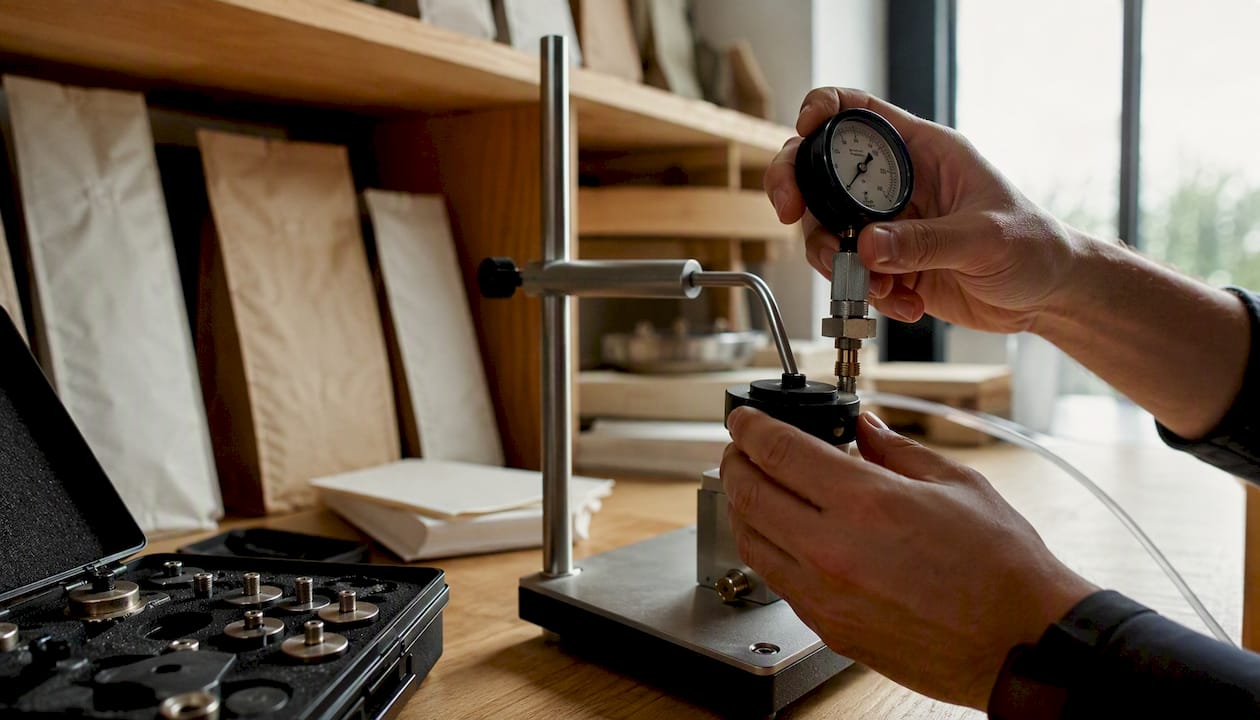
| Run a water-immersion test on every sample | Submerge a sealed bag for 30 seconds to confirm no air ingress before committing to a full run. |
| Impacked for low-MOQ custom pouches | Impacked supplies valve-equipped custom coffee bags from 500 units with recyclable film options. |
The case for getting valve specs right before you print
Most small roasters we work with focus heavily on bag design and almost skip the valve conversation entirely — until a shipment arrives bloated or a retail buyer flags a quality issue. The valve spec is a production decision, not a cosmetic one, and it deserves the same attention as your film barrier or print finish.
There is also a sustainability dimension that gets underplayed. Choosing a PE/PP valve on a PE/PP film structure keeps the whole bag recyclable through store-drop-off programs. Mixing a PLA valve onto a non-compostable film creates a recycling problem, not a solution. Getting that material match right from the start is far easier than reprinting 10,000 bags after a sustainability audit. For roasters curious about the flavor science behind degassing itself, Z’s Coffee’s guide to coffee degassing is a useful read for understanding what you are actually protecting.
The other thing worth saying plainly: valveless formats are a legitimate choice for the right roaster. If you are selling direct-to-consumer with a 5-day sell-through and resting your coffee 7 days post-roast, a valve adds cost without adding freshness. But if you are building a retail brand with 90-day shelf life targets, there is no substitute.
Custom valve-equipped coffee bags, built around your brand
Roasters who need valve-equipped packaging without a 10,000-unit commitment have a clear path with Impacked. We supply fully custom printed coffee pouches with pre-installed one-way degassing valves, starting at 500 units, with express production as fast as 2 weeks for digital print runs.
Every order includes design and dieline support, material guidance for recyclable and compostable film options, and a single point of contact from spec to delivery. We work with stand-up pouches, flat-bottom bags, and side-gusset formats across a range of barrier levels, so your valve spec and film structure are matched from the start rather than retrofitted. Get a quote and tell us your fill weight, roast-to-pack timeline, and shelf life target — we will recommend the right valve and film combination for your SKU.
Useful sources for roasters
- America’s Test Kitchen: Coffee bag valve explained — Consumer-facing explainer on valve function and post-purchase freshness benefits.
- PackagingBest: Why coffee bags have vents — Technical breakdown of cracking pressure, port sizing, and the six variables that determine valve choice.
- Plitek: Coffee valve technical resources — Valve applicator system specs, throughput rates, and application method details.
- ePac: Degassing valves explained — Clear overview of when valves are and are not necessary, with production context.
- YamiPak: Coffee bag valve guide — Materials, sustainability options, and QA testing methods.
- Rovema: Degassing valves and production lines — Production-line perspective on valve necessity and roast-to-pack timing.
- Barista Magazine: The rise of valveless coffee bags — Analysis of when valveless formats work and where valves remain the standard.