

Box bottom bags are the strongest shelf packaging format available in flexible packaging today. Built from five panels sealed at eight distinct points, they stand upright without support, hold their shape under pressure, and give your brand four full printable sides plus a base panel. For retail and food brands, that combination of stability and print real estate is hard to match with any other flexible format.
The top suppliers in the US market each bring a distinct angle. ClearBags leads on variety and accessibility, with clear and kraft options plus free samples. Roastar focuses on food-grade performance with advanced closures like degassing valves and zip locks. North Atlantic Bags delivers durable, stylish packaging across an extensive size range. Impacked specializes in fully custom printed bags with low minimum order quantities and sustainable material options, starting at 500 units.
| Supplier | Material Type | Key Features | Sizes Available | Min. Order Qty | Best For |
|---|---|---|---|---|---|
| ClearBags | Clear, Kraft, heat-sealable | Tin tie, zipper handle, window, quad seal | Small to large (candy to coffee) | Low (retail packs) | Transparency and closure variety |
| Roastar | Food-grade laminates, matte | Degassing valve, zip lock, window | Multiple standard sizes | Custom runs | Specialty food and coffee brands |
| North Atlantic Bags | Kraft, matte finishes, laminates | Zipper, window, tin tie | Extensive range | Moderate | SMBs wanting durable, branded packaging |
| Impacked | Recyclable, compostable, custom films | Full custom print, valve, zipper, window | Custom dimensions | 500 units | Food and beverage brands with sustainability goals |
The flat bottom format, also called a block bottom or 8-side seal bag in the industry, signals a premium product tier. Specialty coffee roasters, snack brands, and pet food producers have adopted it specifically because retail buyers and consumers read the format as a step above standard stand-up pouches.
How do the top box bottom bag suppliers compare?
The four suppliers above cover the full spectrum from off-the-shelf retail packs to fully custom printed production runs, but their strengths diverge sharply once you look past the format itself.

ClearBags carries one of the widest ready-to-ship selections in the US market. Their box bottom gusset bags come in clear, kraft-backed, matte black, and silver finishes, with sizes ranging from small candy bags to coffee bags. Closure options include tin ties, zipper handles, and quad seals. The bags are food safe and heat sealable, and ClearBags offers free samples, which is a genuine advantage when you need to test a size before committing to a bulk order. Their flat bottom line also includes home compostable options with paper inserts.
Roastar targets specialty food brands that need functional closures built for product freshness. Their bags are food-grade certified and support degassing valves for coffee, resealable pocket zippers, and clear windows. The pocket zipper sits recessed inside the bag, protecting it from contamination and giving the exterior a clean finish. For coffee roasters or premium snack brands where closure performance directly affects product quality, Roastar’s feature set is purpose-built.
North Atlantic Bags covers a broad size range with an emphasis on durable materials and matte finishes. Their bags suit SMBs that want a polished, branded look without moving into full custom print territory. Kraft paper and matte laminate options give brands a natural or premium aesthetic depending on the product category.
Impacked operates differently from the other three. Rather than selling stock bags, Impacked produces fully custom printed flat bottom bags with your artwork across every panel, including the base. Orders start at 500 units, which lets growing brands test a design before scaling up. Sustainable film options include recyclable and compostable materials, and every order comes with a dedicated account manager from concept to delivery. For food and beverage brands that want packaging to carry their full brand identity, that combination of low MOQ and custom printing is the clearest differentiator in this group.
Trust signals across suppliers:
- Free samples: ClearBags and Roastar both offer sample programs; confirm availability directly with North Atlantic Bags and Impacked before ordering
- Bulk discounts: all four suppliers reduce per-unit pricing at higher volumes; the threshold varies by material and print complexity
- Customer support: ClearBags and Roastar publish direct support channels; Impacked assigns a single point of contact per account
How to choose the right flat bottom bag for your product
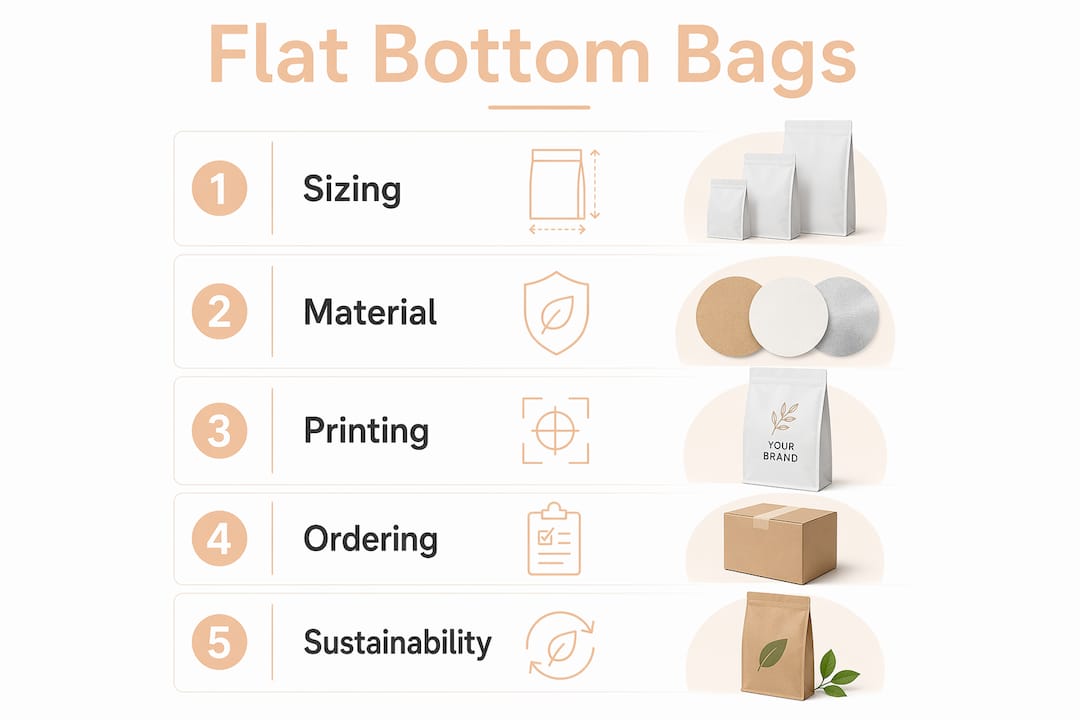
The format is consistent across suppliers, but the right bag for your product depends on five variables that interact with each other.
Key selection criteria:
- Product type and weight: Dense products like whole-bean coffee or pet kibble need heavier barrier films and stronger seals. Lighter snacks or candy can use thinner laminates.
- Barrier requirements: Products sensitive to oxygen, moisture, or light need metalized or aluminum laminate films. Clear films work for products that benefit from visibility but offer lower barrier performance.
- Closure system: Degassing valves are standard for fresh-roasted coffee. Resealable zippers suit snacks and supplements. Tin ties work for bakery and dry goods where a clean, simple closure is preferred.
- Branding space: The five-panel structure gives you front, back, two sides, and a base. If your brand story needs room, this format delivers it. A custom packaging strategy that uses all five panels consistently outperforms single-face designs on shelf.
- Sustainability goals: Recyclable mono-material films and compostable options are available, but not every eco-friendly film supports all closure types.
For sizing, match the bag dimensions to your fill weight with a small buffer. A 250g coffee bag typically runs around 5" x 3" x 8", while a 1kg bag needs closer to 6" x 4" x 12". Most suppliers publish standard size charts, and custom dimensions are available through Impacked and Roastar for brands with non-standard fill weights.
Pro Tip: Before finalizing a sustainable film, ask your supplier to confirm zipper and valve compatibility in writing. Some compostable films cannot bond reliably with standard zipper tracks, and discovering that after production is costly.
Shipping requirements also affect your choice. Flat bottom bags stack efficiently and palletize well, but heavier laminates add weight per unit. For brands shipping direct-to-consumer, lighter recyclable films reduce freight costs without sacrificing shelf appeal.
What does ordering, pricing, and lead time look like?
Pricing for custom flat bottom bags depends on four factors: material choice, bag size, print complexity, and order volume. Heavier barrier films and full-color rotogravure printing cost more per unit than digital printing on lighter stock. Bulk orders reduce the per-unit cost across all suppliers, so brands that can commit to larger runs benefit from better economics.
Minimum order quantities vary by supplier and customization level. Stock bags from ClearBags ship in packs as small as 25 or 50 units, which suits brands testing a size or closure type. Custom printed runs typically start higher. Impacked’s 500-unit minimum is one of the lowest available for fully custom printed bags in the US market, which makes it practical for brands launching a new SKU or seasonal design.
Ordering best practices:
- Request physical samples before placing a production order, especially for new materials or closures
- Confirm FDA food safety compliance for any bag contacting food directly; ClearBags explicitly lists food-safe ratings on their product pages
- Provide print-ready artwork in the supplier’s required format to avoid delays; most suppliers offer dieline templates
- Ask about express production options if your timeline is tight; Impacked offers production as fast as two weeks on select orders
- Clarify palletizing and shipping specs upfront to avoid surprises on freight costs for large orders
Lead times for standard custom orders typically run four to six weeks from artwork approval, depending on the supplier and print method. Digital printing is faster than rotogravure and suits lower-volume runs well. Rotogravure delivers sharper color consistency at high volumes but requires longer setup time.
What sustainability and customization trends should brands know?
The packaging industry has moved well past the simple paper-versus-plastic debate. Brands choosing flat bottom bags today are making decisions across a more complex set of material trade-offs.
Sustainable material options currently available:
- PCR (post-consumer recycled) plastics, which reduce virgin material use while maintaining barrier performance
- Mono-material recyclable films, which are accepted in more curbside programs than multi-layer laminates
- Compostable films certified to ASTM D6400 or EN 13432 standards for industrial composting
- Kraft paper variants, which carry an eco-friendly perception but often require a plastic liner for moisture barrier
The perception point matters. Flat bottom bags in kraft or matte finishes read as premium and sustainable to consumers, even when the inner barrier layer is a conventional laminate. Brands that want to make a genuine sustainability claim need to look at the full material composition, not just the outer surface. Eco-friendly coffee packaging decisions, for example, require balancing compostability with the one-way valve compatibility that keeps coffee fresh.
Impacked’s approach addresses this directly. Their sustainable film options include recyclable and compostable materials, and their account management process includes guidance on which closures are compatible with each film type before production begins. For brands in food, beverage, or pet food packaging, that upstream guidance prevents costly post-production issues.
Pro Tip: Evaluate packaging by its full lifecycle, including whether your customer can actually recycle or compost it at home. A bag labeled “recyclable” that requires a specialized facility offers less real-world impact than a mono-material film accepted in standard curbside programs.
Custom printing trends are moving toward full-bleed artwork across all five panels, with the base panel increasingly used for QR codes, certifications, and brand storytelling. Specialty coffee brands in particular have driven this shift, using the format’s billboard effect to differentiate on crowded retail shelves.
How reliable are box bottom bag suppliers?
Supplier reliability comes down to three things: production consistency, communication, and the ability to resolve issues quickly when they arise.
ClearBags has a long track record in the US retail packaging market and carries a BBB profile that reflects their standing as an established supplier. Their stock bag program means most orders ship without a production lead time, which reduces risk for brands that need inventory quickly.
Roastar and North Atlantic Bags both serve specialty food and retail markets with consistent product quality. Brands ordering custom runs should confirm production timelines and request references or samples from previous orders before committing to a large volume.
Impacked’s model of assigning a single account manager to each project addresses one of the most common complaints in custom packaging: miscommunication between sales, design, and production teams. Having one contact responsible for your order from artwork approval through delivery reduces errors and speeds up resolution when questions arise.
For any supplier, the practical reliability test is simple: ask how they handle a production defect on a completed order, and ask for that answer in writing before you place your first run.
Custom box bottom bags from Impacked, built for your brand
If you’ve reviewed the suppliers above and want fully custom printed packaging without a high minimum order commitment, Impacked offers a direct path. Unlike stock bag suppliers, Impacked produces bags built entirely around your brand, with full-color printing across all five panels, your choice of sustainable or conventional films, and closure options matched to your product.
Orders start at 500 units, express production is available in as little as two weeks, and your account manager handles everything from dieline setup to final delivery. Whether you’re launching a new coffee packaging line, scaling a snack brand, or moving into sustainable flexible packaging, we work closely with you to get the details right before anything goes to print. Get a quote and tell us what you’re building.
Key Takeaways
Box bottom bags deliver the best combination of shelf stability, print area, and customization flexibility available in flexible packaging for retail and food brands.
| Point | Details |
|---|---|
| Five-panel structure | The square base and four side panels give brands more printable surface than any other flexible pouch format. |
| Closure compatibility | Degassing valves, zippers, and tin ties are available, but confirm compatibility with your chosen film before ordering. |
| MOQ and custom printing | Impacked offers fully custom printed bags from 500 units, one of the lowest entry points for custom runs in the US. |
| Sustainability trade-offs | Evaluate full material composition and real-world recyclability, not just surface appearance, when choosing eco-friendly films. |
| Impacked for custom runs | For food and beverage brands wanting tailored packaging with sustainable options and low MOQs, Impacked is the strongest fit. |