

What is a Mylar bag, and why does it matter for preservation?
A Mylar bag is a multilayer laminate pouch built from biaxially oriented polyethylene terephthalate (BoPET), aluminum foil, and a polyethylene (PE) inner layer. Together, these materials create a barrier that blocks oxygen, moisture, light, and odors with a level of effectiveness that standard plastic bags simply cannot match. The primary application is long-term dry food storage, where protecting contents from spoilage factors over years, or even decades, is the goal.
The term “Mylar” itself comes from a DuPont trademark for BoPET film, though today it’s used broadly to describe any laminate barrier bag built around this polyester film structure. Britannica defines Mylar as a versatile plastic film composed of the polyester polyethylene terephthalate, and that foundation is exactly what gives these bags their strength.
Key features at a glance:
- Multilayer laminate construction (BoPET + foil + PE)
- Blocks oxygen, moisture, light, and odors
- Capable of holding a partial vacuum when sealed, increasing protection against spoilage
- Suitable for dry food storage for up to 25–30 years when used with oxygen absorbers
- Available in a wide range of sizes and thicknesses
- Resealable and heat-sealable options available
| Feature | Benefit |
|---|---|
| BoPET outer layer | High tensile strength and dimensional stability |
| Aluminum foil middle layer | Blocks light, oxygen, and moisture |
| PE inner layer | Food-safe sealing surface, moisture resistance |
| Partial vacuum capability | Reduces oxidation and spoilage risk |
| Long shelf life potential | Up to 25–30 years for properly stored dry foods |
Table of Contents
- How the layers of a Mylar bag work together
- Why Mylar bags outperform regular packaging for preservation
- How to seal and use Mylar bags correctly
- How long can you actually store food in Mylar bags?
- How to choose the right Mylar bag for your needs
- What packaging professionals know about Mylar bags that most guides miss
- Custom barrier packaging built for your brand
- Key Takeaways
How the layers of a Mylar bag work together
Understanding the laminate structure of a Mylar bag explains why it outperforms ordinary packaging. Each layer has a specific job, and the combination is what makes the whole system work.
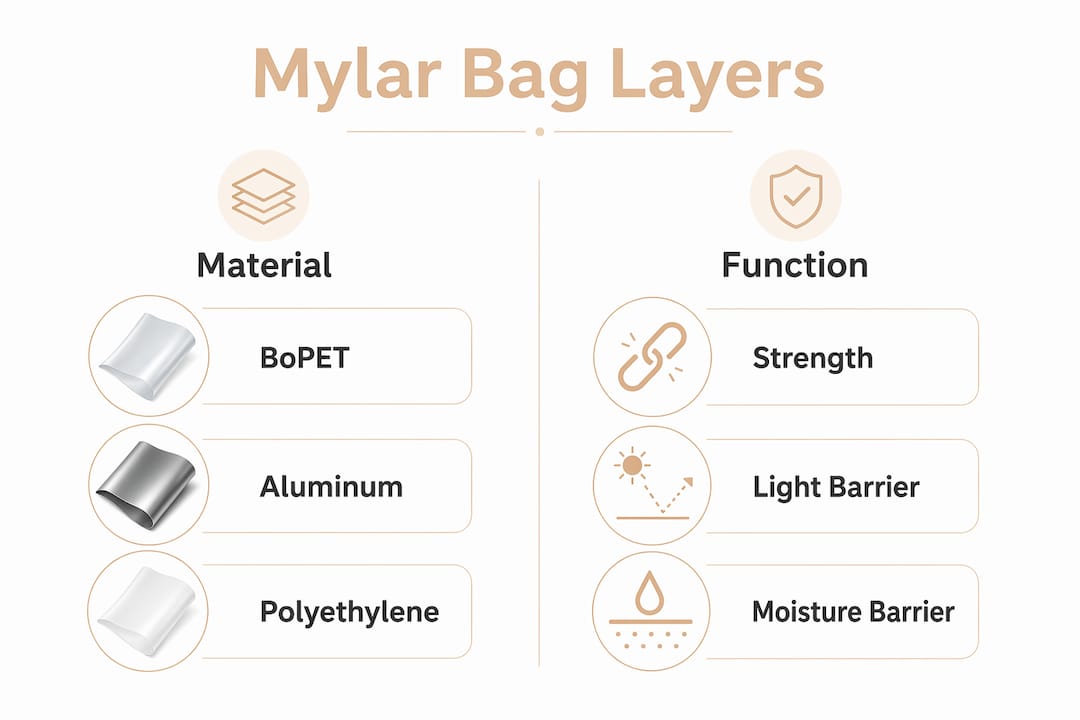
BoPET (biaxially oriented polyethylene terephthalate) forms the structural backbone. The film is stretched along two axes during manufacturing, which aligns the polymer chains and produces exceptional tensile strength, chemical stability, and dimensional stability. According to Wikipedia’s entry on Mylar, BoPET was the first biaxially oriented polymer manufactured on a mass commercial scale, and that heritage shows in its durability.

The aluminum foil or metallized PET layer sits in the middle. This is the barrier workhorse. Aluminum blocks nearly all light transmission and prevents gas exchange, which is why foil-core bags outperform clear plastic on every preservation metric.
The polyethylene inner layer is the food-contact surface. It resists moisture ingress and, critically, it’s the layer that melts and fuses during heat sealing, creating the airtight closure the bag depends on.
The laminate structure is the performance story. A bag labeled “Mylar” is only as good as the quality of its foil or metallized film layer and the integrity of the bond between layers. Cheap bags often use thinner metallized PET instead of true aluminum foil, which can develop micro-cracks after handling and compromise the barrier.
| Layer | Material | Primary Function |
|---|---|---|
| Outer | BoPET polyester film | Structural strength, puncture resistance |
| Middle | Aluminum foil or metallized PET | Light, oxygen, and moisture barrier |
| Inner | Polyethylene (PE) | Heat-sealable, food-safe contact surface |
Why Mylar bags outperform regular packaging for preservation
The practical advantages of these bags become clear when you compare them to alternatives. Regular plastic zip-lock bags are permeable to oxygen and moisture over time. Vacuum-sealed bags remove air but still allow some gas transmission through the plastic walls. Mylar bags, by contrast, combine BoPET’s strength with aluminum foil’s barrier, a synergy that regular packaging materials can’t replicate.
Primary uses include:
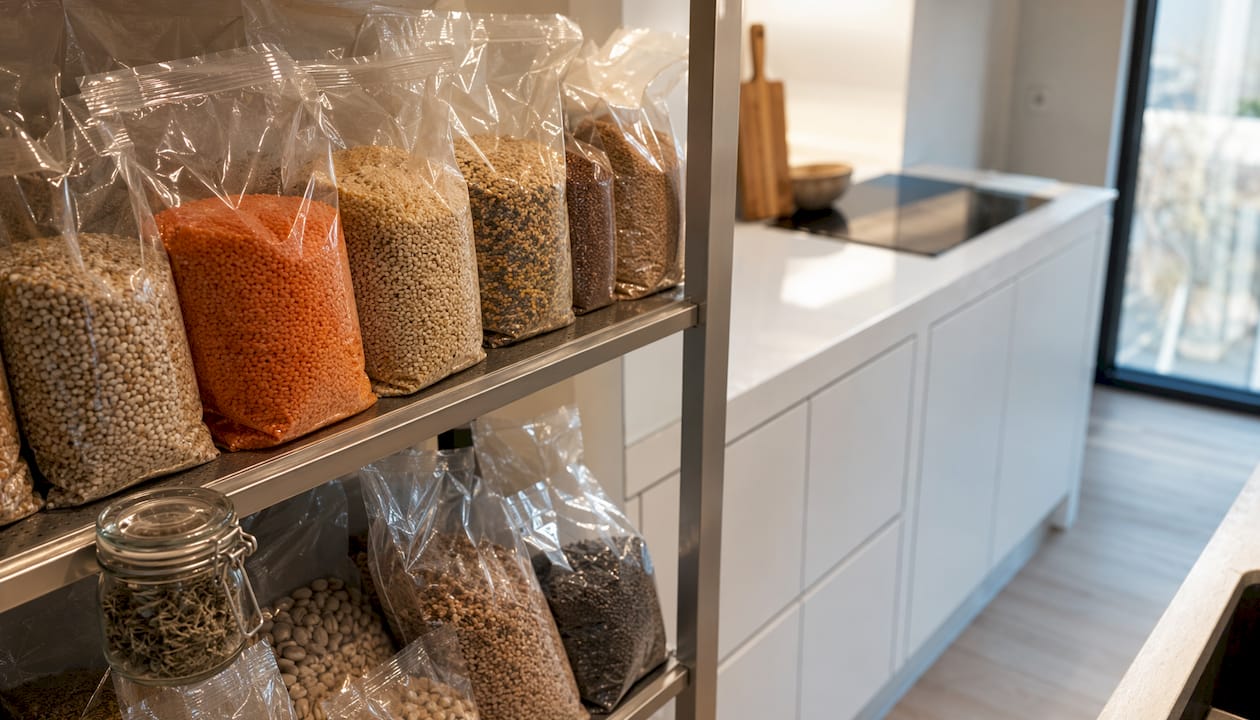
- Long-term dry food storage (rice, beans, flour, oats, pasta, freeze-dried meals)
- Pet food and treats requiring extended freshness
- Pharmaceutical and supplement storage
- Archival documents and collectibles (the Library of Congress uses BoPET-based film for archival storage)
- Coffee and specialty food products requiring light and oxygen protection
- Seafood packaging where barrier performance preserves taste and texture
NASA’s Technology Transfer Office even developed metalized heat-resistant polybags based on Mylar’s thermal barrier properties for seafood shipping, specifically to preserve taste over longer transit durations. That’s a strong signal of how seriously the material’s barrier performance is taken at the highest levels.
Metallized PET reflects up to 99% of light, which directly prevents the photodegradation that strips nutrients from stored foods. For dry goods like rice or flour stored over years, that light barrier is as important as the oxygen barrier.
Benefits that matter most for food storage:
- Extended shelf life for properly sealed dry goods
- Prevents oxidation that causes rancidity and flavor loss
- Blocks moisture that triggers mold and bacterial growth
- Eliminates odor transfer between stored items
- Preserves nutrient content by blocking light-driven degradation
How to seal and use Mylar bags correctly
Getting the seal right is where most people either succeed or fail with long-term storage. A bag with a compromised seal offers no more protection than a regular plastic bag, so the process deserves attention.
Step-by-step sealing process:
- Dry your food thoroughly. Any residual moisture inside the bag will cause mold regardless of how well it’s sealed. Spread grains or legumes on a clean surface and confirm they’re fully dry before packing.
- Fill the bag, leaving some headspace at the top for sealing. Overfilling makes a clean seal difficult.
- Add the correct oxygen absorber. Sizing matters. A 300cc absorber suits a one-gallon bag of dense dry goods; a 2,000cc absorber is needed for a five-gallon bucket liner. Using an undersized absorber leaves residual oxygen that shortens shelf life significantly.
- Seal immediately. Once oxygen absorbers are exposed to air, they begin working. Seal within 15–20 minutes of opening the absorber packet.
- Heat seal the bag. A flat iron set to medium-high, a hair straightener, or a dedicated impulse sealer all work. Run the heat source across the top of the bag in one smooth pass. Let it cool, then press the seal and check for gaps.
- Label with contents and date. This sounds obvious, but unlabeled bags become a guessing game after a year.
- Store in a cool, dry, dark location. A basement shelf or a food-grade bucket in a climate-controlled space is ideal.
Pro Tip: After sealing, press the bag firmly. If it holds its shape and doesn’t reinflate, the oxygen absorber is working and the seal is airtight. If the bag puffs back up within a few hours, reseal it immediately.
The oxygen absorber is not optional for long-term storage. Sealing a bag without one traps the existing air inside, including the oxygen that drives oxidation and spoilage. Properly sized, fresh absorbers are what separate a 25-year storage solution from a 6-month one.
Common mistakes to avoid:
- Using absorbers that have been left open too long (they become saturated and ineffective)
- Sealing bags with any moisture present inside
- Storing bags in areas with temperature fluctuations, which stresses the laminate
- Skipping the label step
How long can you actually store food in Mylar bags?
Storage duration depends on three variables: the quality of the bag itself, the effectiveness of the oxygen absorber, and the conditions where the bag is kept. Cool, dry, dark conditions maximize longevity across all food types. A bag stored in a hot garage will degrade faster than the same bag in a temperature-stable basement.
| Food Type | Estimated Shelf Life in Mylar | Notes |
|---|---|---|
| White rice | 25–30 years | Low oil content, ideal candidate |
| Dried beans / lentils | 25–30 years | Nutritional quality may decline with extended storage |
| All-purpose flour | Several years | Moisture content must be very low before sealing |
| Oats (rolled) | 25–30 years | High fiber, low moisture, excellent candidate |
| Pasta (dry) | 25–30 years | Minimal fat content extends storage life |
| Brown rice | Short term | Natural oils go rancid; not suited for long-term Mylar storage |
| Freeze-dried meals | 25–30 years | Manufacturer’s seal + Mylar provides maximum protection |
| Sugar / salt | Indefinite | No biological spoilage; Mylar prevents clumping |
Key factors that affect how long your storage lasts:
- Bag thickness (thicker bags resist punctures and micro-tears better)
- Foil vs. metallized PET construction (foil provides superior long-term barrier integrity)
- Absorber freshness at the time of sealing
- Ambient temperature and humidity in the storage location
- Whether the food was fully dry before packing
Brown rice is the most common mistake in Mylar storage. Its natural oil content causes it to go rancid within a year or two regardless of how well the bag is sealed. Fresh or moist foods present the same problem. Mylar bags are a dry-goods solution, not a universal preservation method.
How to choose the right Mylar bag for your needs
Not all Mylar bags perform equally, and the differences matter when you’re planning storage that needs to last years. Thickness and construction type are the two most important variables.
Thickness guide:
| Thickness | Best For | Durability |
|---|---|---|
| — | Short-term storage, light dry goods | Moderate; fine for 1–5 year storage |
| 5 mil | General long-term food storage | Good; the most common choice for home use |
| 7 mil | Heavy or sharp-edged items, bulk storage | Excellent; resists punctures from grains or pasta edges |
Size considerations:
- Quart-sized bags suit individual meal portions or small quantities of specialty items like coffee or spices
- Gallon-sized bags work well for standard pantry staples and fit inside five-gallon buckets
- Five-gallon bucket liners are the go-to for bulk storage of rice, beans, or oats
Choosing based on your application:
- For pet food packaging, prioritize a foil-core laminate with a strong heat seal to handle the fat content in kibble and treats
- For coffee, a one-way degassing valve combined with a Mylar-style barrier pouch is the right combination
- For archival documents or collectibles, clear BoPET bags (without the foil layer) preserve items while allowing visual inspection
Pro Tip: Hold the bag up to a bright light. A true foil-core bag will block all light completely. A metallized PET bag will show a faint glow or pinhole light transmission. For serious long-term storage, choose the bag that goes completely dark.
Visual quality indicators:
- Uniform, wrinkle-free laminate with no delamination at edges
- Consistent thickness across the bag surface
- Clean, factory-sealed bottom seam with no gaps
- Foil layer that shows no creasing or cracking when the bag is gently flexed
What packaging professionals know about Mylar bags that most guides miss
Here’s a detail that changes how you evaluate these bags: “Mylar” is a registered trademark owned by DuPont (now part of DuPont’s specialty films portfolio), referring specifically to BoPET film. The bags you buy for food storage aren’t made of Mylar alone. They’re laminate structures that use BoPET as one component, combined with foil and PE. The brand name has become a generic shorthand, much like “Kleenex” for facial tissue, but the actual performance comes from the laminate composition, not the Mylar name.
This distinction matters practically. When evaluating bags for flexible packaging applications, professionals look at the laminate spec sheet, not the brand label. A bag marketed as “premium Mylar” with a thin metallized PET layer will underperform a correctly specified foil-core bag every time.
Foil laminates vs. metallized films: Metallized PET uses a vapor-deposited metal layer that’s extremely thin. After repeated handling, flexing, or temperature cycling, micro-cracks can form in that metal layer, creating pathways for oxygen and moisture. Foil laminates use a discrete aluminum foil layer that maintains its barrier integrity far longer. For anything stored beyond five years, foil-core construction is the professional standard.
Sustainability is a growing consideration in this space. Traditional foil-laminate bags are difficult to recycle because separating the bonded layers is technically challenging. Some manufacturers now offer recyclable mono-material barrier films that approach foil-level performance without the recycling complexity, though they typically don’t match foil’s barrier performance for multi-decade storage. For brands building custom packaging solutions, the choice between maximum barrier performance and recyclability is a real trade-off that deserves honest evaluation.
Pro Tip: When sourcing Mylar-style bags for commercial or brand use, always request the laminate specification in writing. Ask specifically whether the barrier layer is aluminum foil or metallized PET, and what the oxygen transmission rate (OTR) is. Those two data points tell you more about real-world performance than any marketing claim.
Custom barrier packaging built for your brand
If you’re a food, beverage, or pet food brand that needs the barrier performance of Mylar-style packaging with your own design and identity, Impacked delivers exactly that. We specialize in custom printed flexible packaging with low minimum order quantities starting at 500 units, so you can test a design before committing to a large production run.
Every project at Impacked comes with a single point of contact from concept to delivery, full-color custom printing, and access to sustainable material options including recyclable and compostable structures. Whether you need stand-up pouches with foil-core laminates for long shelf life, or premium printed bags for coffee, pet food, or specialty foods, we work closely with you to match the right material spec to your product’s actual needs. Get a quote and let’s build packaging that protects your product and represents your brand.
Key Takeaways
Mylar bags are multilayer foil laminate pouches that protect dry foods from oxygen, moisture, and light, with properly sealed bags capable of preserving dry goods for up to 25–30 years.
| Point | Details |
|---|---|
| Laminate construction | BoPET, aluminum foil, and PE layers each serve a distinct barrier function. |
| Foil vs. metallized PET | Foil-core bags offer superior long-term barrier integrity; metallized PET can develop micro-cracks over time. |
| Oxygen absorbers are critical | Correctly sized, fresh absorbers are what make 25–30 year storage achievable. |
| Food suitability varies | Brown rice and moist foods are poor candidates; white rice, beans, and pasta are ideal. |
| Impacked for brand packaging | Custom printed foil-laminate pouches with low minimums starting at 500 units, built to your spec. |