

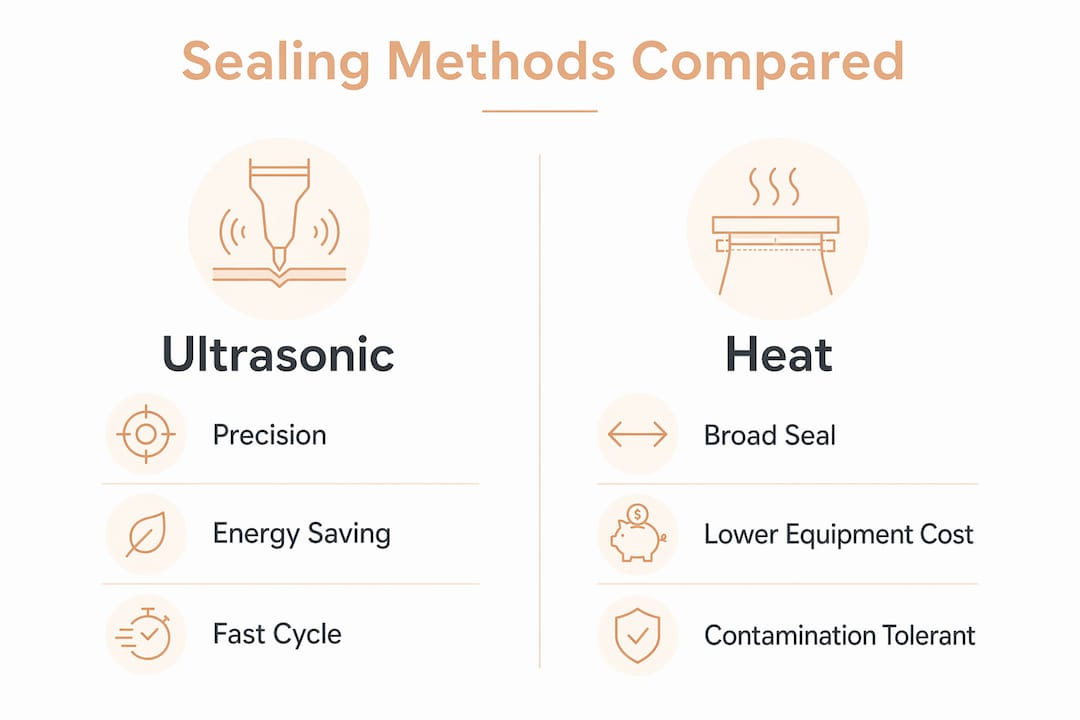
Ultrasonic sealing and heat sealing both bond thermoplastic packaging films, but they work on fundamentally different principles, and that difference shapes everything from your material costs to your sustainability story. Ultrasonic sealing drives high-frequency mechanical vibrations (typically 20–40 kHz) through a sonotrode into the film, generating heat internally at the bond interface only. Heat sealing, by contrast, applies external thermal energy through heated bars or jaws that maintain temperature continuously. For packaging engineers evaluating which method fits their line, the core tradeoffs break down like this:
- Seal width: Ultrasonic seals run 2–6 mm wide; heat seals typically span 5–15 mm, consuming more film per package.
- Energy use: Ultrasonic draws power only during short weld pulses; heat sealing requires continuous heating, increasing baseline energy draw.
- Material sensitivity: Ultrasonic protects heat-sensitive films and contents by keeping tooling cool; heat sealing risks thermal damage to delicate substrates.
- Contamination handling: Ultrasonic vibration can displace thin surface contaminants before the seal forms; heat sealing handles bulk contamination better through wider seals and longer dwell.
- Upfront cost: Heat sealing equipment carries a lower initial price and simpler setup; ultrasonic systems require custom sonotrode tooling and higher capital investment.
- Material compatibility: Heat sealing works with virtually all thermoplastic films; ultrasonic sealing performs best with specific film constructions validated for the process.
Neither method is universally superior. The right choice depends on your film, product, contamination profile, and sustainability targets.
Table of Contents
- How ultrasonic sealing and heat sealing actually work
- What ultrasonic sealing does well, and where it falls short
- What heat sealing does well, and where it falls short
- Which applications suit each sealing method?
- Cost, energy, and sustainability: the numbers that matter
- Maintenance and operational challenges compared
- Packaging that performs from seal to shelf
- Key Takeaways
How ultrasonic sealing and heat sealing actually work
The mechanical distinction between these two methods is sharper than most comparisons suggest. In heat sealing, heated bars or jaws conduct thermal energy from the outside in, melting the sealant layer through a combination of temperature, pressure, and dwell time. The tooling stays hot continuously, which means energy consumption never drops to zero between cycles. Cooling phases add to total cycle time, and the heat spreads laterally beyond the intended seal zone.
Ultrasonic sealing works from the inside out. A vibrating sonotrode presses the film against a fixed anvil, and the molecular friction at the interface generates the heat needed to melt and fuse the layers. The sonotrode and anvil themselves stay relatively cool. Because energy is deposited only where the layers meet and only during the weld pulse, heat spread is minimal and the seal zone stays narrow.
Key process distinction: In ultrasonic sealing, the tool stays cold and heat is generated inside the film. In heat sealing, the tool stays hot and heat is conducted inward. That reversal is why the two methods behave so differently on heat-sensitive and recyclable films.
Key parameters differ accordingly. Heat sealing is controlled by temperature, pressure, dwell time, and jaw geometry. Ultrasonic sealing adds amplitude (the vibration distance, typically 9–35 microns), frequency (commonly 20–35 kHz), and energy input as programmable variables, giving engineers more than a dozen controllable factors versus four for conventional heat sealing.
Cycle times reflect this precision. Ultrasonic sealing cycles run much faster than heat sealing, which typically requires longer per seal. On rotary ultrasonic systems, that speed advantage compounds significantly at scale.
Pro Tip: When evaluating ultrasonic sealing for your line, request a trial seal on your actual film and product. Cycle time and seal strength figures from vendor literature are application-specific, and your film’s sealant layer chemistry determines whether the process window is viable.
What ultrasonic sealing does well, and where it falls short
Ultrasonic sealing’s strongest advantages are precision and efficiency. Because the tooling stays cool, it protects heat-sensitive contents and films that would degrade under conventional thermal exposure. Bio-based, compostable, and mono-material recyclable films often have narrow processing windows that heat sealing struggles to hit consistently. Ultrasonic’s localized energy delivery keeps those materials within spec.
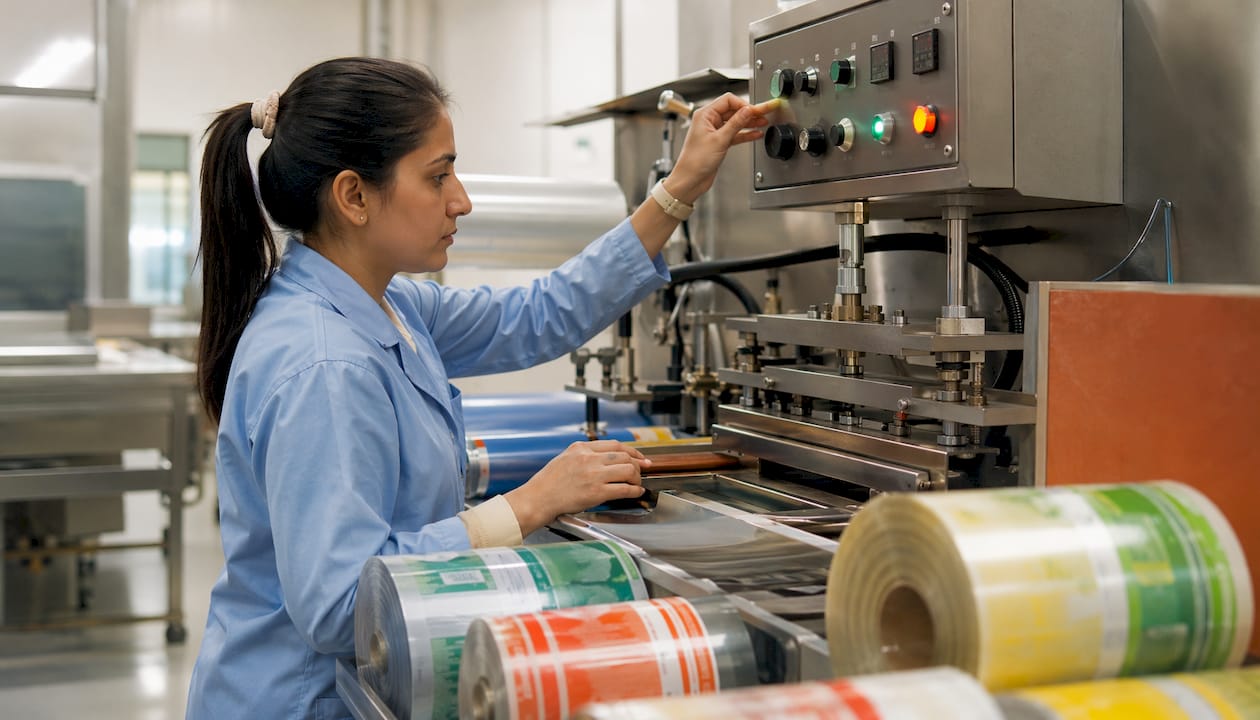
The contamination tolerance advantage is real but conditional. In a documented case on a beef-jerky vertical bagger, switching from hot-bar to ultrasonic sealing allowed the line to seal through jerky fines that had been causing leakers, with the seal surface shrinking from approximately 1.25 inches to under a quarter of an inch and output rising from roughly 35–40 to 75 bags per minute. That result is specific to one product, one film, and one validated setup. The honest generalization: ultrasonic can improve sealing through some thin contamination layers on the right film, not universally through any contaminant.
Advantages of ultrasonic sealing:
- Narrow, precise seals reduce film consumption per package compared to thermal methods.
- No warm-up or cool-down time; the generator draws power only during the weld pulse.
- Superior performance on bio-based, compostable, and recyclable mono-material films.
- Maintained 92% seal strength versus 78% for heat sealing when tested with a 2-micron thin vegetable oil film.
- Advanced process monitoring with programmable parameter limits supports quality control and traceability.
Disadvantages of ultrasonic sealing:
- Higher initial capital cost and custom sonotrode tooling per application.
- Tooling changeovers are more complex than swapping heat seal bars.
- Not universally compatible with all film constructions; validation trials are required.
- Some release additives and trapped moisture can interfere with the weld.
- Electronics and sonotrode require periodic inspection by trained technicians.
The payback period on ultrasonic equipment is longer, but the ongoing consumable costs are lower. There are no heater cartridges, no Teflon release tapes, and no heated bar replacements to budget for.
What heat sealing does well, and where it falls short
Heat sealing has been the dominant packaging seal method for decades, and that position reflects genuine strengths. Lower upfront equipment cost, simpler operator training, and compatibility with virtually every thermoplastic film make it the default choice for most food, beverage, and consumer goods lines. A well-tuned hot bar or impulse sealer handles polyethylene stand-up pouches, high-barrier laminates, and multi-layer co-extruded films with equal reliability.
Advantages of heat sealing:
- Lower initial capital investment and widely available replacement parts.
- Compatible with virtually all thermoplastic films, including complex multi-layer laminates.
- Established operational familiarity; most packaging technicians know the parameters.
- Handles heavier contamination in the seal zone better through wider seals and longer dwell times.
- Multiple delivery methods available: constant-heat hot bar, impulse, band/rotary, and induction.
Disadvantages of heat sealing:
- Continuous energy draw even between cycles; heated bars maintain temperature at all times.
- Wider seal widths increase film consumption per package across high-volume runs.
- Heat spread beyond the seal zone risks damaging heat-sensitive products or film layers.
- Longer cycle times (0.5–3 seconds) limit throughput compared to ultrasonic on fast lines.
- HVAC energy costs in controlled environments can increase substantially due to ambient heat emission from continuously heated tooling, a factor often overlooked in total cost of ownership calculations.
One nuance worth noting: heat sealing’s wider seal actually helps when contamination is bulky (powders, liquids pooling in the seal zone), because the longer dwell and greater surface area can still achieve fusion. Ultrasonic’s narrow, fast weld is less forgiving of that scenario.
Which applications suit each sealing method?

The choice between ultrasonic and heat sealing is not a ranking exercise. It is an engineering decision driven by your specific product, film, and production context.
Ultrasonic sealing is the stronger fit when:
- Your film is bio-based, compostable, or a mono-material recyclable with a narrow processing window.
- Contents are heat-sensitive (fresh produce, certain dairy products, pharmaceutical items).
- Seal aesthetics matter and narrow, clean seals are a design or material-reduction priority.
- Thin oily or fine-particle contamination in the seal zone is causing leakers on your current line.
- You are running sterile or cleanroom packaging where minimal heat exposure is required.
- Energy-on-demand and sustainability metrics are part of your operational mandate.
Heat sealing is the stronger fit when:
- You are running high-volume lines with conventional thermoplastic films and cost is the primary constraint.
- Your product generates bulk contamination (powders, liquids) in the seal zone.
- Film compatibility breadth matters more than seal precision.
- Equipment simplicity and fast operator onboarding are priorities.
- You need a proven, widely supported technology with readily available service.
Typical industries by method:
- Ultrasonic sealing: Snack foods with oily residue, fresh produce, compostable packaging for foodservice, pharmaceutical blister and pouch sealing, seafood packaging requiring tight seals with minimal heat exposure, and coffee packaging where film integrity is critical.
- Heat sealing: Beverage pouches, frozen food bags, pet food pouches, multi-layer retort packaging, and high-volume consumer goods where film compatibility and equipment cost drive the decision.
For flexible packaging applications where sustainability mandates are tightening, ultrasonic sealing is increasingly worth evaluating even when heat sealing has historically been the default.
Cost, energy, and sustainability: the numbers that matter
Energy consumption is where the operational cost gap between these two methods becomes concrete. Consider two comparable lines running 100 welds per minute for 16 hours per day. A conduction heat-sealing process might require four 500-watt cartridge heaters, consuming 32,000 watts per day to maintain seal-bar temperatures continuously. An ultrasonic system of similar capacity, rated at 1,500 watts peak, draws power only during weld pulses (approximately 200 milliseconds per weld), consuming around 24,000 watts per day under those conditions. That works out to roughly 25% less energy at maximum output in this scenario.
| Factor | Ultrasonic Sealing | Heat Sealing |
|---|---|---|
| Energy draw pattern | Pulse only (during weld) | Continuous (always on) |
| Estimated daily energy (100 wpm, 16 hr) | ~24,000 watts | ~32,000 watts |
| Seal width | 2–6 mm | 5–15 mm |
| Film savings potential | 30–50% narrower seals | Baseline |
| Initial equipment cost | Higher | Lower |
| Consumable/maintenance cost | Lower (no heater cartridges or tapes) | Higher (cartridges, tapes, bars) |
| HVAC impact | Minimal | Elevated in controlled environments |
| Compostable/mono-material fit | Strong | Limited |
Material savings add up quickly at scale. A snack food packager producing 6-inch VFFS bags uses approximately 1.0 inch of total package length for two conventional heat seals (0.5 inch each, top and bottom). Two comparable ultrasonic welds require just 0.25 inch total, a per-bag material saving of 0.75 inch. Across millions of bags annually, that reduction translates to meaningful film cost savings and a smaller material footprint.
The sustainability case for ultrasonic sealing extends beyond energy. Its compatibility with mono-material polyethylene structures and compostable films directly supports recyclability goals that are increasingly part of brand commitments and regulatory direction in the U.S. market. Heat sealing can work with these materials, but the tighter process control required often makes ultrasonic the more reliable path.
Maintenance and operational challenges compared
Maintenance profiles for these two technologies differ in both frequency and skill requirements. Heat sealing equipment demands regular replacement of heater cartridges, Teflon release tapes, and sealing bars, all of which wear with use and thermal cycling. Calibration of jaw temperature is ongoing, and any drift in the heating element affects seal consistency. These are manageable tasks, but they generate recurring consumable costs and downtime.
Ultrasonic sealing equipment requires less frequent consumable replacement. There are no heater cartridges or release tapes. Maintenance focuses on periodic inspection of the sonotrode, anvil, and electronics, with sonotrode replacement driven by wear rather than a fixed schedule. The tradeoff is that sonotrode inspection and replacement requires trained technicians familiar with ultrasonic systems, which are less universally available than heat sealing service technicians.
Tooling changeovers present a real operational challenge for ultrasonic systems. Because sonotrodes are often custom-designed per application, switching between film types or package formats can require a tooling swap and revalidation. Heat sealing bars are more generic and interchangeable, making format changes faster on conventional lines.
From a quality control standpoint, ultrasonic systems offer an advantage: advanced generators can monitor energy, amplitude, and force in real time, flagging out-of-spec welds immediately. Heat sealing quality monitoring is possible but typically requires additional instrumentation. For regulated industries like pharmaceuticals or medical devices, that built-in process traceability is a meaningful operational benefit.
Packaging that performs from seal to shelf
Choosing the right sealing technology is one part of the equation. Getting packaging that’s built for your product, your brand, and your sustainability goals is the other part, and that’s where Impacked comes in.

Impacked works directly with food, beverage, pet food, and lifestyle brands to design and produce custom printed packaging, from flexible pouches and coffee packaging to tubes and boxes, with full-color printing, sustainable material options including recyclable and compostable substrates, and low minimums starting at just 500 units. Whether your sealing spec calls for narrow ultrasonic welds on a mono-material film or conventional heat seal construction on a multi-layer laminate, we work with you from concept through delivery with a single point of contact. No handoffs, no guesswork on materials. Ready to see what’s possible for your next packaging project? Get a quote and we’ll get to work.
Key Takeaways
Ultrasonic sealing delivers narrower, more energy-efficient seals than heat sealing, making it the stronger choice for heat-sensitive films and sustainability-focused packaging, while heat sealing remains the lower-cost, broader-compatibility default for most thermoplastic applications.
| Point | Details |
|---|---|
| Energy consumption gap | Ultrasonic draws power only during weld pulses; heat sealing runs continuously, consuming roughly 32,000 watts per day on a comparable line. |
| Seal width and material savings | Ultrasonic seals run 2–6 mm wide versus 5–15 mm for heat sealing, enabling narrower seals and meaningful film reduction. |
| Contamination performance | Ultrasonic maintained 92% seal strength versus 78% for heat sealing when tested under thin (2-micron) vegetable oil contamination. |
| Application fit | Ultrasonic excels with bio-based, compostable, and heat-sensitive films; heat sealing remains preferred for high-volume runs with conventional thermoplastics. |
| Impacked packaging solutions | Impacked designs custom printed packaging in recyclable and compostable materials, with low minimums from 500 units, suited to both sealing specifications. |