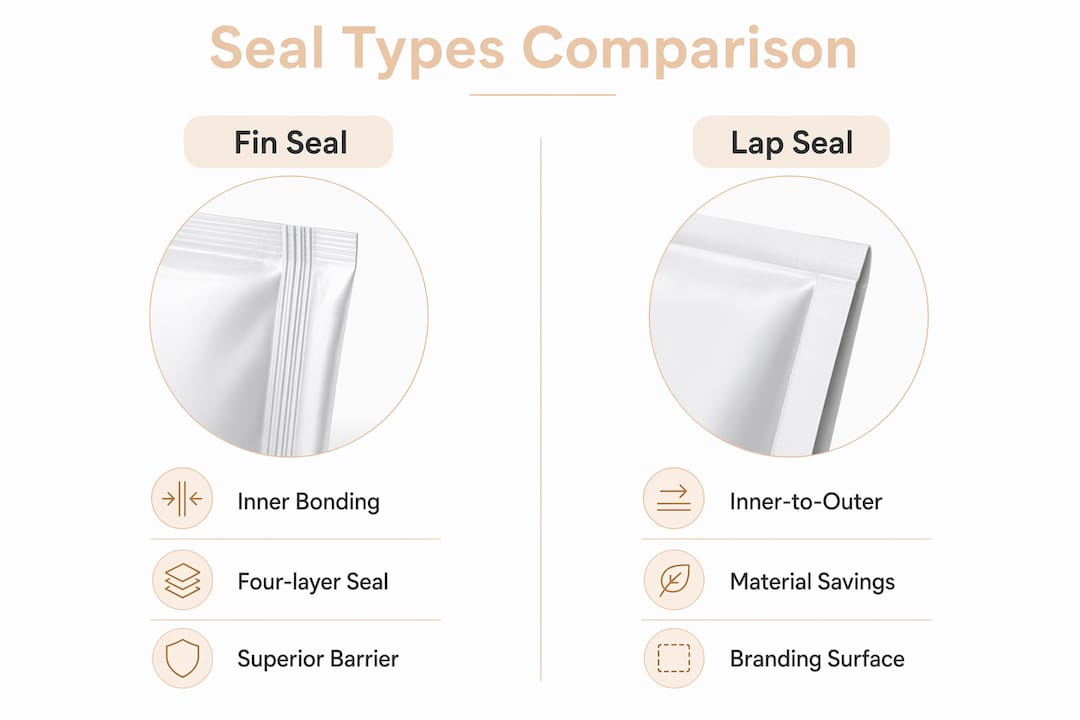
Fin seals and lap seals are the two dominant longitudinal sealing methods in flexible packaging, and choosing between them shapes everything from shelf life to material cost. A fin seal joins the two inner sealant surfaces of a film face-to-face, creating a protruding “fin” seam with a four-layer bond. A lap seal overlaps the film edges, bonding the inner surface of one edge to the outer surface of the other, producing a flat, smooth seam. Here is the quick orientation:
- Fin seal: Inner-to-inner bonding; requires 12–20 mm additional film width per package; superior hermeticity; works with nearly all laminated films
- Lap seal: Inner-to-outer bonding; saves 10–15% of film compared to fin seals; flat, graphics-friendly seam; restricted to films with heat-sealable outer layers
- Choose fin seal when barrier integrity, long shelf life, or complex laminated films are non-negotiable
- Choose lap seal when material economy, clean aesthetics, and lower-barrier products are the priority
What makes a fin seal distinct from other sealing methods
A fin seal is formed by folding the film so both inner sealant layers meet face-to-face, then applying heat and pressure to fuse them. The result is a narrow, protruding seam that runs vertically down the back of the package.
- Four-layer bond structure: The fused seam creates a four-layer folded joint, making it far more resistant to peeling and bursting than a two-layer overlap
- No exposed outer edge: Without an exposed film edge to act as a peel-initiation point, the seal holds under mechanical stress and rough handling
- Broad film compatibility: Works with complex laminates like PET/AL/PE where the outer PET layer is not heat-sealable, making it the only viable option for many high-barrier structures
- Machine versatility: Consistent results at high speeds on vertical form-fill-seal (VFFS) lines, with a wider operational window than lap seals
- Design trade-off: The protruding fin may interrupt back-panel graphics, though many brands fold it flat or use that space for QR codes or compliance text
The fin seal is standard in coffee, medical, dairy, and premium food packaging precisely because its sealant-to-sealant bond creates a reliable hermetic barrier against oxygen and moisture.
What makes a lap seal the right fit for some applications
A lap seal overlaps the two film edges and bonds the inner surface of one to the outer surface of the other. The seam lies flat against the package, leaving the back panel smooth and uninterrupted.
- Flat, continuous finish: No raised seam means full-bleed graphics, clean typography, and uninterrupted branding across the entire package surface
- Material savings: The minimal overlap saves 10–15% of film compared to fin seals, which require 12–20 mm of extra film width per package, translating to meaningful cost reductions on high-volume runs
- Film restriction: Requires films where both the inner and outer surfaces are heat-sealable, such as monolayer polyethylene (PE) or purpose-built co-extruded films; improper film choice leads to seal failure and product loss
- Lower peel strength: The two-layer overlap bond is inherently less resistant to peeling than a fin seal’s four-layer structure
- Best applications: Pillow packs, resealable pouches, dry snacks, baked goods, and retail-facing products where appearance drives purchase decisions
Lap seals are a smart choice when the product does not demand a hermetic barrier and the brand wants a premium shelf presence without the visual interruption of a fin.

Fin seal vs lap seal: side-by-side comparison
| Feature | Fin Seal | Lap Seal |
|---|---|---|
| Seal type | Inner-to-inner bonding | Inner-to-outer bonding |
| Material usage | Requires 12–20 mm extra film width per package | Saves 10–15% of film compared to fin seal |
| Seal appearance | Protruding fin; may interrupt back graphics | Flat, smooth, uninterrupted surface |
| Seal strength | High; four-layer bond, hermetic | Variable; two-layer bond, peel-prone edge |
| Film compatibility | Excellent; works with most laminates | Limited; requires sealable outer layer |
| Typical applications | Coffee, medical, dairy, premium foods | Snacks, baked goods, pillow packs, retail goods |
| Limitations | Higher material cost; fin affects back panel | Sensitive to film choice and machine setup |
Where each seal type performs best in real applications
Fin seals are the default for any product where barrier failure carries real risk. Seafood packaging, medical devices, dairy products, and specialty coffee all rely on the fin seal’s hermetic bond to lock out oxygen and moisture over extended shelf lives. VFFS lines running at high speeds favor fin seals because the inner-to-inner bond reduces seal failures and machine downtime.

Lap seals shine in formats where the back panel is a branding canvas. Pillow pouches for crackers, resealable bags for tea or light snacks, and retail-facing consumer goods all benefit from the flat, seamless finish. Flexible packaging formats like pillow packs and resealable pouches pair naturally with lap seals when the film structure supports it.
How to choose between a fin seal and a lap seal for your project
- Identify your film structure first. If the outer layer is a non-sealable material like PET or OPP, a fin seal is your only option. If both surfaces are heat-sealable, a lap seal becomes viable.
- Assess barrier requirements. Products sensitive to oxygen, moisture, or contamination need the hermetic integrity of a fin seal. Dry, low-risk goods can work with a lap seal’s lower peel strength.
- Weigh material cost against risk. Lap seal film savings are real, but spoilage from seal failure can erase those gains quickly on sensitive products.
- Consider your back-panel design. A lap seal gives you an uninterrupted canvas; a fin seal limits that space but can be folded flat or used creatively.
- Factor in machine setup. Fin seals run on a wider range of VFFS equipment with less sensitivity to temperature variation; lap seals may need dedicated settings or longer changeovers.
Pro Tip: Before committing to a lap seal, confirm with your film manufacturer that the outer layer is genuinely heat-sealable at your machine’s operating temperatures. A mismatch here is the single most common cause of catastrophic seal failure in lap seal applications.
Material usage, seal reliability, and machine compatibility in depth
The additional film width a fin seal demands adds up on high-volume runs, but it buys a four-layer bond that passes ASTM F88 peel tests with consistently higher force values than lap seals. The fin itself acts as a mechanical rib, improving package rigidity and making the seal less prone to failure from machine parameter variations.
Lap seals require a smaller overlap than fin seals, producing meaningful film savings noted earlier. That efficiency is real on large runs, but it comes with a narrower operational window. Temperature fluctuations or misalignment that a fin seal would tolerate can cause a lap seal to fail or produce weak spots.
| Metric | Fin Seal | Lap Seal |
|---|---|---|
| Extra film width needed | 12–20 mm per package | — |
| Film savings vs. other method | — | 10–15% reduction |
| Bond layers at seal | Four | Two |
| Operational window | Wide; forgiving of parameter variation | Narrow; sensitive to temperature and alignment |
| Film compatibility | Broad; most laminates and barrier films | Restricted; sealable outer layer required |
Common defects and how to troubleshoot them
Fin seal defects most often trace back to insufficient heat or pressure, contaminated film surfaces, or misaligned sealing jaws. A weak fin that peels apart under light tension usually means the sealing temperature is too low for the sealant layer. Wrinkled or folded fins typically result from film tension issues upstream of the sealing station.
Lap seal defects are more varied and often more serious. Incomplete bonding across the seam almost always points to film incompatibility: the outer layer is not fusing with the inner sealant at the set temperature. Peeling at the exposed edge of the overlap is a structural vulnerability of the two-layer bond and worsens if the overlap width falls below the minimum for the film type. Consistent leakers on a lap seal line warrant an immediate film compatibility audit before adjusting machine parameters.
Both seal types benefit from regular jaw cleaning, calibrated temperature profiling, and periodic ASTM F88 peel testing to catch drift before it becomes a defect rate problem.
Key Takeaways
Fin seals deliver superior barrier integrity and broader film compatibility, while lap seals offer meaningful material savings and a cleaner aesthetic for lower-barrier applications.
| Point | Details |
|---|---|
| Bonding method determines strength | Fin seals use inner-to-inner bonding for a four-layer joint; lap seals use inner-to-outer for a two-layer bond. |
| Material efficiency trade-off | Lap seals save 10–15% of film; fin seals require 12–20 mm extra width per package. |
| Film compatibility is the deciding factor | Non-sealable outer layers (PET, OPP) make fin seals the only viable option. |
| Aesthetics favor lap seals | Lap seals produce a flat, uninterrupted back panel ideal for full-bleed graphics. |
| Machine tolerance favors fin seals | Fin seals run on a wider operational window and are less sensitive to temperature variation. |
Ready to put this into practice? At Impacked, we work closely with you to match the right seal type, film structure, and format to your product’s exact needs. Whether you need custom flexible packaging with fin seal integrity or a lap seal design that maximizes shelf appeal, we bring the expertise and the materials to make it happen. Get a quote and let’s build packaging that performs.