

Yes, most packaged retail food products sold in Australia must carry a country of origin label. The single most important next step is to classify your product as either a priority food or a non-priority food, then calculate the percentage of Australian ingredients by ingoing weight where relevant. The legal basis is the Country of Origin Food Labelling Information Standard 2016, which became mandatory from 1 July 2018 and is enforced by the Australian Competition & Consumer Commission (ACCC) under Australian Consumer Law (ACL). Three permitted label formats exist: the three-component mark (kangaroo triangle, bar chart, text statement), the two-component mark (bar chart plus text statement), and a text-only country of origin statement for non-priority foods.
Your immediate next steps:
- Classify your product as priority or non-priority using the ACCC’s food categories (fruit, vegetables, meat, seafood, dairy, bread, cereals, juices, sauces, and honey are priority foods).
- Gather sourcing data — collect supplier invoices and calculate the ingoing weight of Australian ingredients as a percentage of total ingoing weight.
- Use the official labelling tool at business.gov.au to generate compliant graphic components, then verify your percentage calculations independently.
- Contact your packaging partner to reserve space in your dieline for the mark, box, lot/batch number, and supplier address before artwork sign-off.
Table of Contents
- What is the legal basis for country of origin labelling in Australia?
- Which foods require a country of origin label, and what’s exempt?
- What label formats are permitted under the standard?
- What do ‘grown in’, ‘produced in’, ‘made in’, and ‘packed in’ actually mean?
- How do you create a compliant COOL label, step by step?
- Common mistakes to avoid before you send files to print
- What happens if a regulator contacts you about your label?
- Where can you find official tools and guidance?
- How a packaging partner helps you get to market compliantly
- Key Takeaways
- Why the label is the last thing most brands think about, and the first thing regulators check
- Get compliant packaging to market faster with Impacked
- Useful sources and official references
What is the legal basis for country of origin labelling in Australia?
The Country of Origin Food Labelling Information Standard 2016 is the primary legal instrument governing country of origin labelling in Australia. It sits within the broader Australian Consumer Law framework and distinguishes between priority and non-priority foods, specifying which graphical formats each category requires.
The ACCC and state and territory ACL regulators share enforcement responsibility. The ACCC handles national investigations and systemic issues, while state bodies like the NSW Food Authority enforce food-specific labelling rules at a local level. Food Standards Australia New Zealand (FSANZ) sets the Food Standards Code, which governs other mandatory label elements such as allergen declarations, nutrition information panels (NIPs), and lot/batch numbers. These two frameworks run in parallel: the Information Standard covers origin claims, and the Food Standards Code covers the rest of the label.
Regulators can require businesses to substantiate origin claims at any time. That means producing supplier invoices, ingredient weight calculations, and sourcing records on request. Businesses that cannot substantiate a claim face enforcement action for misleading conduct, regardless of whether the claim was intentional.
Statistic callout: The current country of origin labelling system came into full effect in July 2018, following a transition period that gave businesses time to update packaging and supply chain records.
State food labelling rules add a further layer. The NSW Food Authority lists mandatory label elements beyond origin, including the supplier’s street address, lot or batch number, and NIP. These traceability fields are critical for product recalls and must be planned into your packaging layout from the start.
Which foods require a country of origin label, and what’s exempt?
Most packaged food sold at retail in Australia requires a country of origin label. The standard divides foods into two tiers with different requirements.

Priority foods vs. non-priority foods
Priority foods require the full graphical mark (either three-component or two-component) and include:
- Fresh, frozen, dried, or canned fruit and vegetables
- Meat (beef, lamb, pork, chicken, and other species)
- Seafood (fish, prawns, oysters, and other seafood)
- Dairy products (milk, cheese, butter, yogurt)
- Bread and bread products
- Breakfast cereals
- Fruit and vegetable juices
- Sauces, spreads, and dips
- Honey and honey products
Non-priority foods only require a text statement and include most other packaged foods not in the list above, such as confectionery, snack foods, and mixed prepared meals that fall outside the priority categories.
Common exemptions
Some foods are entirely exempt from the Information Standard’s labelling requirements, though ACL still governs any origin claims made on signage or in advertising:
- Food made and packaged on the premises from which it is sold (e.g., a bakery selling its own bread)
- Food packaged in the presence of the purchaser (e.g., a deli counter)
- Whole or cut fresh fruit and vegetables sold in transparent packaging
Practical decision markers for businesses:
- If your product is packaged for retail sale and falls into a priority category, the graphical mark is mandatory.
- If you sell unpackaged produce at a market stall, the Information Standard may not apply, but any verbal or written origin claim you make is still subject to ACL.
- Foodservice operators selling dishes containing seafood must follow separate origin labelling standards under ACL, even when the food is not pre-packaged.
| Product type | Priority or non-priority | Label format required |
|---|---|---|
| Fresh apples in a bag | Priority | Three- or two-component mark |
| Frozen beef patties | Priority | Three- or two-component mark |
| Retail honey jar | Priority | Three- or two-component mark |
| Packaged mixed nuts | Non-priority | Text statement only |
| Artisan jam sold at a market stall | Exempt (packaged on premises) | None required; ACL still applies to claims |
| Imported prawns packed in Australia | Priority | Country of origin statement in a box |
What label formats are permitted under the standard?
Three formats are permitted, and the right one depends on whether your product is a priority food and where it was grown, produced, made, or packed.
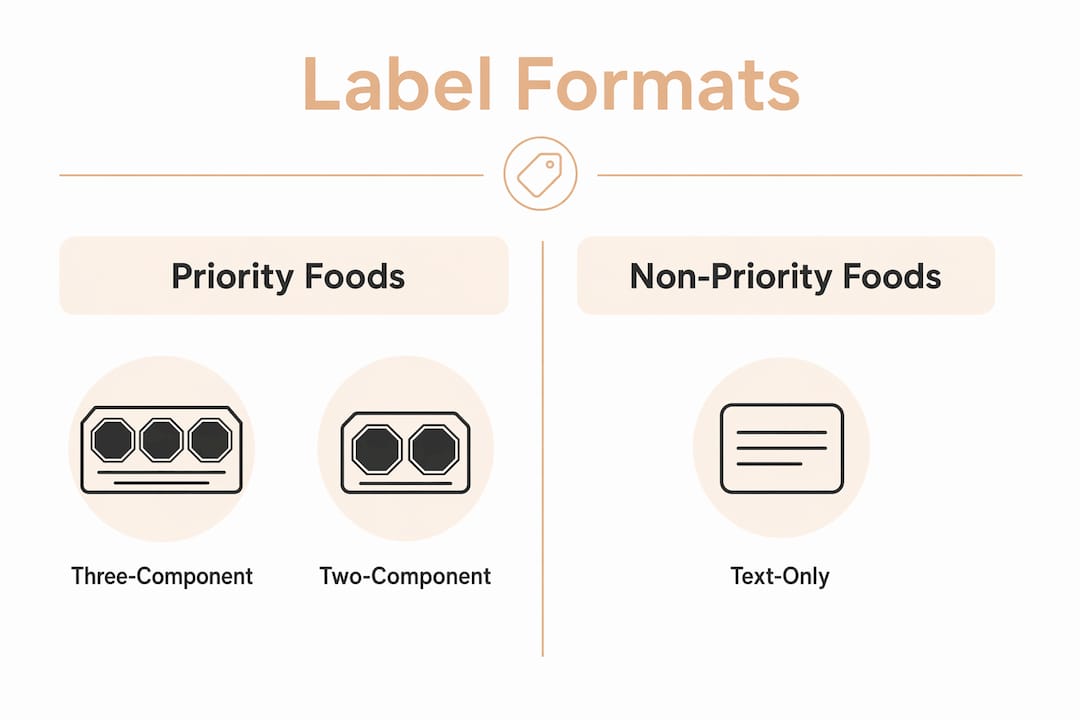
The three-component mark
This is the most recognizable format. It combines:
- The kangaroo-in-a-triangle logo
- A bar chart showing the minimum proportion of Australian ingredients by ingoing weight
- A text statement such as “Made in Australia from at least 80% Australian ingredients”
The three-component mark is available only for foods grown, produced, or made in Australia. The bar chart must be shaded to reflect the actual minimum proportion of Australian ingredients. Priority foods made in Australia from 100% Australian ingredients use the “Grown in Australia” or “Produced in Australia” variant with a fully filled bar.
The two-component mark
This format drops the kangaroo logo and uses only the bar chart plus a text statement. It applies to priority foods made in Australia that include some imported ingredients, or to imported priority foods packed in Australia. Imported priority foods packed in Australia cannot use the kangaroo logo; they must carry a country of origin statement in a clearly defined box.
Text-only country of origin statement
Non-priority foods require only a plain text statement, such as “Made in Australia” or “Product of New Zealand.” No graphic mark is needed, but the statement must still be accurate and not misleading under ACL.
| Format | When to use | Kangaroo logo? | Bar chart? |
|---|---|---|---|
| Three-component mark | Priority food grown/produced/made in Australia | Yes | Yes |
| Two-component mark | Priority food made in Australia with some imported ingredients, or imported priority food packed in Australia | No | Yes |
| Text statement | Non-priority food (any origin) | No | No |
Key requirements for the graphical mark:
- The mark must appear in a clearly legible size; minimum dimensions are specified in the style guide available through the business.gov.au labelling tool.
- Priority foods packed in Australia that are not grown, produced, or made in Australia must display the statement in a defined box.
- The bar chart proportion must reflect the minimum guaranteed percentage, not an average or estimate.
The business.gov.au labelling tool generates downloadable graphic components for each format. Use it to produce the artwork, but remember: the tool does not validate your ingredient percentage calculations. That responsibility stays with your business.
What do ‘grown in’, ‘produced in’, ‘made in’, and ‘packed in’ actually mean?
These four phrases are legal representations under ACL, not marketing copy. Using the wrong one is one of the most common and costly labelling mistakes Australian food businesses make.
Precise definitions
- ‘Grown in [country]’: The food was grown, harvested, and minimally processed in that country, and all significant ingredients were grown there. This is the highest-origin claim.
- ‘Produced in [country]’: The food was produced in that country from ingredients grown or sourced there. Typically used for single-ingredient products like honey or olive oil.
- ‘Made in [country]’: The food underwent a substantial transformation in that country. A percentage claim is required when not all ingredients are from that country (e.g., “Made in Australia from at least 65% Australian ingredients”). The percentage is calculated by ingoing weight.
- ‘Packed in [country]’: The food was packaged in that country but was not necessarily grown, produced, or made there. This is the lowest-origin claim and cannot use the kangaroo logo.
Correct use of these claims provides a safe harbour defence under ACL, meaning a business that accurately applies the right claim and can substantiate it is protected from misleading conduct enforcement on that point.
Decision flow
If your product was grown entirely in Australia from Australian ingredients, use “Grown in Australia” or “Produced in Australia.” If it was manufactured in Australia but includes some imported ingredients, use “Made in Australia” with the correct percentage. If it was only packaged in Australia, use “Packed in Australia” and do not display the kangaroo logo.
When you are between categories, choose the more conservative claim. A “Packed in Australia” label on a product that was actually made here is not a compliance breach; a “Made in Australia” label on a product that was only packed here is.
Pro Tip: Keep a dedicated compliance folder for each SKU containing supplier invoices, ingredient weight calculations, and the date each certificate was issued. When a regulator requests substantiation, having this folder ready reduces your response time significantly and demonstrates good faith.
How do you create a compliant COOL label, step by step?
Follow this checklist from product classification through to print approval and record retention.
-
Classify your product. Confirm whether it is a priority or non-priority food using the ACCC’s category list. Confirm it is sold at retail (not exclusively to foodservice or as an intra-company transfer, which have different rules).
-
Gather sourcing data. Collect supplier invoices and ingredient specifications. Calculate the ingoing weight of Australian ingredients as a percentage of total ingoing weight for the finished product. Exclude only volatile losses where permitted by guidance. Retain all supporting documents.
-
Choose the correct format and generate artwork. Use the business.gov.au labelling tool to download the appropriate graphic components. Select the three-component mark, two-component mark, or text statement based on your product’s origin and priority classification.
-
Integrate all mandatory label elements. Beyond the origin mark, your label must include the supplier’s name and street address, a lot or batch number, allergen declarations, and a NIP. The NSW Food Authority provides a full list of mandatory elements. Reserve space for all of these in your dieline before artwork is finalized.
-
Run an internal verification check before printing. Confirm percentages match your sourcing data, the mark meets minimum size requirements, the box is present where required, and all traceability fields are populated. Retain a dated copy of the approved artwork alongside your substantiation documents.
| Step | Responsible role | Evidence to retain |
|---|---|---|
| Product classification | Product manager / QA | Written classification decision with category reference |
| Ingredient percentage calculation | Procurement / QA | Supplier invoices, ingoing weight spreadsheet |
| Artwork generation | Marketing / packaging supplier | Downloaded tool output, format selection rationale |
| Label integration | Packaging supplier / designer | Dieline with all mandatory elements marked |
| Pre-press verification | QA / product manager | Signed-off artwork proof, dated compliance checklist |
Pro Tip: Schedule a content freeze at least two weeks before your print run. Late changes to ingredient sourcing or supplier details after artwork approval are the leading cause of reprints and compliance breaches. Lock the label content, then lock the artwork.
Common mistakes to avoid before you send files to print
Most labelling errors are discovered late, when correcting them is expensive. These are the patterns we see most often.
Frequent mistakes:
- Using “Made in Australia” when the product was only packed here, or vice versa. These are distinct legal claims with different substantiation requirements.
- Calculating Australian ingredient percentage by retail price or volume rather than ingoing weight. The standard requires ingoing weight.
- Omitting the lot/batch number or supplier street address. These are mandatory under the Food Standards Code and are the first things a regulator checks during a recall.
- Relying on the business.gov.au generator to validate ingredient percentages. The tool generates graphics only; it does not check your sourcing data.
- Displaying the kangaroo logo on imported products packed in Australia. The logo is reserved for products grown, produced, or made in Australia.
- Making origin claims on signage or advertising that differ from the label. ACL applies to all representations, not just the physical label.
Quick red flags to check on any label:
- Does the bar chart proportion match your calculated Australian ingredient percentage?
- Is the mark large enough to be legible at the pack’s actual print size?
- Is the origin statement in a defined box where required (imported priority foods packed in Australia)?
- Are the lot/batch number and supplier address present and complete?
Pre-press QA checklist (roles and documents):
- QA manager: confirm ingredient percentage against sourcing spreadsheet
- Product manager: confirm correct format selected for product category
- Packaging supplier: confirm mark dimensions meet minimum size requirements and contrast is sufficient for the substrate
- Marketing: confirm no conflicting origin claims appear in advertising or on the website
What happens if a regulator contacts you about your label?
The ACCC and state ACL regulators can contact your business at any time to request substantiation for an origin claim. This can be triggered by a consumer complaint, a competitor complaint, or a routine market surveillance sweep.
What regulators typically request:
- Supplier invoices and certificates of origin for all ingredients
- Ingoing weight calculations showing how the Australian ingredient percentage was derived
- Copies of current and previous label artwork with approval dates
- Evidence of any supply chain changes that affected ingredient sourcing
Possible enforcement outcomes for non-compliance:
- Corrective notices requiring label changes within a specified timeframe
- Infringement notices carrying financial penalties
- Product recalls where misleading claims pose a risk to consumer trust or safety
- Civil penalty proceedings for serious or systemic breaches
The ACCC’s approach is generally to seek compliance first, particularly for first-time issues where the business cooperates and corrects the problem quickly. Businesses that cannot produce substantiation records, or that have made claims they cannot support, face a much harder process.
Practical steps if you receive a regulator inquiry:
- Assemble your compliance folder immediately: supplier invoices, weight calculations, dated artwork approvals.
- Do not alter or destroy records. Provide what you have and note any gaps honestly.
- If the label is incorrect, prepare a corrected version and communicate your correction timeline to the regulator proactively.
- Retain records of all correspondence with the regulator.
Regulators expect businesses to retain substantiation records as standard practice. An organized audit folder per SKU, with dated evidence, is the single most practical step you can take to reduce enforcement risk.
Where can you find official tools and guidance?
These are the authoritative resources for Australian food businesses working through origin label requirements.
- business.gov.au Country of Origin Labelling Tool: The official interactive tool to generate downloadable label graphics. Use it to produce compliant artwork components. It does not validate ingredient percentages, so verify those separately.
- ACCC country of origin food labelling guidance: Covers priority vs. non-priority foods, permitted formats, and enforcement approach. The starting point for any compliance question.
- ACCC country of origin claims guidance: Explains the legal meaning of “grown in,” “produced in,” “made in,” and “packed in,” and the safe harbour framework under ACL.
- NSW Food Authority labelling laws: Lists all mandatory label elements under the Food Standards Code, including lot/batch numbers, supplier address, allergen declarations, and NIP requirements.
- Department of Industry, Science and Resources: Provides an overview of the labelling system, links to the business.gov.au tool, and background on the 2018 implementation.
- Country of Origin Food Labelling Information Standard 2016: The full legal text of the standard, including all divisions covering priority and non-priority foods, imported foods, and varying Australian content.
- Impacked: For dieline integration and layout support, including reserving space for origin marks, lot/batch fields, and supplier address on custom printed pouches, boxes, and tubes.
How a packaging partner helps you get to market compliantly
Getting the label right on paper is one thing. Getting it onto a print-ready dieline, at the correct size, with the right contrast on your chosen substrate, is where many businesses run into trouble. A packaging partner who understands the regulatory requirements can prevent the most expensive mistakes.
Practical services a packaging partner provides:
- Reviewing dielines to confirm space is reserved for the origin mark, box (where required), lot/batch number, and supplier address before artwork is finalized
- Checking mark dimensions against minimum size requirements for the pack format
- Advising on substrate and print contrast to ensure the bar chart and text statement remain legible after printing
- Producing low-MOQ proof runs so you can verify the label at actual print size before committing to a full production run
- Supporting seafood packaging and pet food packaging formats where origin labelling rules carry additional complexity
A typical compliant production workflow looks like this: product classification and ingredient percentage calculation (your team) → supplier evidence capture and compliance folder setup (procurement/QA) → artwork integration with all mandatory elements (packaging partner) → small proof run to verify legibility and placement → full production run with dated artwork approval on file.
Pro Tip: Ask your packaging partner to mark up the dieline with a “regulatory zone” that shows the minimum space reserved for the origin mark, box, lot/batch, and supplier address. Treating this zone as non-negotiable in the design brief prevents last-minute layout conflicts that delay print approval.
Sustainable material choices also affect legibility. If you are considering compostable or recycled substrates, confirm print contrast requirements with your supplier early. Compostable packaging materials can behave differently under print than conventional films, and the origin mark must remain clearly readable regardless of substrate.
Key Takeaways
Most packaged retail food products sold in Australia must carry a country of origin label under the Country of Origin Food Labelling Information Standard 2016, with priority foods requiring a graphical mark and all origin claims subject to ACL enforcement.
| Point | Details |
|---|---|
| Classify first | Determine priority vs. non-priority status before choosing a label format; priority foods require a graphical mark. |
| Calculate by ingoing weight | Australian ingredient percentage must be calculated by ingoing weight, not volume or retail price. |
| Use the tool, then verify | The business.gov.au labelling tool generates artwork but does not validate your ingredient percentages; verify independently. |
| Retain substantiation records | Keep a dated compliance folder per SKU with supplier invoices and weight calculations ready for regulator requests. |
| Impacked for layout support | Impacked integrates origin marks, lot/batch fields, and supplier address into dielines for custom printed pouches, boxes, and tubes from 500 units. |
Why the label is the last thing most brands think about, and the first thing regulators check
Most food brands treat the origin label as a design afterthought. It gets added to the artwork in the final round of revisions, squeezed into whatever space is left after the brand name, product description, and nutritional panel have claimed their territory. That approach is exactly backwards.
The origin mark, the lot/batch number, and the supplier address are the three elements a regulator will look at first in any compliance check or product recall. They are also the three elements most likely to be missing, illegible, or incorrect when a label was designed without regulatory input from the start. A bar chart that is technically present but printed at 6pt on a dark background is not compliant. A “Made in Australia” claim without a substantiated ingredient percentage is not compliant. A label with no lot/batch number is not compliant, regardless of how good the origin mark looks.
The practical fix is straightforward: bring your packaging partner into the process at the dieline stage, not the artwork approval stage. Reserve the regulatory zone first, then design around it. That single change eliminates most of the late-stage reprints and compliance corrections we see. It also means your first proof run is a genuine test of the label, not a scramble to fit mandatory elements into a layout that was never designed to accommodate them.
Get compliant packaging to market faster with Impacked
Compliant labels require more than the right words. They require a dieline that reserves space for every mandatory element, a substrate that maintains print contrast, and a proof run that confirms legibility before you commit to a full production run.
Impacked works with food, beverage, seafood, and pet food brands across Australia to produce custom printed flexible packaging and custom printed boxes with all mandatory elements integrated from the first dieline. Low minimum order quantities starting at 500 units mean you can run a compliant proof before scaling. Express production options get corrected labels back to you quickly when supply chain changes require an update.
Our team reviews your dieline for regulatory zone compliance, checks mark dimensions and print contrast, and flags any missing mandatory elements before your files go to print. Whether you need pouches for coffee or sauces, bags for seafood or pet food, or boxes for retail grocery, we build the compliance requirements into the layout from day one. Request a quote and send us your current artwork or dieline for a free layout review.
Useful sources and official references
- ACCC: Country of origin food labelling: The primary ACCC guidance page covering priority vs. non-priority foods, permitted formats, enforcement approach, and substantiation requirements. Start here.
- ACCC: Country of origin claims: Explains the legal definitions of “grown in,” “produced in,” “made in,” and “packed in,” and the safe harbour framework under ACL.
- business.gov.au: Country of origin labelling tool: The official interactive tool to generate downloadable label graphics and access the style guide and design element library.
- NSW Food Authority: Labelling laws: Full list of mandatory label elements under the Food Standards Code, including lot/batch numbers, supplier address, allergen declarations, and NIP requirements.
- Department of Industry, Science and Resources: Country of origin labelling: Overview of the labelling system with links to the business.gov.au tool and background on the 2018 implementation.
- Country of Origin Food Labelling Information Standard 2016 (Federal Register of Legislation): The full legal text of the standard. Use this to check specific provisions for priority and non-priority foods, imported foods, and varying Australian content rules.
- FSANZ: Labelling: FSANZ’s overview of the Food Standards Code labelling requirements, covering general and product-specific rules that apply alongside the origin standard.