

Cold seal packaging uses a pressure-activated cohesive adhesive to form a secure bond without any heat. The film is pre-coated with a water-based adhesive that bonds only to itself when pressed together, protecting heat-sensitive products from thermal stress while enabling significantly faster production speeds. For brand owners and packaging professionals working with confectionery, seafood, pharmaceuticals, or fresh produce, this technology offers a practical path to better product protection and lower operating costs.
At a glance, cold seal packaging delivers:
- No heat required: sealing occurs through pressure alone
- Cohesive adhesive bonds to itself, not to other surfaces
- Compatible with refrigerated and moist production environments
- Suitable for recyclable and compostable film substrates
- Faster line speeds compared to traditional heat seal systems
- Reduced energy consumption and improved worker safety
How cold seal packaging works: adhesive technology and the sealing process
The adhesive at the heart of cold seal technology is typically a water-based formulation combining natural rubber latex with synthetic polymers. This blend is engineered to stay non-tacky during storage and handling, yet form a strong cohesive bond the moment two coated surfaces are pressed together under sufficient pressure.
Application happens during film converting, before the packaging line ever runs. The adhesive is applied to the film using gravure or roller coating systems, then dried, leaving a self-adhesive coating that only activates against itself. On the packaging line, sealing is as simple as pressing the coated surfaces together with a crimp jaw or pressure bar.
Key steps in the cold seal process:
- Adhesive is applied to the film via gravure or roller coating
- Film passes through a drying stage to remove moisture and set the coating, preparing it for subsequent steps
- Coated film is wound into reels with a release lacquer layer to prevent blocking
- On the packaging line, coated surfaces are brought together and pressed
- Pressure activates the cohesive bond instantly, with no heat dwell time
- Sealed packages exit the line immediately, with no cooling period needed
Why cold seal outperforms heat seal for sensitive products
Production speeds with cold seal systems can reach up to 10x faster than heat seal, because there is no warm-up period, no heat dwell time, and no cool-down cycle. That throughput advantage compounds quickly on high-volume lines.
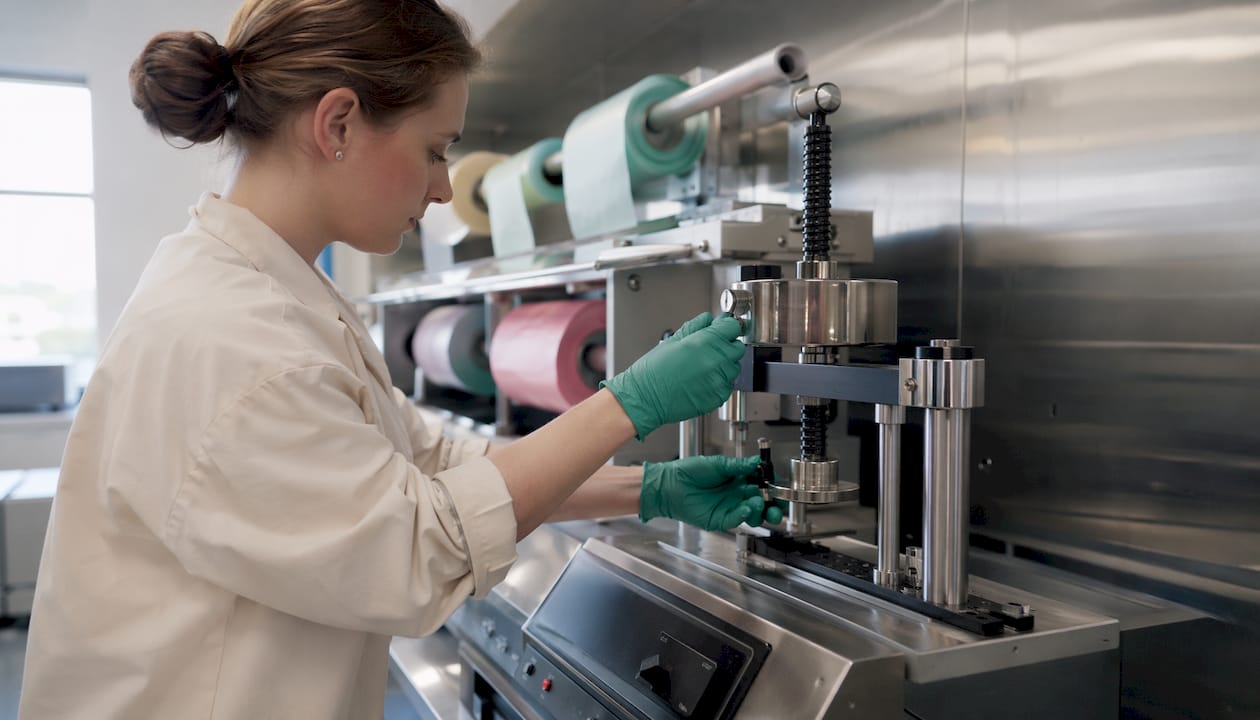
Product protection is the other major factor. Chocolates, ice cream bars, and certain pharmaceutical products degrade or deform under heat. Cold seal eliminates that risk entirely, since the sealing step never introduces thermal stress. The same logic applies to seafood and fresh produce packed in refrigerated environments, where heat seal equipment would create condensation and thermal shock issues.
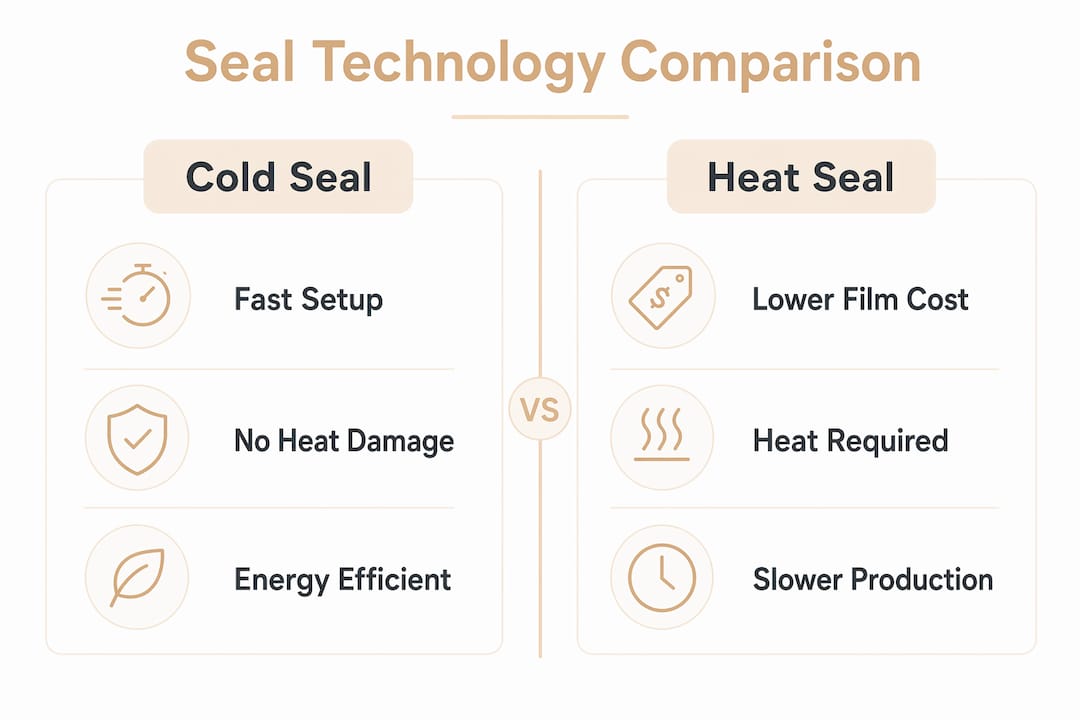
Energy savings are substantial too. Without heating elements running continuously, energy consumption drops considerably, and machinery experiences less wear, which reduces maintenance costs over time. Worker safety also improves: removing hot sealing jaws from the line eliminates a common source of burns and accidents.
Cold seal vs. heat seal: a direct comparison:
- Speed: Cold seal requires no heat dwell or cool-down; heat seal does
- Product safety: Cold seal causes zero thermal stress; heat seal risks melting or degradation
- Energy use: Cold seal needs no heating elements; heat seal runs continuously hot
- Worker safety: Cold seal removes hot machinery from the line
- Film compatibility: Cold seal works with thinner, recyclable, and compostable substrates
- Environment: Cold seal functions in refrigerated or moist conditions; heat seal cannot
Where cold seal packaging is used across industries
Confectionery and snack foods represent the most established application. Chocolate bars, granola bars, and ice cream novelties have been packaged with cold seal film for decades precisely because the process never exposes the product to heat.
Seafood is another strong fit. Fillets, shellfish, and other chilled seafood products are often packed in wet, refrigerated environments where heat seal equipment simply cannot operate reliably. Cold seal handles these conditions without issue, and recyclable polypropylene secondary containers complement the primary cold seal film for cold chain shipping.
Common cold seal packaging applications:
- Chocolate bars, candy bars, and confectionery wraps
- Ice cream bars and frozen novelty products
- Granola bars, protein bars, and snack wraps
- Fresh produce packed in the field or in coolers
- Shellfish, fish fillets, and other chilled seafood
- Heat-sensitive pharmaceuticals and diagnostic kits
- Delicate electronics such as circuit boards and sensors
- Medical supplies requiring sterile, heat-free packaging
Impacked’s seafood packaging and flexible packaging solutions are designed with exactly these environments in mind, supporting brands that need custom printed films compatible with cold seal adhesive systems.
How to select the right films and adhesives for cold seal
The balance between cohesion and release is the central challenge in adhesive selection. The adhesive must bond firmly when two coated surfaces are pressed together, yet release cleanly from the release lacquer on the opposite side of the reel during unwinding. Getting that balance wrong causes either weak seals or blocking during storage.
Mechanical stability is a critical but often overlooked factor. During high-speed gravure coating, the adhesive is subjected to intense shear where the doctor blade meets the gravure cylinder. Natural rubber latex formulations that lack sufficient mechanical stability will coagulate under that shear, causing streaking and inconsistent adhesion across the film. Modern engineered formulations address this by extending mechanical stability well beyond the thresholds typical of standard latex products.
Pro Tip: When specifying a cold seal adhesive for high-speed gravure coating, request the mechanical stability test data from your adhesive supplier. A formulation with a higher mechanical stability threshold will deliver more consistent doctor blade wipe and fewer coating defects on fast lines.
Film selection matters equally. Water-based cold seal adhesives are compatible with thinner films and recyclable or compostable substrates without sacrificing seal integrity, which opens the door to more sustainable packaging structures. Storage conditions also affect performance: humidity, temperature, and cleanliness must be controlled to keep the adhesive active and ready to bond.
Compatibility considerations and limitations
Cold seal adhesives bond only to themselves, which is a strength in most applications but a real constraint in others. If your packaging design requires sealing to a dissimilar substrate or a non-coated surface, cold seal will not work. Both contact surfaces must carry the cohesive coating.
Latex-based formulations can also present allergen concerns in food and pharmaceutical applications, since natural rubber latex is a recognized allergen. Synthetic alternatives exist and are worth specifying when the end product or its users may have sensitivities. Low-ammonia formulations reduce vapor discomfort for press operators during coating, which is a meaningful quality-of-life improvement on high-volume converting lines.
Pressure consistency is non-negotiable. Insufficient or uneven pressure across the seal area produces weak bonds that fail during distribution. This means your packaging line equipment must be calibrated and maintained to deliver uniform pressure, and incoming film reels should be tested for coating uniformity before production runs begin.
Cost comparison: cold seal versus heat seal packaging
The upfront economics of cold seal packaging require some nuance. Cold seal film costs more per unit than uncoated film, because the adhesive coating and release lacquer are applied during converting. Heat seal film is simpler and cheaper to produce.
Where cold seal recovers that cost difference, and then some, is on the production line. Faster throughput, lower energy consumption, and reduced machinery wear all contribute to a lower total cost per sealed unit at volume. For brands running high-speed lines with heat-sensitive products, the operational savings typically outweigh the film cost premium within a reasonable production horizon.
Maintenance costs also favor cold seal over time. Heat seal equipment runs hot continuously, accelerating wear on sealing jaws and heating elements. Cold seal equipment applies pressure without heat, which generally extends component life and reduces unplanned downtime.
What’s new in cold seal technology for 2026
Sustainability is driving the most significant current development in cold seal adhesives. Formulators are engineering water-based systems that perform reliably on mono-material recyclable films, including oriented polypropylene and polyethylene structures, which are increasingly required by brand sustainability commitments and retailer mandates. The ability to decrease film thickness without losing seal strength is a direct result of these advances, reducing material use per package.
Transparent film compatibility is another active area. Brands want consumers to see the product through the packaging, and newer cold seal adhesive systems support highly transparent film structures without the ghosting or streaking that older formulations produced at high coating speeds.
On the equipment side, pressure application systems are becoming more precise, with servo-driven crimp jaws that maintain consistent seal pressure across varying film gauges. This reduces seal failures from pressure inconsistency, one of the most common quality issues in cold seal operations.
Working with a packaging partner who understands these material and process requirements from the start saves significant time and cost. Impacked works directly with brand owners and packaging professionals to specify the right film structures, print methods, and sustainable materials for your product. Get a custom quote and we’ll help you build a packaging solution that performs on the line and on the shelf.
Key Takeaways
Cold seal packaging bonds through pressure alone, making it the preferred choice for heat-sensitive products, high-speed lines, and sustainable film structures.
| Point | Details |
|---|---|
| Pressure-only sealing | Cold seal adhesive bonds coated surfaces together with no heat, eliminating thermal stress on products. |
| Up to 10x faster throughput | No warm-up or cool-down cycles allow production speeds far beyond heat seal systems. |
| Energy and cost savings | Eliminating heating elements reduces energy consumption and machinery wear over time. |
| Mechanical stability matters | Adhesives must resist shear during high-speed gravure coating to prevent coagulation and streaking. |
| Sustainable film compatibility | Water-based formulations support recyclable and compostable substrates without sacrificing seal strength. |